
What this calculator does
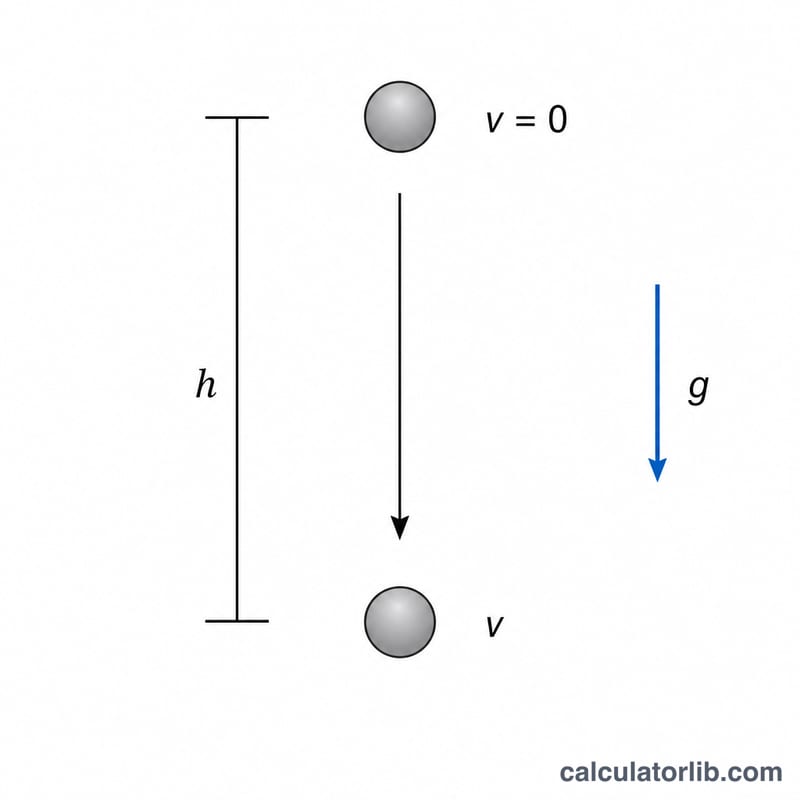
This tool models an object released from rest and falling freely under gravity, with no air resistance. Given a target fall velocity, it computes how long the object must fall to reach that speed and how far it travels in the process. It is useful for physics homework, drop-test estimates, and quick kinematics checks.
How to use it
Enter the target fall velocity and pick its unit (meters per second or kilometers per hour). Then enter the gravitational acceleration. The default is standard gravity, \(9.80665\ \text{m/s}^2\), but you can change it to model other bodies, for example the Moon at about \(1.62\ \text{m/s}^2\). The calculator converts the speed to SI units internally and returns the elapsed time in seconds and the fall distance in meters.
The formula explained
For an object starting from rest, velocity grows linearly with time: \(v = \text{g} \times t\), which rearranges to $$t = \frac{v}{\text{g}}.$$ The distance fallen is \(h = \tfrac{1}{2} \times \text{g} \times t^2\), and substituting \(t\) gives the compact form $$h = \frac{v^2}{2\,\text{g}}.$$ Both formulas assume initial velocity is zero and motion is purely downward in a vacuum.
Worked example
Suppose the target speed is \(30\ \text{m/s}\) and \(\text{g} = 9.80665\ \text{m/s}^2\). Then $$t = \frac{30}{9.80665} = 3.0592\ \text{s},$$ and $$h = \frac{900}{19.6133} = 45.888\ \text{m}.$$ Entering \(108\ \text{km/h}\) instead converts to the same \(30\ \text{m/s}\) (\(108 / 3.6\)), producing identical results.
FAQ
Does this account for air resistance? No. It assumes ideal free fall in a vacuum. Real objects slow their acceleration as drag rises and eventually reach terminal velocity, so actual times and distances will be larger than predicted.
Can I use it on other planets? Yes. Just set the gravitational acceleration to the value for that body, such as \(1.62\) for the Moon or \(3.71\) for Mars.
What if I enter zero gravity? Division by zero is undefined, so the calculator guards against \(\text{g} = 0\) and returns zero rather than an infinite result. Use a positive \(\text{g}\) for meaningful output.