
What Is Reaction Distance?
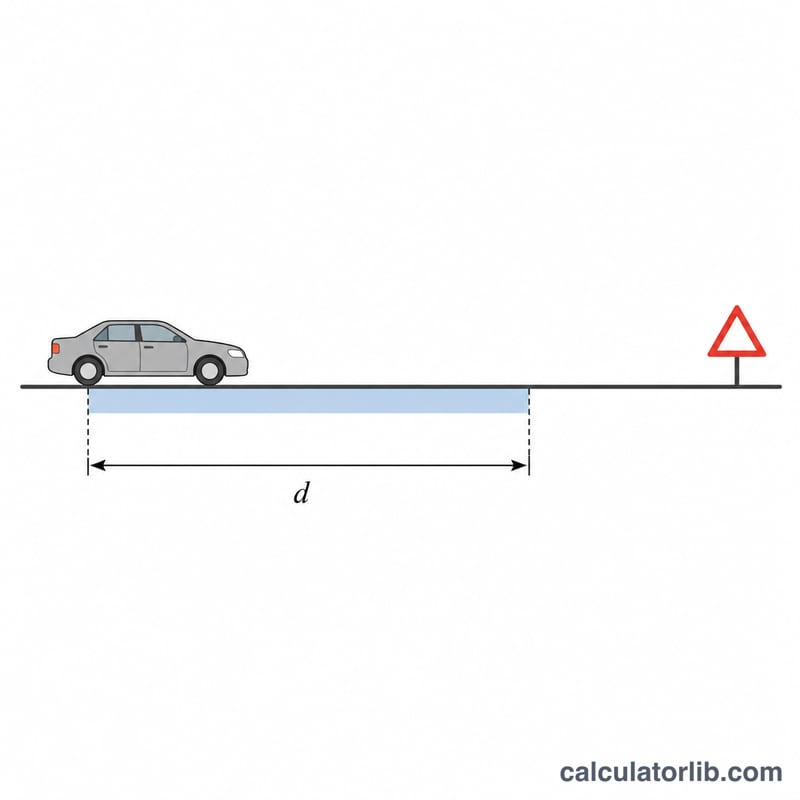
Reaction distance is how far a vehicle travels during the driver's reaction time — the interval between perceiving a hazard and beginning to brake. During this time the vehicle continues at its full speed, so even a fraction of a second covers a surprising amount of ground. This calculator computes that distance from your speed and reaction time. Note it covers only the reaction phase; actual stopping distance also includes the braking distance once the brakes engage.
How to Use It
Enter your speed and choose its unit (km/h, mph, or m/s). Enter a reaction time in seconds — a commonly used average for an alert driver is about 1.0–1.5 seconds, longer when distracted or tired. The calculator converts your speed to meters per second, multiplies by the reaction time, and returns the reaction distance in both meters and feet.
The Formula Explained
The relationship is simply distance = speed × time: \(d = v \times t_{\text{reaction}}\). Because speed must be in consistent units, the tool first converts to meters per second (divide km/h by 3.6, or multiply mph by 0.44704), then multiplies by the reaction time in seconds to give distance in meters.
$$d = \left(\frac{\text{Speed (km/h)}}{3.6}\right) \times \text{Reaction (s)}$$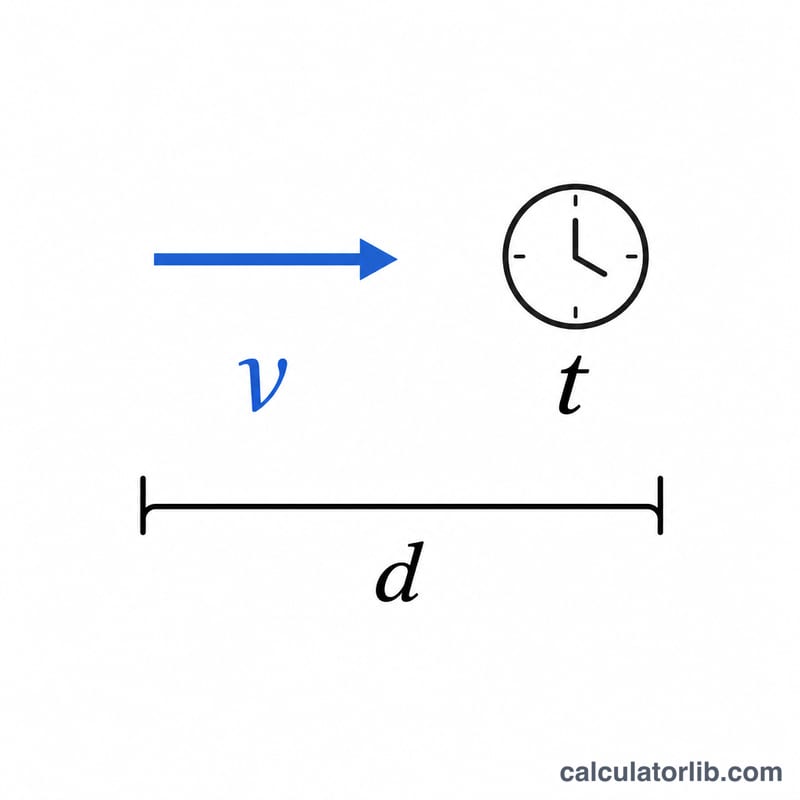
Worked Example
Suppose you are driving at 100 km/h with a reaction time of 1.5 seconds. First convert: \(100 \div 3.6 = 27.78\) m/s. Then multiply:
$$27.78 \times 1.5 \approx 41.67 \text{ meters}$$So you travel roughly 42 meters (about 137 feet) before you even touch the brakes.
FAQ
Does this include braking distance? No — it is only the reaction (thinking) distance. Total stopping distance adds the braking distance, which depends on deceleration and road conditions.
What reaction time should I use? Around 1.0–1.5 s for an alert driver; 2 s or more if tired, distracted, or impaired.
Why does speed matter so much? Because distance scales directly with speed, doubling your speed doubles the reaction distance for the same reaction time.