
What Is Surface Tension?
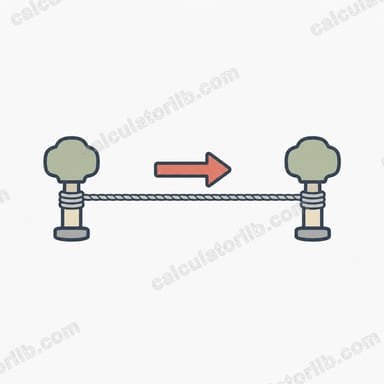
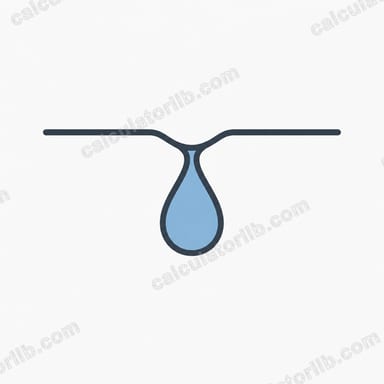
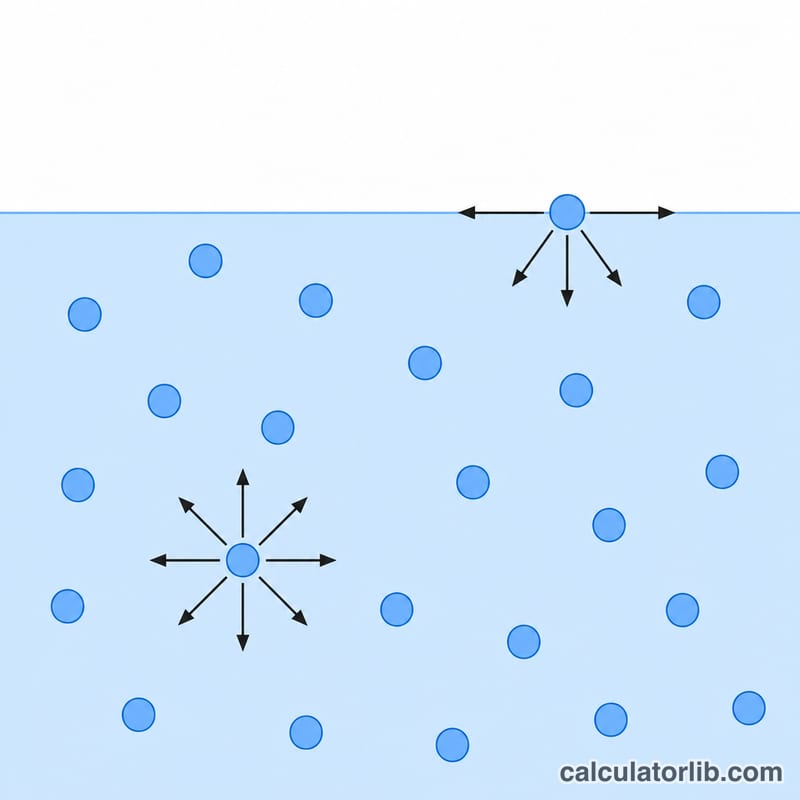
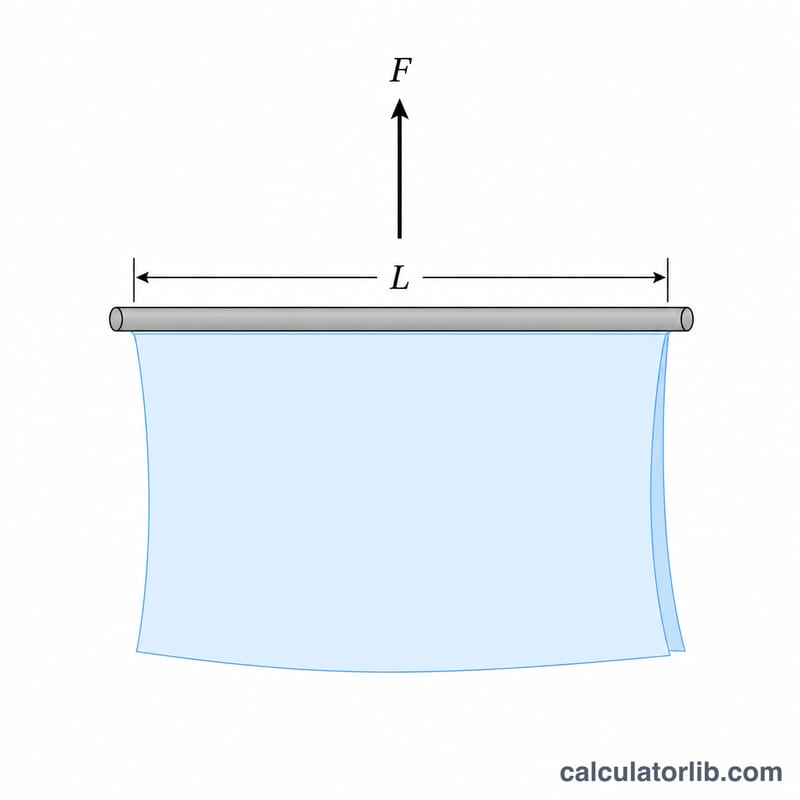
Surface tension (\(\gamma\)) is the cohesive force per unit length that acts at the surface of a liquid, making it behave like a stretched elastic membrane. It is what lets small insects walk on water and forms droplets into spheres. This calculator determines surface tension from the classic Wilhelmy / Du Noüy ring-style measurement, where a known force pulls a film of liquid clinging to a wire or plate of length L.
The Formula Explained
The working equation is $$\gamma = \frac{\text{Force (N)}}{2 \times \text{Wetted Length (m)}}$$ Here F is the maximum force (in newtons) needed to detach the liquid film from the wire, and L is the wetted length (in meters). The factor of 2 appears because a soap-film-style sheet has two surfaces — a front and a back — each pulling on the wire. The result is in newtons per meter (N/m); multiplying by 1000 gives the more common millinewtons per meter (mN/m), the unit used in tables of liquid properties.
How to Use This Calculator
Enter the measured force in newtons and the wetted length of the wire or plate in meters, then read the surface tension. For example, water at room temperature has a surface tension near 0.072 N/m (72 mN/m).
Worked Example
Suppose a wire of wetted length L = 0.5 m supports a liquid film with a measured force of F = 0.072 N. Then $$\gamma = \frac{0.072}{2 \times 0.5} = \frac{0.072}{1} = 0.072 \text{ N/m}$$ or 72 mN/m — consistent with pure water.
FAQ
Why divide by 2L instead of L? A free liquid film spans the wire with two surfaces, so the total length of contact is twice the wire length.
What units should I use? Force in newtons and length in meters give \(\gamma\) in N/m. The calculator also reports mN/m for convenience.
Does temperature matter? Yes — surface tension decreases as temperature rises, so report the temperature alongside any measurement.