What Is a Tension Calculator?
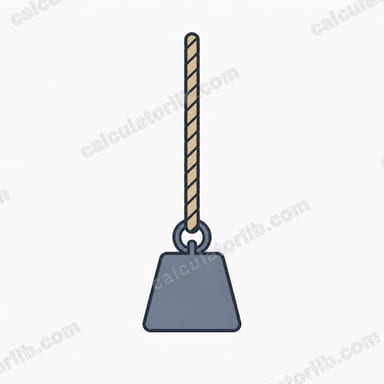
Tension is the pulling force transmitted along a rope, cable, string, or chain when it is pulled tight by forces acting from opposite ends. This calculator finds the tension force (in newtons) for a single mass hanging from or being lifted by a rope, accounting for any vertical acceleration. It applies the universal Newtonian equation \(T = m(g + a)\), so it works anywhere — no country-specific rules involved.
How to Use It
Enter three values: the mass being supported (kg), the vertical acceleration of the system (m/s², positive upward and negative downward), and the local gravitational acceleration \(g\) (default 9.81 m/s² for Earth). The calculator returns the rope tension and, for comparison, the static weight of the mass.
The Formula Explained
By Newton's second law, the net upward force on a hanging mass equals its mass times its acceleration: \(T - mg = ma\). Rearranging gives $$T = m(g + a)$$ When the mass is at rest or moving at constant velocity (\(a = 0\)), tension simply equals the weight, \(T = mg\). If the mass accelerates upward, tension exceeds weight; if it accelerates downward, tension is less than weight.

Worked Example
A 10 kg crate is lifted upward at 2 m/s² with \(g = 9.81\) m/s². $$\text{Tension} = 10 \times (9.81 + 2) = 10 \times 11.81 = 118.1 \text{ N}$$ Its static weight is \(10 \times 9.81 = 98.1\) N, so accelerating it upward adds 20 N of tension.
Gravitational Acceleration Values (g) for Common Bodies
The gravity field in the calculator sets the weight term of the tension equation. Use the value for the body where the mass is located. Approximate surface gravity values:
| Body | Surface gravity g (m/s²) |
|---|---|
| Earth (standard) | 9.80665 (9.81 is typical) |
| Moon | 1.62 |
| Mars | 3.71 |
| Venus | 8.87 |
| Jupiter | 24.79 |
| Mercury | 3.70 |
On Earth, g varies slightly with latitude and altitude: about 9.78 m/s² at the equator to about 9.83 m/s² at the poles, and it decreases slightly as you go higher. For most engineering and homework problems, 9.81 m/s² (or the standard 9.80665 m/s²) is accurate enough.
Interpreting Your Tension Result
- T > mg: the net force is upward, so the mass is accelerating upward (a > 0).
- T = mg: the mass is at rest or moving at constant velocity (a = 0).
- T < mg: the net force is downward, so the mass is accelerating downward (a < 0).
- T = 0: free fall, where \(a = -g\) and the rope goes slack.
The result is the force carried by the rope. Compare it with the rope's rated working load limit (WLL) or breaking strength, which already builds in a safety factor. Never load a rope up to its breaking strength. Account for the extra tension from accelerations, jerks and shock loads, which can far exceed the static weight.
The formula assumes a single vertical rope, an ideal massless and inextensible rope, and no angled supports, pulleys or friction. For angled ropes, multiple supports or a heavy cable, the tension differs and needs a fuller force analysis.
FAQ
What if the mass just hangs still? Set acceleration to 0; tension equals the weight, \(mg\).
How do I handle a descending elevator? Use a negative acceleration. For example \(a = -2\) m/s² reduces the tension below the weight.
What value of g should I use? 9.81 m/s² is standard on Earth's surface. Use 1.62 for the Moon or 3.71 for Mars.