
What Is Reduced Mass?
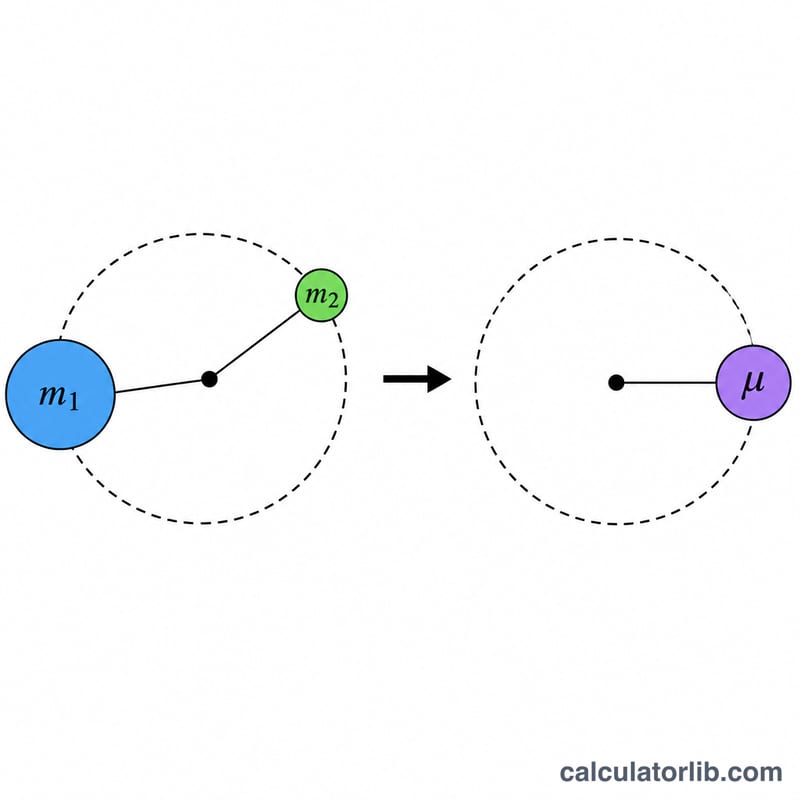
The reduced mass (μ, "mu") is the effective inertial mass of a two-body system. When two objects interact — like two stars orbiting each other, two atoms in a diatomic molecule, or a planet and its moon — their relative motion can be described as if a single particle of mass μ were moving in the combined potential. This simplifies a complex two-body problem into an equivalent one-body problem.
The Formula
Reduced mass is defined as:
$$\mu = \frac{m_1 \times m_2}{m_1 + m_2}$$
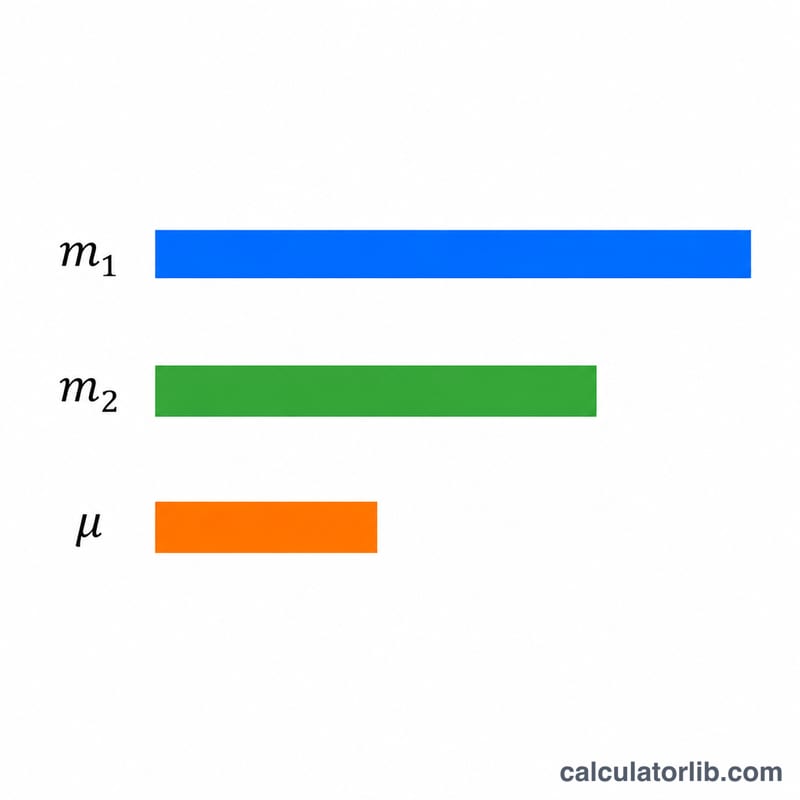
where \(m_1\) and \(m_2\) are the two masses. Notice that μ is always smaller than either individual mass. If one mass is much larger than the other, μ approaches the smaller mass. If the two masses are equal (\(m_1 = m_2 = m\)), then \(\mu = m/2\).
How to Use the Calculator
Enter the two masses in any consistent unit (kg, g, atomic mass units, solar masses — as long as both use the same unit). The calculator returns the reduced mass in the same units, along with the total mass for reference.
Worked Example
Suppose \(m_1 = 2\ \text{kg}\) and \(m_2 = 3\ \text{kg}\). Then $$\mu = \frac{2 \times 3}{2 + 3} = \frac{6}{5} = 1.2\ \text{kg}.$$ The reduced mass (1.2 kg) is smaller than both inputs, as expected.
FAQ
Why is reduced mass useful? It lets you treat the relative motion of two bodies as a single particle, simplifying orbital mechanics, molecular vibration, and collision problems.
What units should I use? Any units, as long as both masses share the same unit; the result is in that unit.
Can reduced mass be larger than a single mass? No. The reduced mass is always less than or equal to the smaller of the two masses, and at most half the total mass.