
What Is Virtual Temperature?
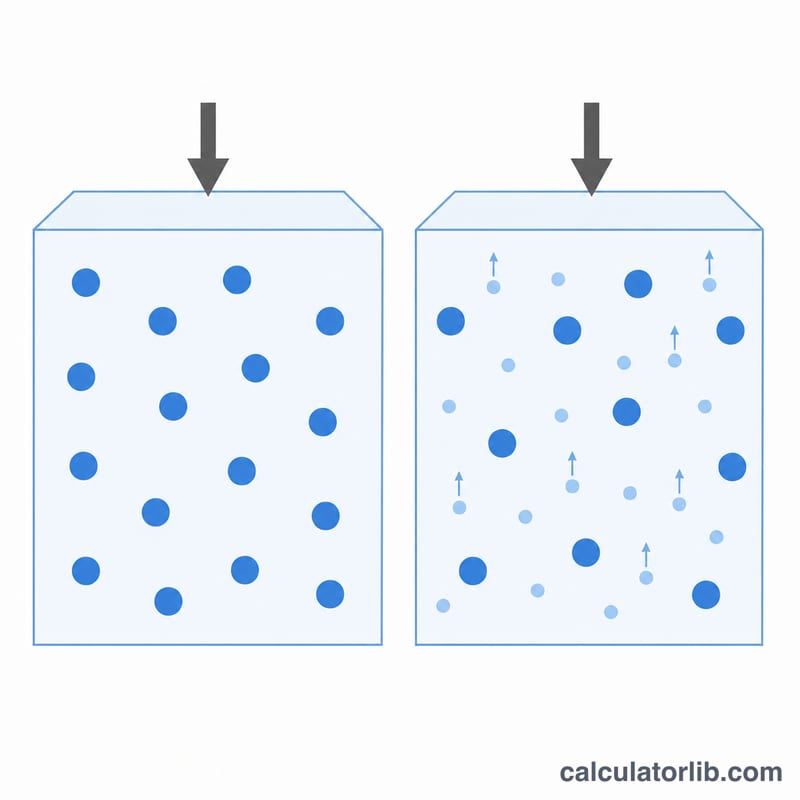
Virtual temperature (\(T_v\)) is the temperature that completely dry air would need to have in order to match the density of a given sample of moist air at the same pressure. Because water vapor is less dense than dry air, adding moisture makes an air parcel slightly less dense — equivalent to it being slightly warmer. Meteorologists use virtual temperature to simplify the ideal gas law for moist air and to assess buoyancy and atmospheric stability.
How to Use This Calculator
Enter the air temperature and select its unit (Kelvin, Celsius, or Fahrenheit). Then enter the water vapor mixing ratio in grams of water vapor per kilogram of dry air. The calculator converts the temperature to Kelvin, converts the mixing ratio to a dimensionless value, and returns the virtual temperature in K, °C and °F, plus the small increment it adds over the actual temperature.
The Formula Explained
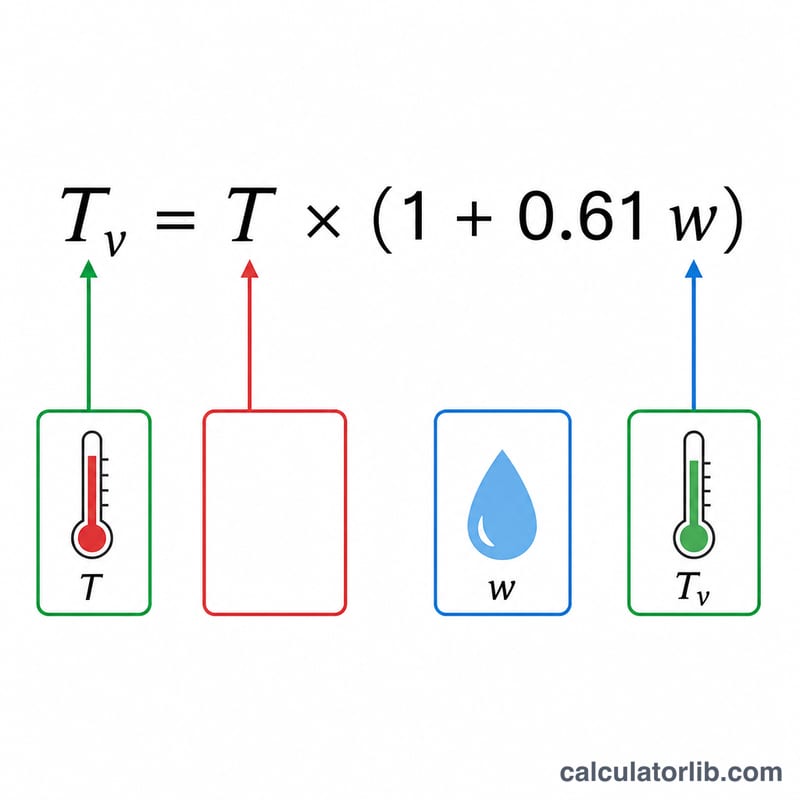
The relationship is $$T_v = T \times (1 + 0.61\,w)$$ where \(T\) is the absolute (Kelvin) temperature and \(w\) is the mixing ratio expressed as a dimensionless ratio (kg of vapor per kg of dry air). The constant 0.61 comes from the ratio of the gas constants of dry air and water vapor. Since \(w\) is typically small (a few thousandths), the virtual temperature is usually only a degree or two above the actual temperature.
Worked Example
Suppose T = 20 °C (293.15 K) and the mixing ratio is 10 g/kg. First, \(w = 10 / 1000 = 0.010\). Then $$T_v = 293.15 \times (1 + 0.61 \times 0.010) = 293.15 \times 1.0061 = 294.938 \text{ K}$$ or about 21.79 °C. The moist air behaves like dry air that is roughly 1.79 K warmer.
FAQ
Why must temperature be in Kelvin? The formula multiplies temperature by a factor, so it only works on an absolute scale. Using Celsius or Fahrenheit directly would give wrong answers — this tool converts for you.
What units is the mixing ratio in? Here you enter it in g/kg (common in soundings); internally it is divided by 1000 to the dimensionless kg/kg used in the equation.
Is virtual temperature always higher than actual temperature? Yes, for any moist air. Drier air gives a smaller difference, and perfectly dry air gives \(T_v = T\).