
What this calculator does
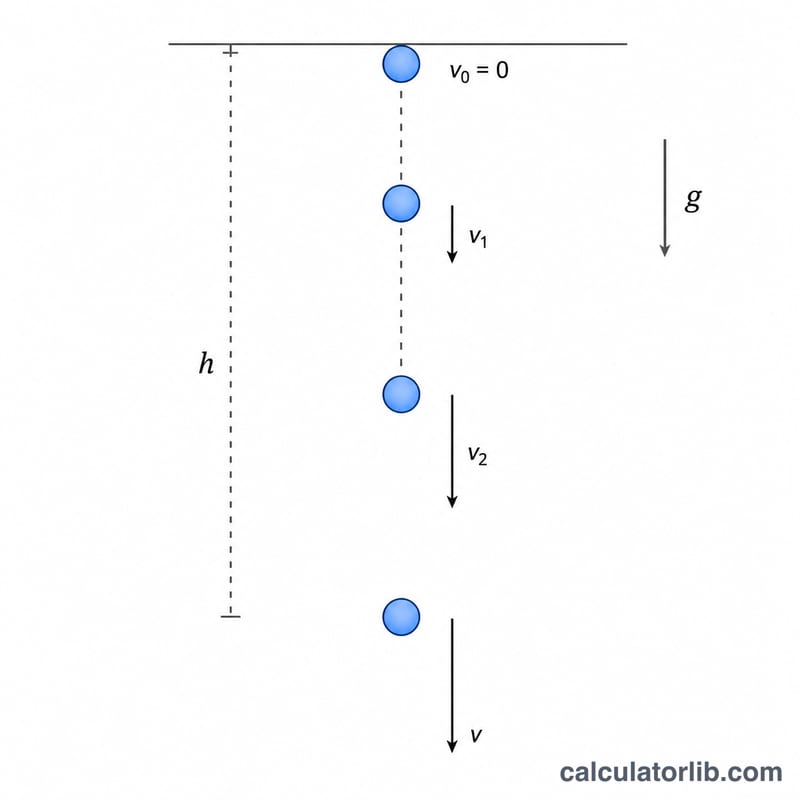
This tool computes the distance an object falls and the velocity it reaches after a given time of free fall, assuming it is dropped from rest in a vacuum (no air resistance). It applies universal classical mechanics, so the results hold anywhere; you can also change the gravitational acceleration to model other bodies such as the Moon or Mars.
How to use it
Enter the elapsed time \(t\) in seconds since the object began falling. The gravitational acceleration \(g\) is pre-filled with standard gravity, \(9.80665\ \text{m/s}^2\), but you can replace it with the Moon's ~1.62, Mars's ~3.71, or a local value. The calculator returns the fall distance \(h\) in meters and the fall velocity \(v\) in both m/s and km/h.
The formula explained
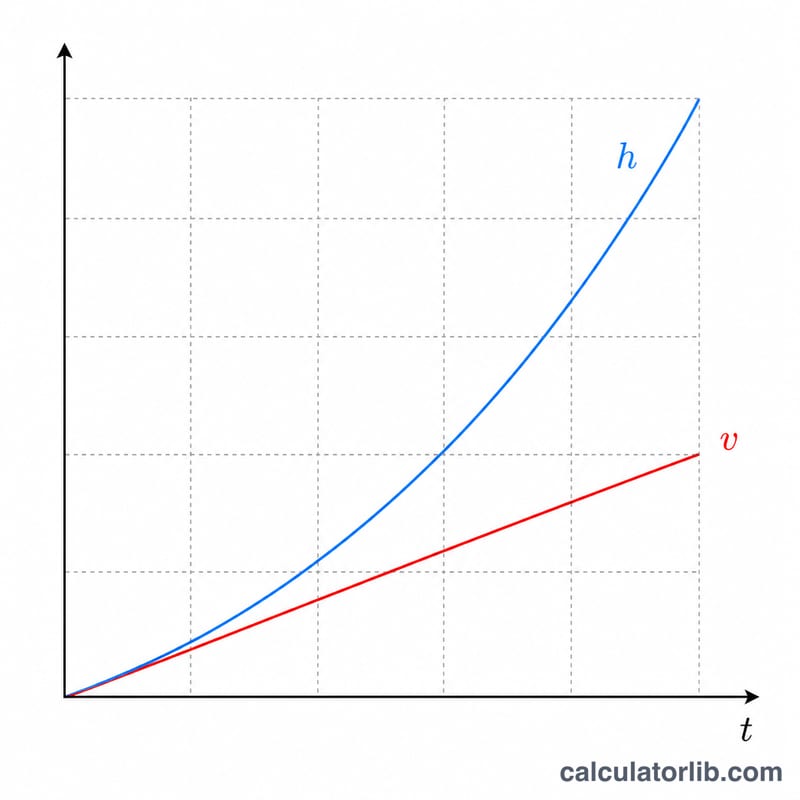
For an object starting from rest with uniform acceleration \(g\), the kinematic equations give the distance and the velocity
$$h = \tfrac{1}{2}\,g\,t^{2} \qquad v = g\,t$$To express the velocity in km/h, multiply the m/s value by \(3.6\) (since \(3600\ \text{s/h}\) divided by \(1000\ \text{m/km}\) equals \(3.6\)).
Worked example
With \(t = 5\ \text{s}\) and \(g = 9.80665\ \text{m/s}^2\):
$$h = 0.5 \times 9.80665 \times 25 = 122.583125\ \text{m}$$and
$$v = 9.80665 \times 5 = 49.03325\ \text{m/s}$$which is \(49.03325 \times 3.6 = 176.5197\ \text{km/h}\). So after 5 seconds the object has fallen about \(122.58\ \text{m}\) and is moving at roughly \(49\ \text{m/s}\) (about \(177\ \text{km/h}\)).
FAQ
Does this account for air resistance? No. It assumes a vacuum, so real objects that experience drag and reach terminal velocity will fall slower and shorter than predicted for long times.
Can I use it for other planets? Yes. Just set \(g\) to that body's surface gravity, for example about \(1.62\ \text{m/s}^2\) for the Moon or \(3.71\ \text{m/s}^2\) for Mars.
What if time is zero? Then both the distance and velocity are zero, which is correct for the instant the object is released.