
What this calculator does
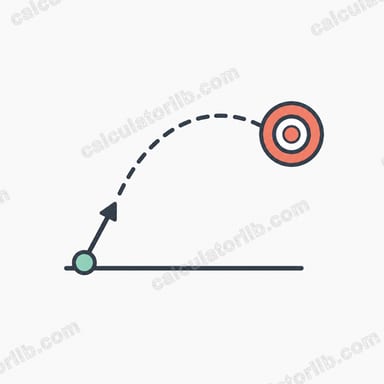
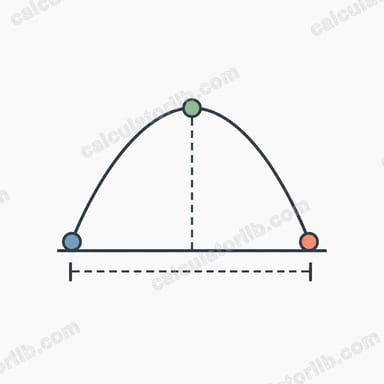
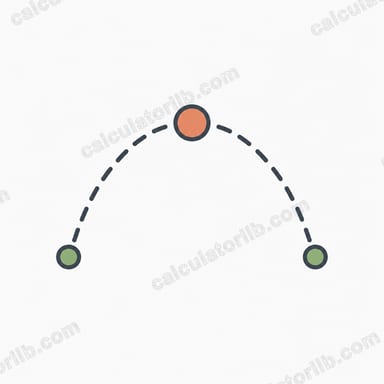
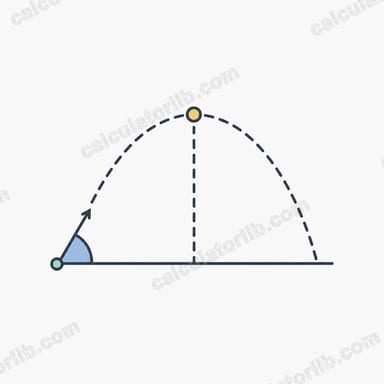
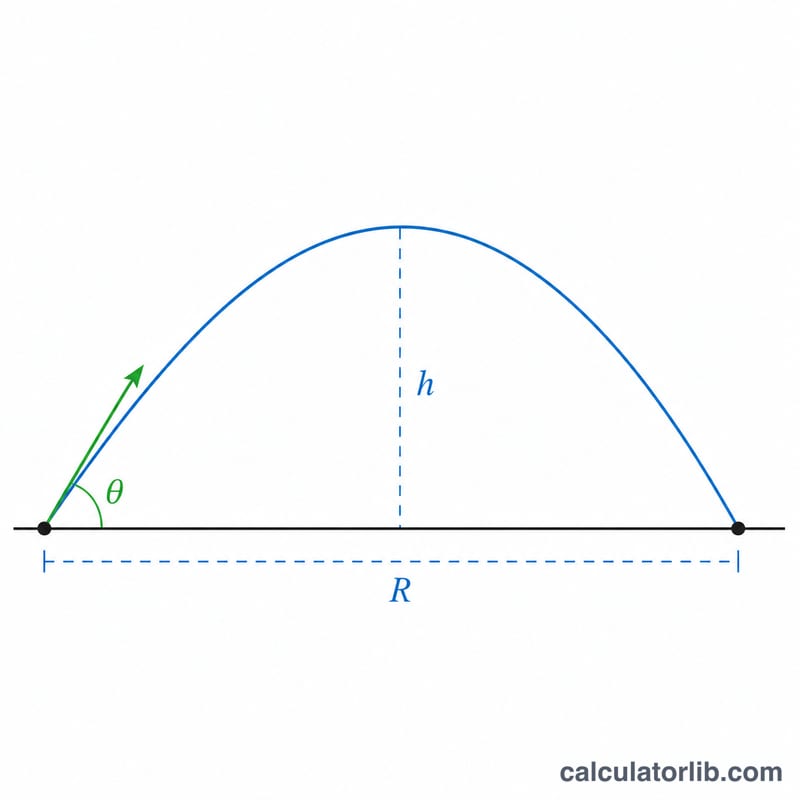
This tool solves the classic parabolic (projectile) motion problem for an object launched from the ground at a fixed angle that rises to a known maximum (apex) height. Given the launch angle and the peak height, it returns the initial launch speed, the total time of flight, and the horizontal range. It assumes no air resistance and a flat, symmetric trajectory, so the object lands back at the launch height. The physics is universal and applies identically everywhere.
How to use it
Enter the launch angle in degrees (between 0 and 90), the apex height in meters, and the gravitational acceleration in m/s² (the default 9.80665 is standard Earth gravity). Press calculate to see the speed in both m/s and km/h, the flight time in seconds, and the range in meters.
The formulas explained
At the highest point the vertical velocity is zero, so the upward kinematics give \((v\cdot\sin\theta)^2 = 2gh\), hence \(v = \sqrt{2gh} / \sin\theta\). The time to rise is \(v\cdot\sin\theta/g\), and the full flight is twice that: \(t = 2\sqrt{2gh}/g\). The range is the horizontal speed multiplied by the flight time: \(l = t \cdot v \cdot \cos\theta\). Let \(S = \sqrt{2gh}\); then
$$v = \frac{S}{\sin\theta}, \quad t = \frac{2S}{g}, \quad l = t\cdot v\cdot\cos\theta$$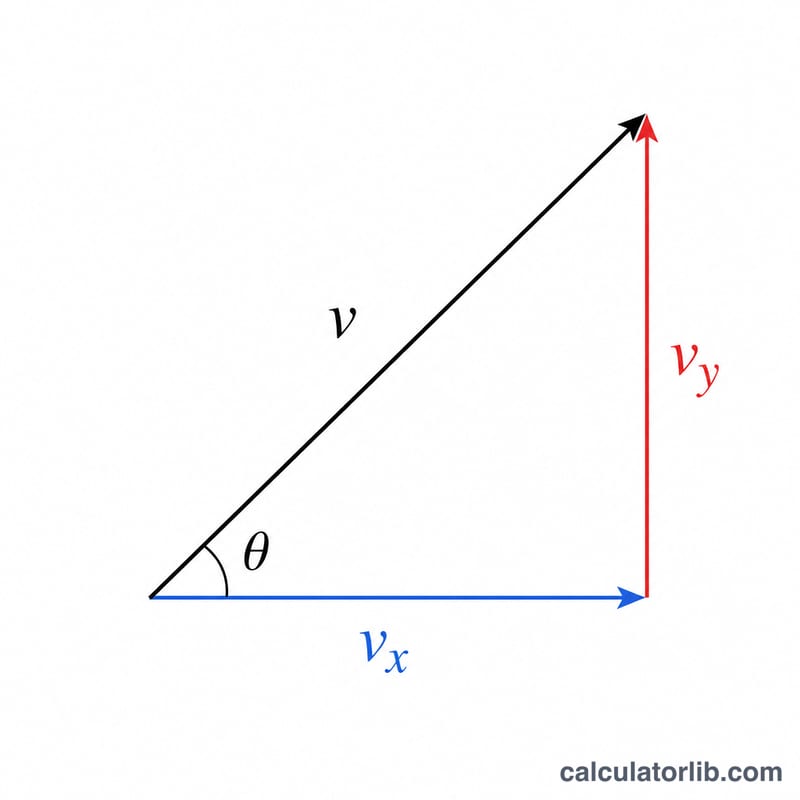
Worked example
For \(\theta = 60\degree\), \(h = 50\,\text{m}\), \(g = 9.80665\,\text{m/s}^2\):
$$S = \sqrt{2\times 9.80665\times 50} = 31.3155\,\text{m/s}$$With \(\sin 60\degree = 0.866025\) and \(\cos 60\degree = 0.5\), the initial speed is
$$\frac{31.3155}{0.866025} = 36.16\,\text{m/s}\ (\text{about } 130.18\,\text{km/h})$$The flight time is
$$\frac{2\times 31.3155}{9.80665} = 6.387\,\text{s}$$and the range is
$$6.387\times 36.16\times 0.5 = 115.47\,\text{m}$$FAQ
What happens at 90 degrees? The object goes straight up, so \(\cos\theta = 0\) and the horizontal range is zero; it returns to its launch point.
Does air resistance change the result? Yes, in reality drag reduces both range and apex height. This calculator ignores air resistance, giving idealized vacuum values.
Why two speed units? The km/h figure (\(v \times 3.6\)) is just the same initial speed expressed in a more familiar everyday unit.