
What this calculator does
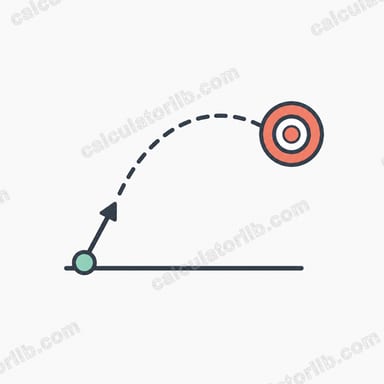
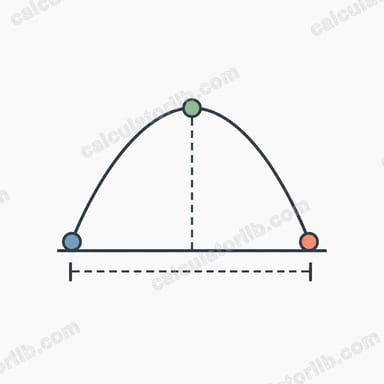
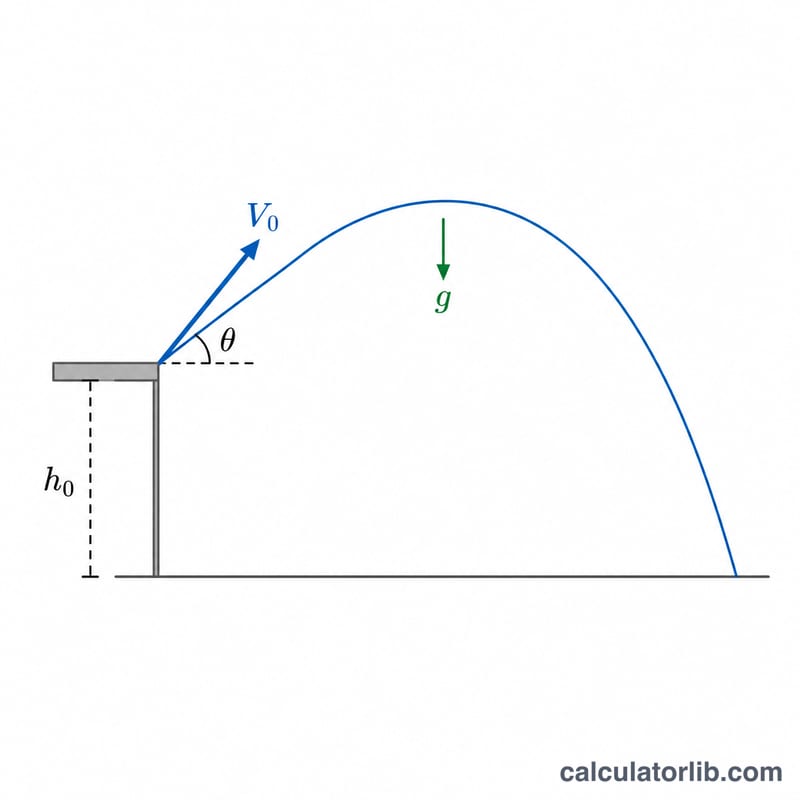
This tool models projectile motion launched from a height above (or below) the landing plane, ignoring air resistance. Given the initial speed, the launch angle, the launch height, and gravity, it returns the time of flight, the maximum height reached, and the horizontal range from launch point to landing point. It is a universal physics tool (no country scope) using SI units internally.
Sign convention
Take "up" as positive and place the origin at the launch point. The landing plane sits at \(y = -h_0\). So a positive launch height h0 means the projectile lands below the launch point (extra drop, longer flight). If the landing point is higher than the launch point, enter h0 as a negative value.
How to use it
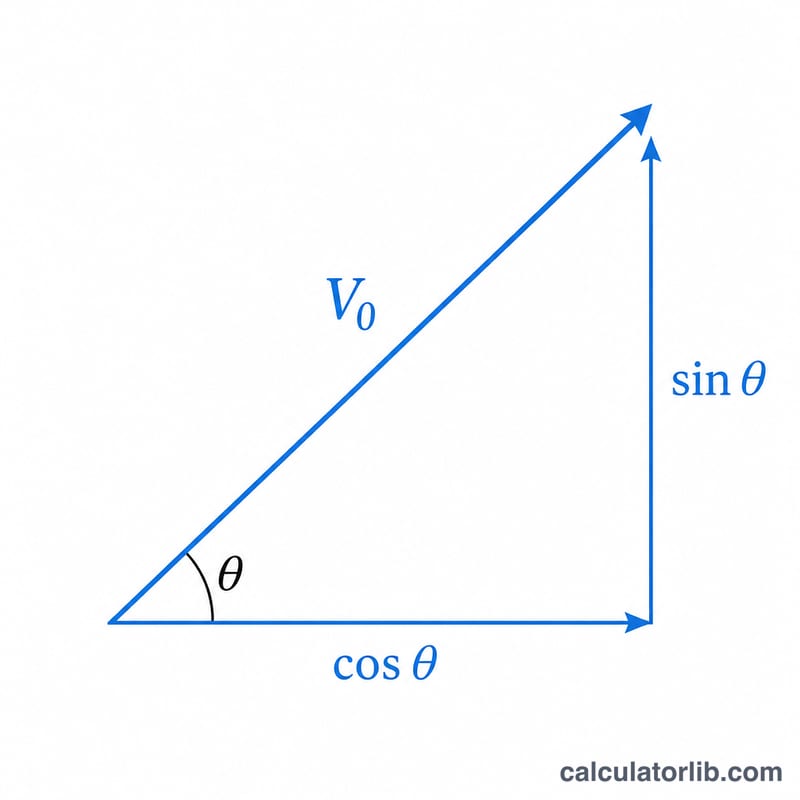
Enter the initial speed Vs (choose m/s or km/h), the launch angle in degrees (0-90), the launch height h0 in metres, and the gravitational acceleration g (default 9.80665 m/s² for Earth). The calculator converts speed to m/s, breaks it into horizontal and vertical components, and solves the vertical equation for the physical landing time.
The formula
With \(V_x = V_0 \cdot \cos\theta\) and \(V_y = V_0 \cdot \sin\theta\), solving \(V_y \cdot t - \tfrac{1}{2} g \cdot t^2 = -h_0\) gives the later (physical) root:
$$t = \frac{V_y + \sqrt{V_y^2 + 2g \cdot h_0}}{g}$$The apex above the launch point is \(H = \dfrac{V_y^2}{2g}\), and the range is \(R = V_x \cdot t\). If the term under the square root is negative the projectile never reaches the landing plane.
Worked example
\(V_0 = 30\ \text{m/s}\), \(\theta = 60°\), \(h_0 = 20\ \text{m}\), \(g = 9.80665\ \text{m/s}^2\). \(V_y = 25.9808\ \text{m/s}\), \(V_x = 15\ \text{m/s}\). Discriminant \(= 675 + 392.266 = 1067.266\), \(\sqrt{\ } = 32.669\). Time of flight
$$t = \frac{25.9808 + 32.669}{9.80665} = 5.9806\ \text{s}$$Max height \(= \dfrac{675}{19.6133} = 34.415\ \text{m}\) above launch (54.415 m above the ground). Range
$$R = 15 \times 5.9806 = 89.709\ \text{m}$$FAQ
What if launch and landing are level? Set h0 = 0; the formula reduces to the classic \(t = \dfrac{2 V_0 \cdot \sin\theta}{g}\) and \(R = \dfrac{V_0^2 \cdot \sin(2\theta)}{g}\).
Why does it say "does not reach"? Only when h0 is negative (target above launch) and the vertical velocity is too small to climb to that plane.
Does it include air resistance? No - this is the idealized vacuum model, ideal for textbook problems and quick estimates.