
What this calculator does
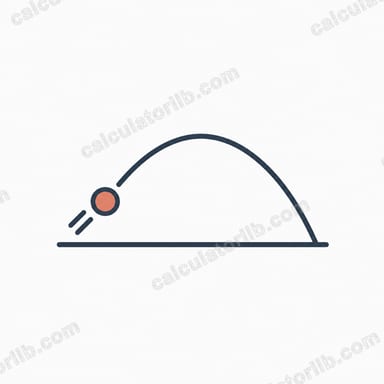
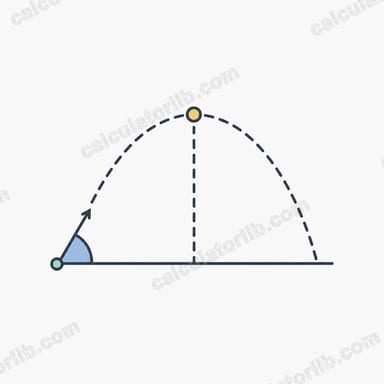
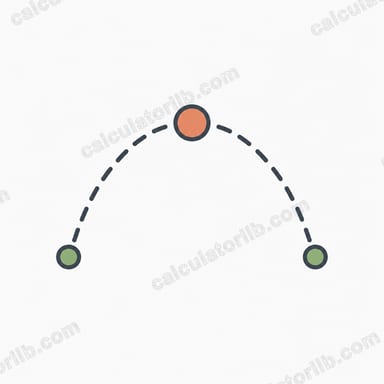
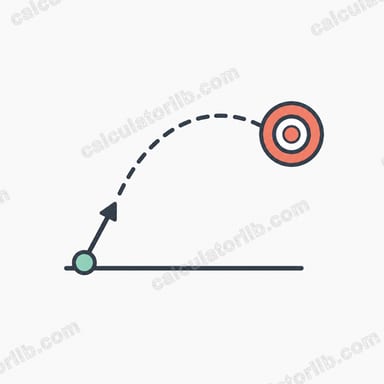
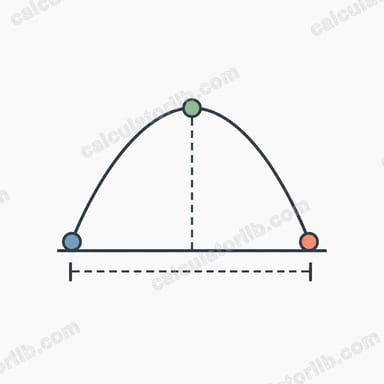
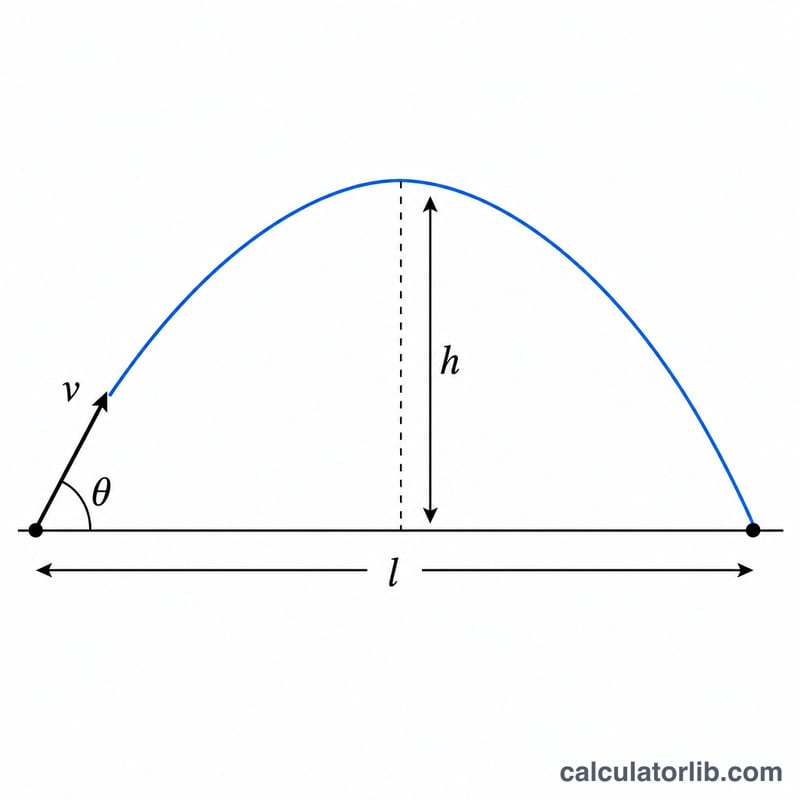
This tool works backwards from the shape of a projectile's flight. If you know how high it peaked (the maximum height h) and how far it traveled horizontally (the range l), it returns the initial launch speed, the launch angle, and the total time of flight. It assumes no air resistance and that the launch and landing points are at the same elevation, so the path is a symmetric parabola.
How to use it
Enter the peak height in meters, the horizontal range in meters, and the gravitational acceleration (default is standard gravity, 9.80665 m/s²). Press calculate to see the required initial speed in both m/s and km/h, the launch angle measured from the horizontal, and the time the projectile stays in the air. Set the range to 0 m to model a purely vertical launch (angle = 90°).
The formula explained
At the apex the vertical velocity is zero, so the peak height fixes the initial vertical velocity: \(v_y = \sqrt{2gh}\). The time to rise to the apex is \(\sqrt{2h/g}\), and the full flight lasts twice as long: \(t = 2\sqrt{2h/g}\). Horizontal motion is at constant speed, so \(v_x = l / (2\sqrt{2h/g})\). The launch speed is the vector sum \(v = \sqrt{v_x^{2} + v_y^{2}}\), and the angle above horizontal is \(\theta = \arctan(4h/l)\) (the gravity terms cancel in that ratio).
$$v_0 = \sqrt{v_x^{2} + v_y^{2}} \qquad \theta = \arctan\!\left(\frac{4\,\text{Peak height } h}{\text{Range } l}\right)$$ $$\text{where}\quad \left\{ \begin{aligned} v_y &= \sqrt{2\,\text{g}\,\text{h}} \\ v_x &= \frac{\text{l}}{2\,t_{\uparrow}} \\ t_{\uparrow} &= \sqrt{\frac{2\,\text{h}}{\text{g}}} \end{aligned} \right.$$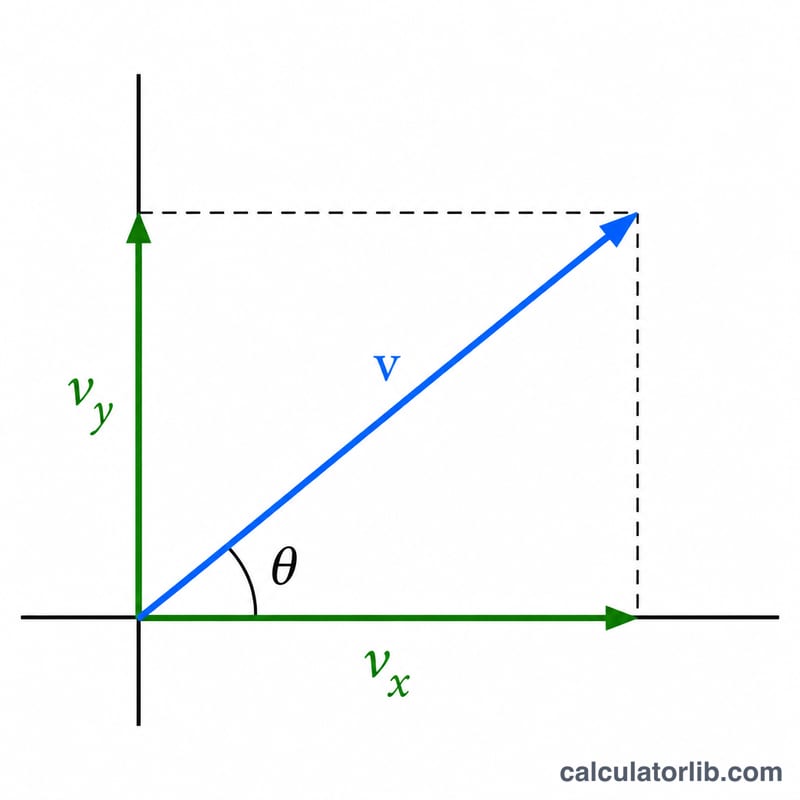
Worked example
For h = 50 m, l = 80 m, g = 9.80665 m/s²:
$$v_y = \sqrt{2\times9.80665\times50} = 31.316 \text{ m/s}$$ $$t = 2\sqrt{\frac{100}{9.80665}} = 6.387 \text{ s}$$ $$v_x = \frac{80}{6.387} = 12.526 \text{ m/s}$$ $$v = \sqrt{12.526^{2} + 31.316^{2}} = 33.73 \text{ m/s} \ (\text{about } 121.4 \text{ km/h})$$ $$\theta = \arctan\!\left(\frac{200}{80}\right) = \arctan(2.5) = 68.20^{\circ}$$FAQ
Does this account for air resistance? No. It uses ideal projectile motion in a vacuum, which is accurate for dense objects at modest speeds.
What if launch and landing heights differ? The symmetric model assumes equal elevations. For different heights the time and range relationships change and these formulas no longer apply directly.
Why does the angle ignore gravity? Because \(\tan\theta = v_y/v_x\) simplifies to \(4h/l\), with g canceling out. Gravity still affects the speed and flight time, just not the angle.