
What This Calculator Does
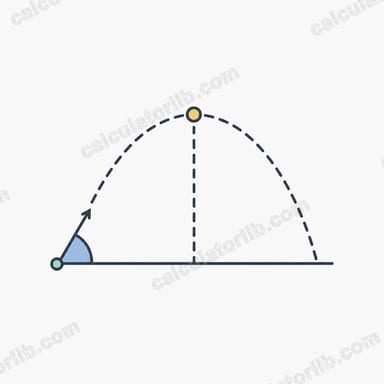
The Projectile Maximum Height Calculator finds the highest vertical point reached by an object launched into the air, given its initial speed and launch angle. It applies to any unpowered projectile motion under constant gravity — a thrown ball, a kicked football, a launched water jet, or a fired pellet — while ignoring air resistance.
How to Use It
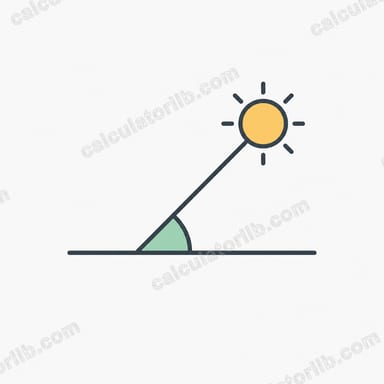
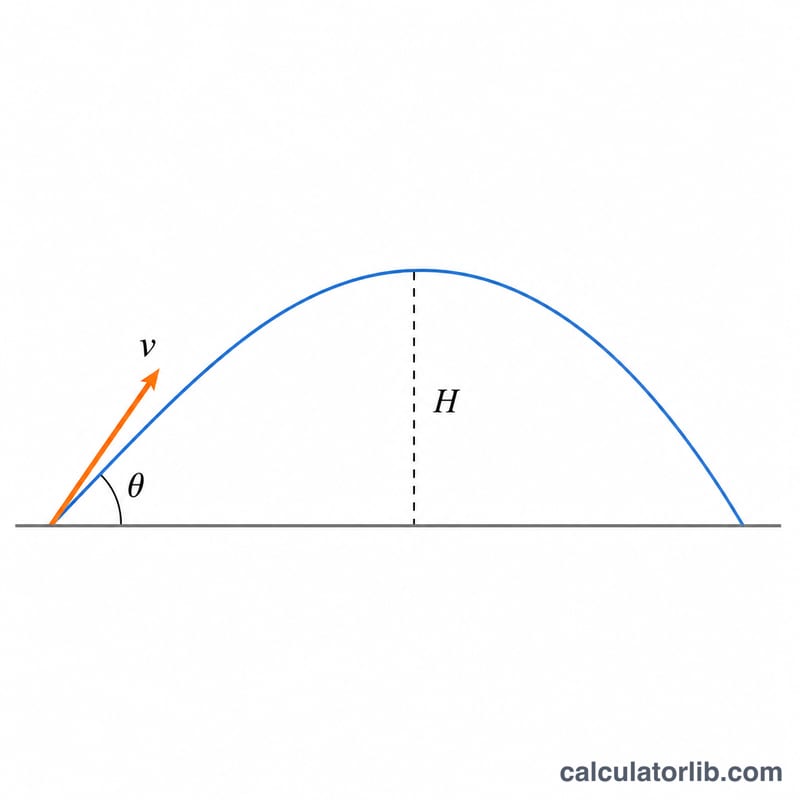
Enter the initial velocity in metres per second, the launch angle in degrees (measured from the horizontal), and the gravitational acceleration (9.81 m/s² on Earth by default; use 1.62 for the Moon or 3.71 for Mars). The calculator returns the maximum height, the vertical component of the launch velocity, and the time taken to reach the peak.
The Formula Explained
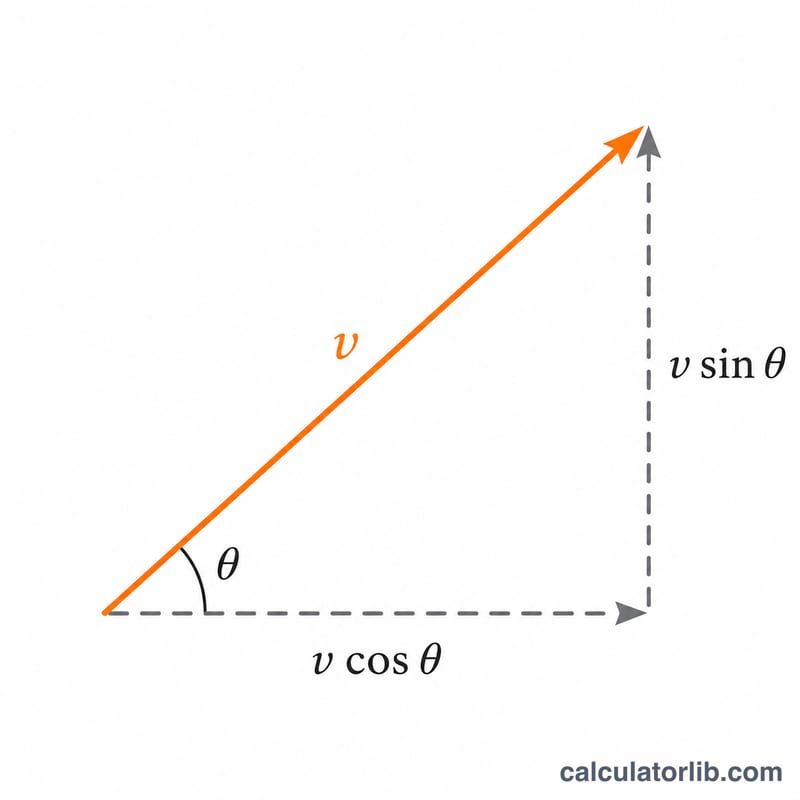
The peak height is given by $$H = \frac{\left(\text{Velocity} \cdot \sin\text{Angle}\right)^{2}}{2\,\text{g}}$$ Only the vertical velocity component, \(v\cdot\sin\theta\), contributes to height. At the apex the vertical velocity is zero, so using the kinematic relation \(v_y^2 = (v\cdot\sin\theta)^2 - 2gH\) and setting the final velocity to zero gives \(H\) directly. Maximum height is greatest at a 90° launch (straight up) and zero at a 0° launch (purely horizontal).
Worked Example
Launch a ball at 20 m/s and 45° on Earth (g = 9.81). The vertical component is \(20 \times \sin(45°) = 14.142 \text{ m/s}\). The maximum height is $$\frac{(14.142)^2}{2 \times 9.81} = \frac{200}{19.62} \approx 10.19 \text{ metres}$$ reached after about 1.44 seconds.
FAQ
Does this include air resistance? No. It assumes ideal projectile motion in a vacuum, which is a good approximation for dense, slow objects but overestimates height for light objects at high speed.
What angle gives the most height? A 90° launch (straight up) maximises height, while a 45° launch maximises horizontal range.
Can I use feet or mph? The formula is unit-agnostic, but keep velocity and gravity in consistent units. With m/s and m/s² the result is in metres.