
What is the Crash / Impact Force Calculator?
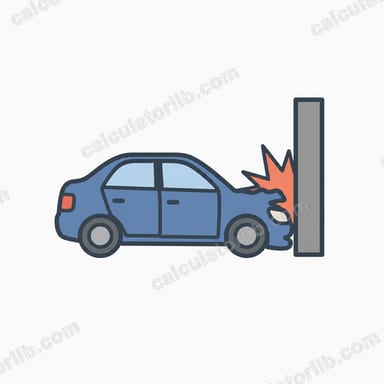
This calculator estimates the average force experienced during a collision or impact. When a moving object is brought to rest, all of its kinetic energy must be absorbed over the stopping distance. The shorter that distance, the larger the force — which is why crumple zones, airbags, and padding save lives by extending the stopping distance.
How to use it
Enter the mass of the object (kg), its impact speed (m/s), and the stopping distance (m) — the distance over which it comes to a stop. The tool returns the average impact force in newtons and kilonewtons, the kinetic energy involved, and the equivalent deceleration in g.
The formula explained
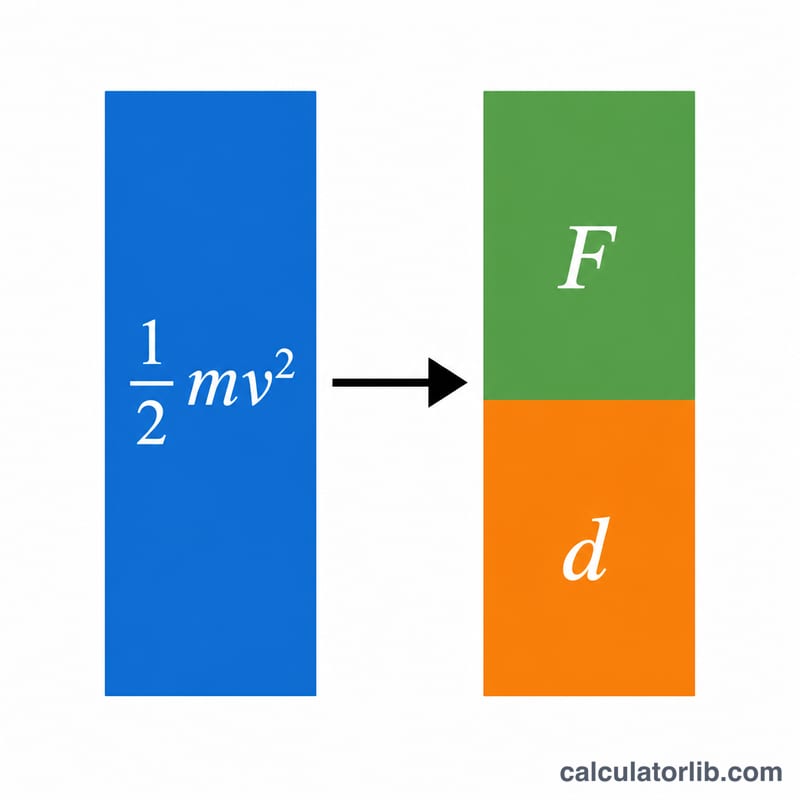
The work-energy principle states that the work done by the impact force equals the kinetic energy dissipated: \(F \times d = \tfrac{1}{2} m v^{2}\). Rearranging gives $$F = \frac{m v^{2}}{2d}.$$ This yields the average force; the peak instantaneous force can be considerably higher depending on how the deceleration is distributed.
Worked example
A 1500 kg car hits a wall at 15 m/s (54 km/h) and the crumple zone gives 0.5 m of stopping distance. Kinetic energy = $$\tfrac{1}{2} \times 1500 \times 15^{2} = 168{,}750 \text{ J}.$$ Force = $$\frac{168{,}750}{0.5} = 337{,}500 \text{ N} \ (337.5 \text{ kN}).$$ That equals about 23 g of deceleration.
FAQ
Why does a longer stopping distance reduce force? The same energy is spread over more distance, so less force is needed at each instant — the basis of crumple zones and airbags.
Is this peak or average force? It is the average force over the stop. Real peak forces fluctuate and are often higher.
What units should I use? Use SI units: kg, m/s, and meters. The result is in newtons (1 kN = 1000 N).