
What this calculator does
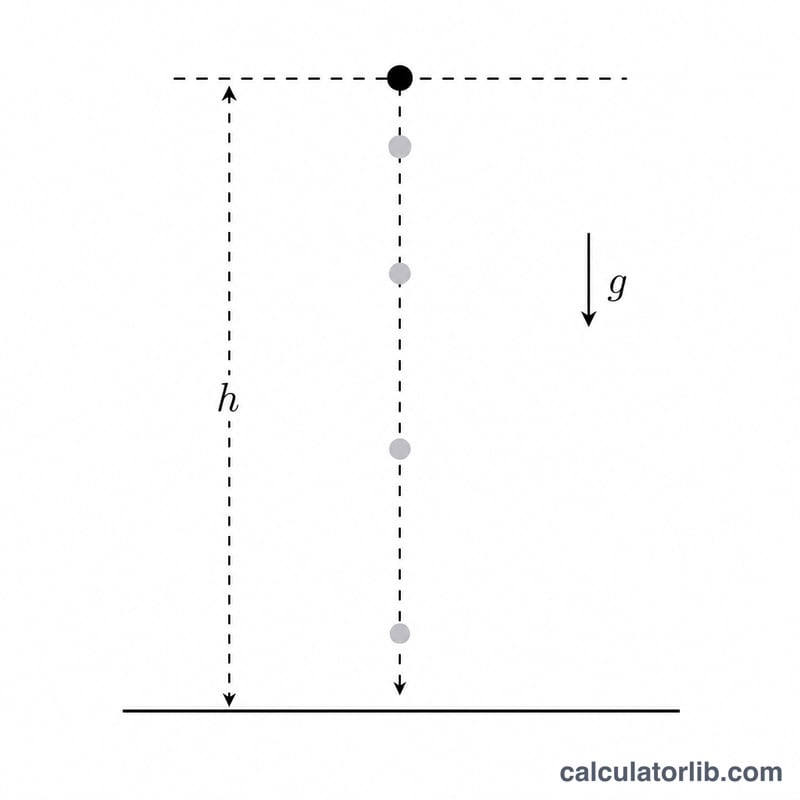
This free fall calculator finds how long an object takes to fall a given distance and how fast it is moving when it has fallen that far. It assumes the object is released from rest (initial velocity zero) and falls freely through a vacuum, so there is no air resistance or drag and the gravitational acceleration is constant over the fall.
How to use it
Enter the fall distance h in meters and the gravitational acceleration g in meters per second squared. The default g is 9.80665 m/s², the internationally adopted standard gravity for Earth. You can change g to model other bodies — for example the Moon (about 1.62 m/s²) or Mars (about 3.71 m/s²). The tool returns the elapsed time in seconds and the impact speed in both m/s and km/h.
The formulas explained
Starting from rest, the distance fallen in time t is \(h = \frac{1}{2}gt^2\). Solving for time gives \(t = \sqrt{\dfrac{2h}{g}}\). The speed gained is \(v = gt\), which combined with the time equation gives \(v = \sqrt{2\,g\,h}\). To express speed in km/h, multiply the m/s value by 3.6 since \(1 \text{ m/s} = 3.6 \text{ km/h}\).
$$t = \sqrt{\dfrac{2h}{g}} \qquad v = \sqrt{2\,g\,h}$$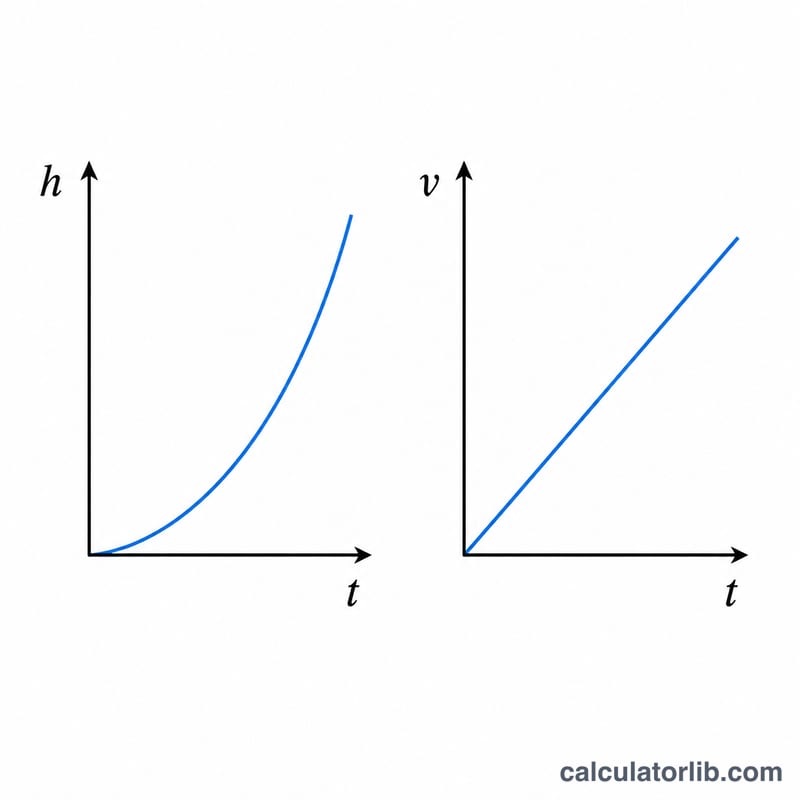
Worked example
Drop an object 100 m on Earth (\(g = 9.80665 \text{ m/s}^2\)). Time:
$$t = \sqrt{2 \times 100 / 9.80665} = \sqrt{20.3943} \approx 4.516 \text{ s}$$Speed:
$$v = \sqrt{2 \times 9.80665 \times 100} = \sqrt{1961.33} \approx 44.287 \text{ m/s}$$which is \(44.287 \times 3.6 \approx 159.43 \text{ km/h}\). As a check, \(v = g \times t = 9.80665 \times 4.516 \approx 44.287 \text{ m/s}\).
FAQ
Does this account for air resistance? No. Real falling objects experience drag and approach a terminal velocity; this model is for a vacuum and overstates speed for long drops.
Why can I edit gravity? So you can model falls on the Moon, Mars, or any body by entering its surface gravity.
What if distance is zero? Both the time and speed are zero, since the object has not fallen yet.