
What Is the Quantum Numbers Calculator?
This calculator takes a principal quantum number n and instantly works out the set of allowed quantum numbers and capacities for that electron shell. Quantum numbers describe the unique "address" of an electron in an atom: the energy level (\(n\)), the subshell shape (\(l\)), the orbital orientation (\(m_\ell\)), and spin. Given \(n\), the rules of quantum mechanics fix the allowed values of \(l\) and \(m_\ell\) as well as how many subshells, orbitals, and electrons the shell can contain.
How to Use It
Enter a whole-number principal quantum number \(n\) (1 for the first shell, 2 for the second, and so on). The calculator returns the maximum number of electrons (\(2n^2\)), the range of azimuthal values \(l\) (0 to \(n-1\)), the number of subshells (\(n\)), the number of orbitals (\(n^2\)), and the magnetic quantum number range (\(-l\) to \(+l\)) for each subshell.
The Formula Explained
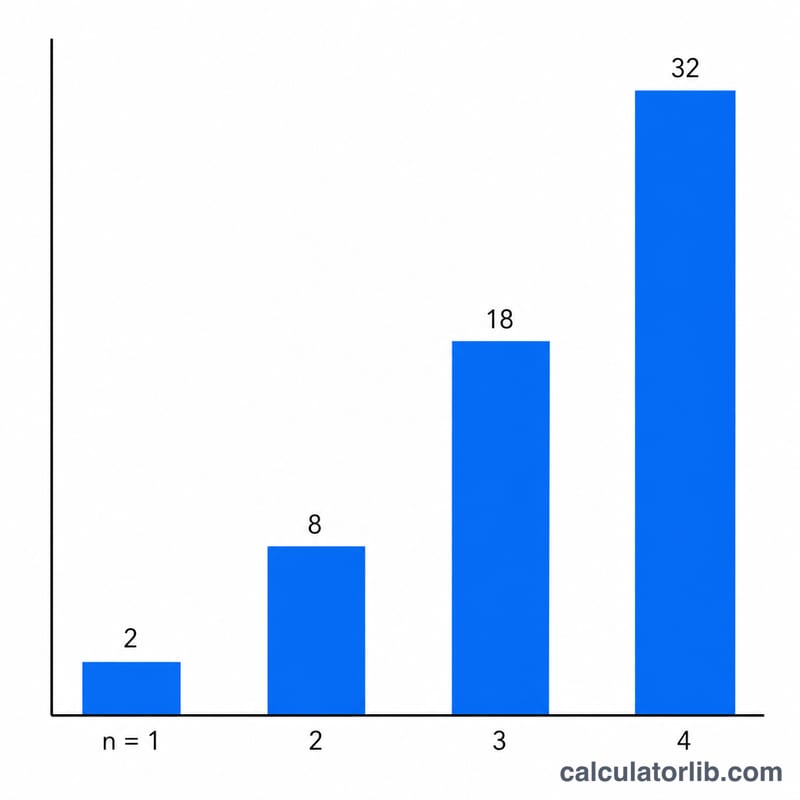
For a given shell \(n\): the azimuthal quantum number l can be any integer from 0 up to \(n-1\), giving exactly \(n\) subshells (s, p, d, f...). For each \(l\), the magnetic quantum number mₗ takes the \(2l+1\) integer values from \(-l\) to \(+l\). Summing \(2l+1\) over all \(l\) from 0 to \(n-1\) gives \(n^2\) orbitals. Since each orbital holds two electrons (spin \(\pm\tfrac{1}{2}\)), the maximum electron count is \(2n^2\).
$$\begin{gathered} \text{Orbitals} = \text{n}^{2}, \quad \text{Max Electrons} = 2\,\text{n}^{2} \\[1.5em] \text{where}\quad \left\{ \begin{aligned} \text{Subshells} &= \text{n} \\ \ell_{\max} &= \text{n} - 1 \end{aligned} \right. \end{gathered}$$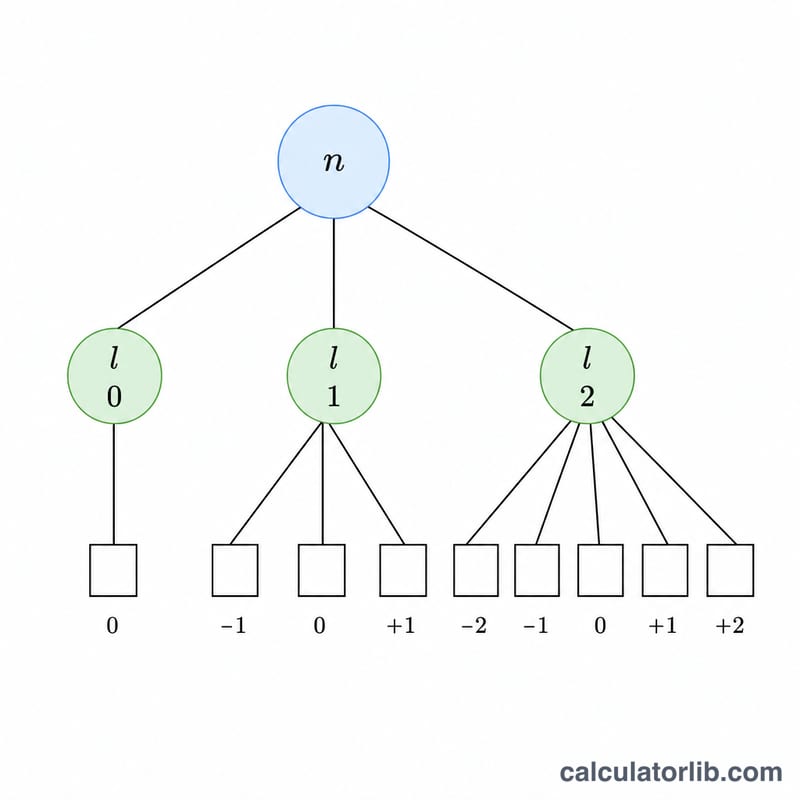
Worked Example
Take \(n = 3\). Then \(l = 0, 1, 2\) (three subshells: 3s, 3p, 3d). The orbital count is \(n^2 = 9\) (one s, three p, five d). The maximum electrons is $$2n^2 = 2 \times 9 = 18.$$ The \(m_\ell\) values reach from \(-2\) to \(+2\) for the d subshell.
FAQ
Why is the maximum 2n²? There are \(n^2\) orbitals in shell \(n\), and each orbital holds 2 electrons with opposite spins, so \(2 \times n^2 = 2n^2\).
What does l = 0,1,2,3 correspond to? These are the s, p, d, and f subshells respectively.
How many mₗ values does a subshell have? Exactly \(2l+1\), ranging from \(-l\) to \(+l\) in integer steps.