
What It Is
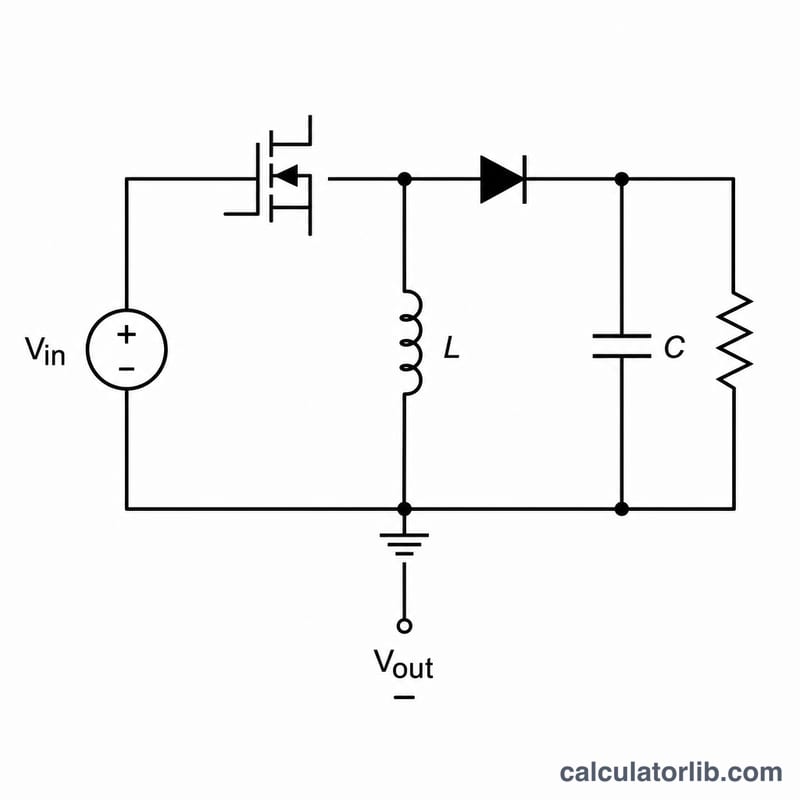
An inverting buck-boost converter is a switched-mode DC-DC topology that produces a regulated output voltage of opposite polarity to its input. Depending on the duty cycle, it can step the magnitude up (boost) or down (buck) while always inverting the sign. This calculator uses the ideal continuous-conduction-mode (CCM) transfer function to estimate the output voltage from the input voltage and switching duty cycle.
How to Use It
Enter the input voltage Vin in volts and the duty cycle D as a percentage (0–99%). The tool converts the percentage to a fraction, applies the transfer function, and returns the output voltage along with the voltage gain. Because the topology inverts polarity, the result is negative.
The Formula Explained
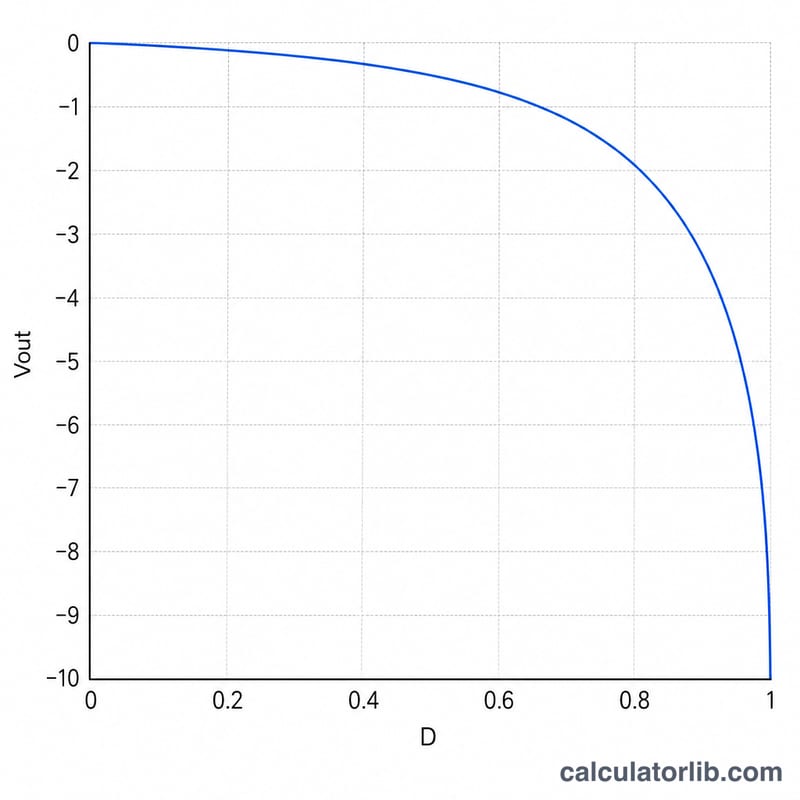
The ideal CCM relationship is $$V_{out} = -\,\text{Vin (V)} \cdot \frac{D}{1-D}$$ where \(D\) is the fraction of each switching period that the main switch is on. At \(D = 50\%\) the magnitude equals Vin; below 50% it bucks (smaller magnitude); above 50% it boosts (larger magnitude). As \(D\) approaches 1, the gain rises sharply, so the calculator guards against \(D = 100\%\).
Worked Example
With \(\text{Vin} = 12\,\text{V}\) and \(D = 50\%\) (0.5): $$V_{out} = -12 \times \frac{0.5}{0.5} = -12\,\text{V}$$ The output is −12 V, equal in magnitude but inverted. At \(D = 75\%\), gain \(= 0.75/0.25 = 3\), so $$V_{out} = -12 \times 3 = -36\,\text{V}$$
FAQ
Why is the output negative? The inverting buck-boost arranges the inductor and switch so energy is delivered to the load with reversed polarity relative to the common ground.
Is this accurate for real circuits? It is the ideal lossless CCM result. Real converters have switch, diode, and inductor losses, so the actual magnitude is slightly lower.
What duty cycle gives Vout = −Vin? \(D = 50\%\), where \(D/(1-D) = 1\).