What is the Coffee Roast Weight Loss Calculator?
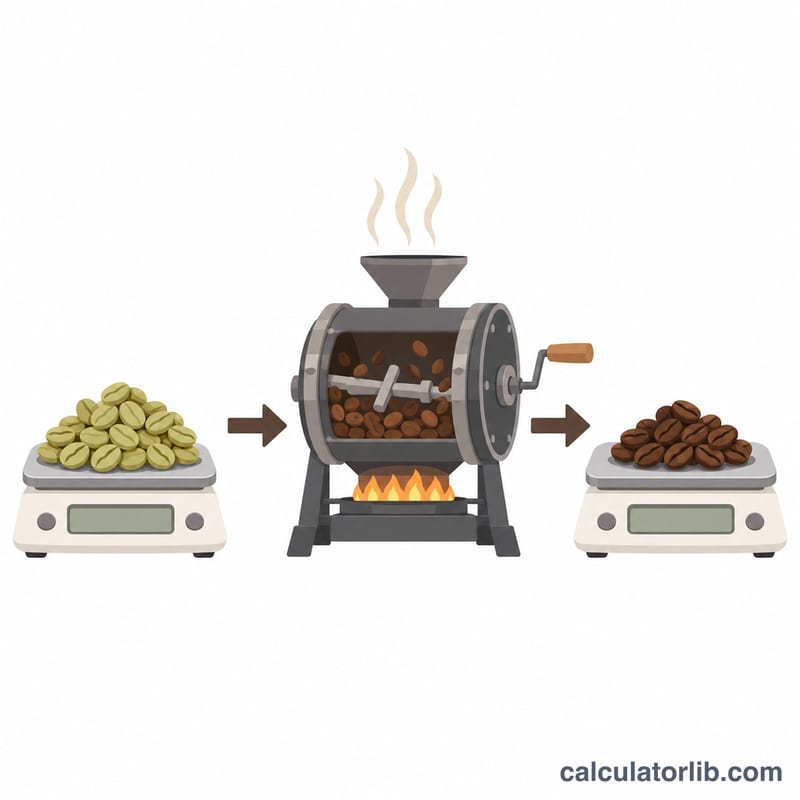
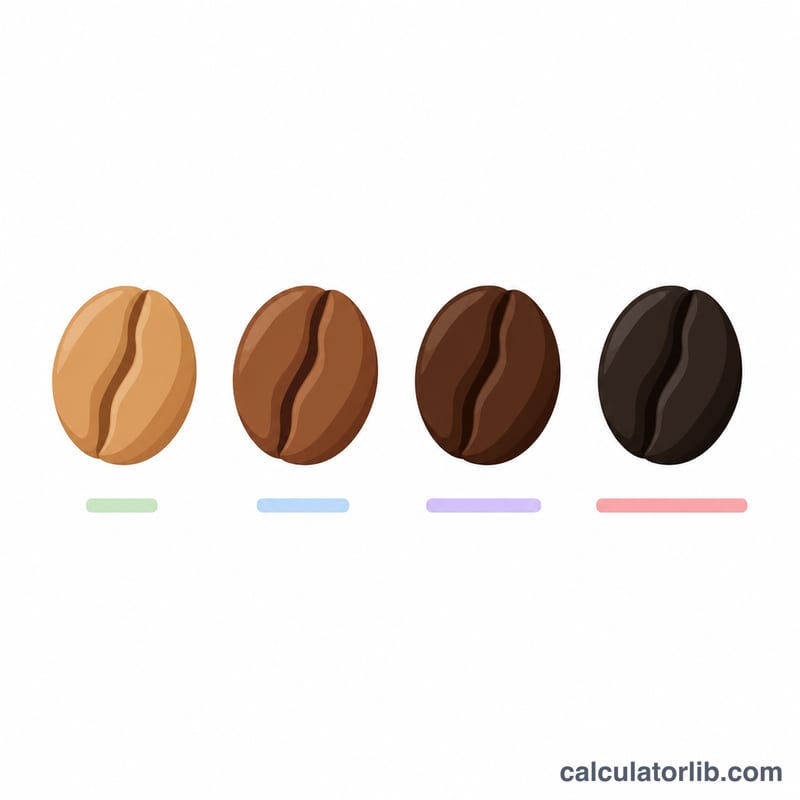
When green coffee beans are roasted they lose weight. Moisture evaporates, chaff detaches, and organic compounds burn off, so a batch always weighs less coming out of the roaster than it did going in. This calculator turns your green and roasted weights into two numbers roasters care about: the roast weight loss percentage and the roast yield. Tracking these figures helps you cost your coffee accurately, compare roast profiles, and judge how dark a batch really went.
How to use it
Weigh your beans before roasting and enter that value as the green bean weight. After the roast has cooled, weigh the batch again and enter it as the roasted bean weight, using the same unit for both. The calculator instantly returns the percentage of weight lost, the grams lost, and the remaining yield.
The formula explained
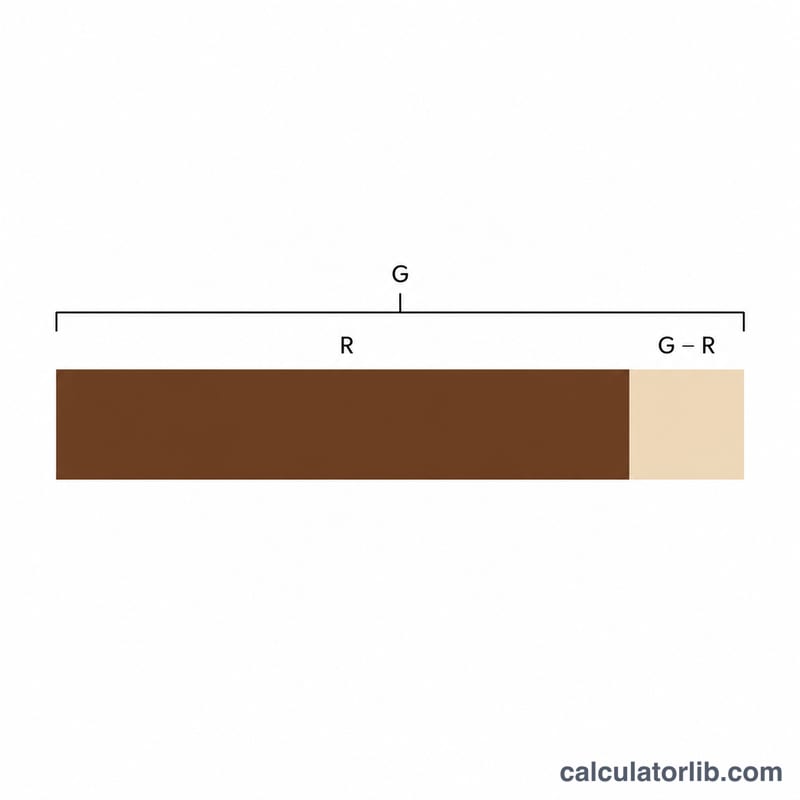
Let \(W_g\) = green bean weight and \(W_r\) = roasted bean weight. The roast weight loss is the difference between the two divided by the starting weight:
$$\text{Loss \%} = \frac{W_g - W_r}{W_g} \times 100$$The yield is simply the part that survives the roast:
$$\text{Yield \%} = \frac{W_r}{W_g} \times 100$$Typical loss runs from about 12 percent for a light roast to 20 percent or more for a dark roast.
Worked example
Suppose you load 1000 g of green beans and pull 840 g of roasted coffee. The loss is:
$$\text{Loss \%} = \frac{1000 - 840}{1000} \times 100 = 16\%$$and the yield is:
$$\text{Yield \%} = \frac{840}{1000} \times 100 = 84\%$$So you lost 160 g, a 16 percent roast loss, leaving 84 percent as finished coffee.
Planning Green Coffee Quantities
To roast a set amount of finished coffee, work backwards from your expected weight loss. Rearranging the loss formula gives the green weight you need:
$$G = \frac{R_{\text{target}}}{1 - \dfrac{L}{100}}$$Here \(G\) is the green bean weight, \(R_{\text{target}}\) is the roasted weight you want, and \(L\) is the expected loss in percent.
Example: You want 1 kg (1,000 g) of roasted coffee, and this roast usually loses 15%:
$$G = \frac{1000\ \text{g}}{1 - 0.15} = \frac{1000\ \text{g}}{0.85} \approx 1176.5\ \text{g}$$That is about 1.18 kg of green coffee. To check, roast 1,000 g of green beans and get 850 g back. That is a loss of 15%, which is the rate used above. Note that dividing by 0.85 is not the same as adding 15%. Adding 15% to 1 kg would give only 1.15 kg of green coffee, and you would end up with too little roasted coffee.
Practical tips
- Log the loss for every batch. Write down the green weight, roasted weight and loss % for each origin and roast profile. Loss changes with bean density, moisture content and how dark you roast. Lighter roasts usually lose less weight and darker roasts lose more. Your own records will predict future batches better than a general rule of thumb.
- Price by roasted weight, not green weight. Use the yield you recorded for the batch to find the real cost of each roasted kilogram: $$\text{Cost per roasted kg} = \frac{\text{Green price per kg}}{\text{Yield \%}/100}$$ For example, green coffee at $8.00 per kg with an 85% yield costs \(\frac{\$8.00}{0.85} \approx \$9.41\) per roasted kg, before labour, energy and packaging.
- Buy extra green coffee. Keep a buffer for test roasts when you set up a new profile or start a new lot. Also allow for weight you lose when sorting out defective beans (quakers, broken or insect-damaged beans) before or after roasting. That sorting loss is not included in the roast loss figure.
- Plan with conservative numbers. If your recorded losses for a coffee range between two values, plan with the higher one so you don't fall short of your target roasted weight.
FAQ
What is a normal roast weight loss? Most roasts land between 12 and 20 percent. Lighter roasts lose less, darker roasts lose more because they spend longer developing.
Why does coffee lose weight when roasted? The biggest factor is water: green beans hold roughly 10 to 12 percent moisture that boils off. The rest comes from chaff and the breakdown of organic matter.
Can I use ounces or pounds instead of grams? Yes. The percentage result is unit-independent as long as you enter both weights in the same unit.