
What is the Chicken Egg Production Calculator?
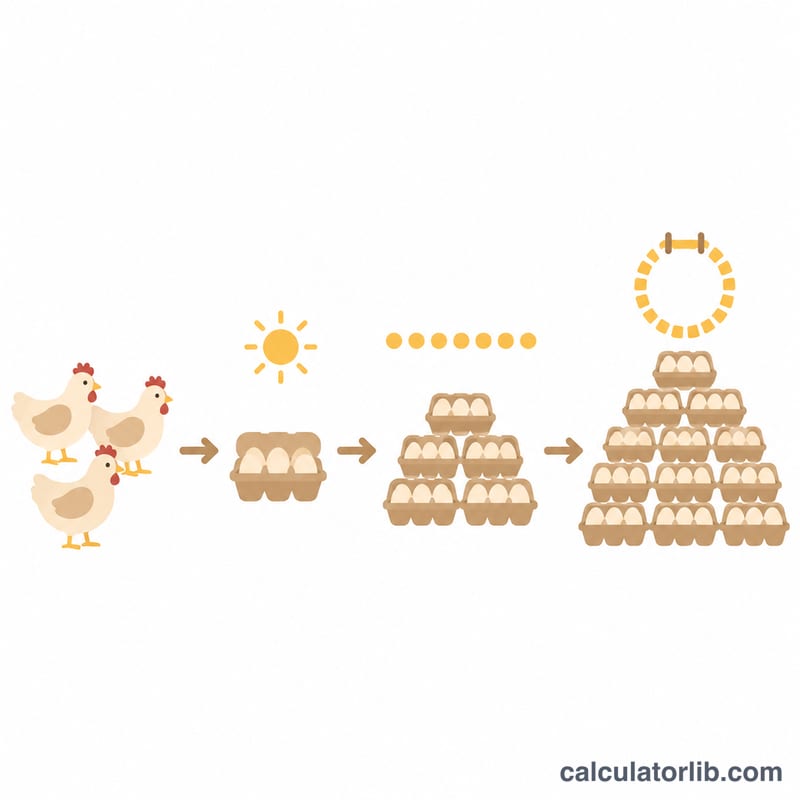
The Chicken Egg Production Calculator estimates how many eggs a flock will produce each day, week, and year. It combines three practical inputs — flock size, breed laying rate, and hen age — so backyard keepers and small commercial producers can forecast supply, plan sales, and size feed orders with confidence.
The formula
Daily output scales a breed annual laying potential down to a single day and then adjusts it for the age of the birds:
$$\text{Daily} = N \times \frac{R}{365} \times f_{\text{age}}$$where \(N\) = number of hens, \(R\) = breed laying rate in eggs per hen per year, and \(f_{\text{age}}\) = an age adjustment factor. Weekly output is \(7\) times the daily figure, and yearly output simplifies to \(N \times R \times f_{\text{age}}\).
How the age factor works
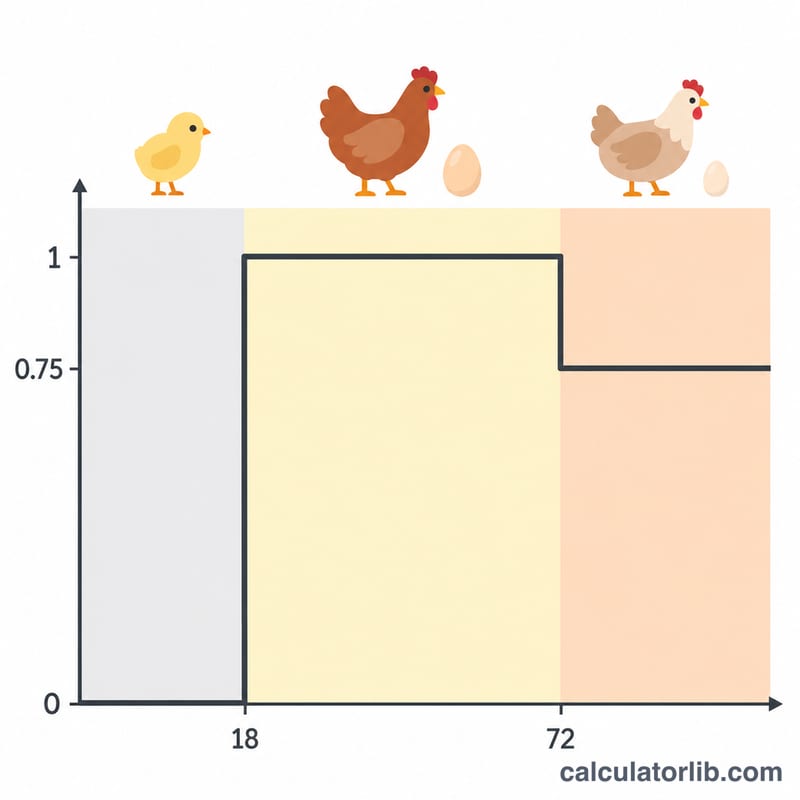
Hens do not lay at a constant rate for life. Pullets under 18 weeks are not yet in lay, so \(f_{\text{age}} = 0\). Birds between 18 and 72 weeks are in their most productive first cycle, so \(f_{\text{age}} = 1\). After roughly 72 weeks, production declines and is modeled here as \(f_{\text{age}} = 0.75\).
How to use it
Enter the number of hens, the breed laying rate (hybrid layers reach about 300 eggs per year while dual-purpose breeds sit near 180–250), and the average age of the flock in weeks. The tool returns daily, weekly, and yearly estimates instantly.
Worked example
A flock of 100 hens of a 300-egg breed, all 30 weeks old, gives:
$$\text{Daily} = 100 \times \frac{300}{365} \times 1 = 82.2\ \text{eggs}$$That works out to about \(575\) eggs per week and \(30{,}000\) eggs per year.
Typical Laying Rates by Breed
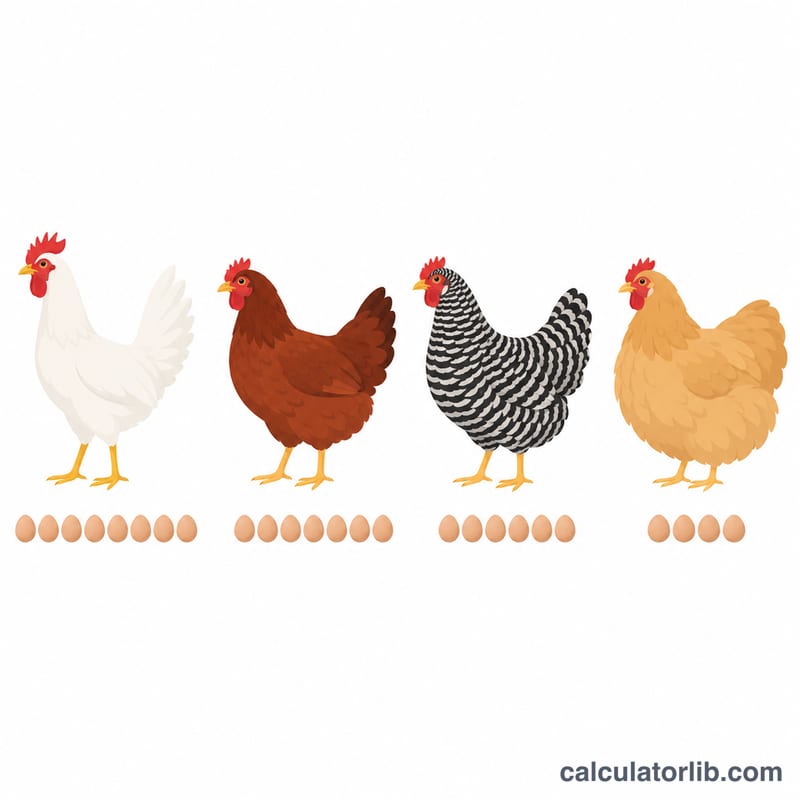
The laying rate \(R\) is the most important input in the calculator. The table lists approximate eggs per hen per year for common breeds. These are widely published ranges for a hen's first full laying year. Use a number from the range as your rate value.
| Breed / type | Approx. eggs per hen per year | Suggested rate input |
|---|---|---|
| ISA Brown / Hy-Line Brown (commercial hybrids) | 300–320 | 300–320 |
| White Leghorn | 280–300 | 280–300 |
| Golden Comet / Red Sex Link | 250–300 | 250–300 |
| Rhode Island Red | 250–300 | 250–300 |
| Australorp | ~250 | 250 |
| Plymouth Rock | 200–280 | 200–280 |
| Sussex | ~250 | 250 |
| Orpington | 175–200 | 175–200 |
| Wyandotte | ~200 | 200 |
| Brahma | ~150 | 150 |
| Silkie | 100–120 | 100–120 |
Note: These figures are approximate. Real output depends on the strain (hatchery and show lines of the same breed can differ a lot), nutrition, daylight, temperature, health and stress. Backyard flocks often lay less than the top of each range. If you are unsure, start with a mid-range value and adjust it once you have a few weeks of your own records.
Production Across Flock Scenarios
Each row uses the calculator's formula: \(\text{Daily} = N \times \frac{R}{365} \times f\), \(\text{Weekly} = 7 \times \text{Daily}\), and \(\text{Yearly} = N \times R \times f\). The age factor is \(f = 0\) under 18 weeks, \(f = 1\) from 18 to 72 weeks, and \(f = 0.75\) over 72 weeks. Dozens per week is weekly eggs ÷ 12.
| Scenario | Age factor \(f\) | Eggs/day | Eggs/week | Dozens/week | Eggs/year |
|---|---|---|---|---|---|
| 6 hens, 300-egg hybrid, 30 weeks old | 1 | ≈ 4.93 | ≈ 34.5 | ≈ 2.9 | 1,800 |
| 6 hens, 200-egg breed, 30 weeks old | 1 | ≈ 3.29 | ≈ 23.0 | ≈ 1.9 | 1,200 |
| 25 hens, 250-egg breed, 80 weeks old | 0.75 | ≈ 12.84 | ≈ 89.9 | ≈ 7.5 | ≈ 4,688 |
| 100 hens, 300-egg breed, 16 weeks old | 0 | 0 | 0 | 0 | 0 |
Here is the math for the 25-hen row:
$$\text{Daily} = 25 \times \frac{250}{365} \times 0.75 = \frac{4687.5}{365} \approx 12.84$$$$\text{Weekly} = 7 \times 12.84 \approx 89.9 \quad\Rightarrow\quad \frac{89.9}{12} \approx 7.5 \text{ dozen}$$$$\text{Yearly} = 25 \times 250 \times 0.75 = 4687.5 \approx 4{,}688$$A few things stand out from the table:
- Breed choice matters as much as flock size. Six hybrids give about 50% more eggs than six 200-egg hens (1,800 vs 1,200 a year).
- Hens older than 72 weeks still lay, but the model reduces their output by 25%.
- Pullets under 18 weeks give zero eggs, however large the flock. At 16 weeks, a 100-hen flock still needs a few weeks before it starts producing.
Planning Tips for Egg Supply and Feed
- Think in dozens. Divide the weekly figure by 12 to get cartons. For example, 34.5 eggs per week ÷ 12 ≈ 2.9 dozen. Round down when planning what you can give away or sell.
- Expect seasonal dips. The calculator gives an average across the year. In winter and during the annual molt, many flocks lay about 20–30% less, and some hens stop completely for a few weeks. You can either plan for the lower winter output or add supplemental light. Hens generally need about 14–16 hours of light a day to keep laying steadily.
- Estimate feed from flock size. A laying hen eats about 0.25 lb (roughly 110–120 g) of layer feed per day. Six hens therefore need about \(6 \times 0.25 = 1.5\) lb a day, or about 10.5 lb (≈ 4.8 kg) a week. Intake goes up in cold weather and with larger breeds, so leave some margin when you order feed.
- Stagger your flock's ages. Hens past about 72 weeks drop to the 0.75 factor, and output keeps falling as they age. Add a few new pullets every year or two so new layers come in as older hens slow down. Remember that new pullets add no eggs until they reach about 18 weeks.
- Keep a buffer before committing to customers. Promise only part of your estimate, for example 70–80% of the calculated weekly dozens. That way a molt, a broody hen, a heat wave or a predator loss doesn't leave you short.
- Check the estimate against real counts. Record eggs collected for a few weeks. Then change the laying-rate input until the calculator matches your flock's actual output.
This is general planning guidance, not veterinary or professional agricultural advice. For flock health or nutrition problems, ask a poultry veterinarian or your local extension service.
FAQ
Does weather affect laying? Yes. Short winter days and heat stress reduce output; this tool models a healthy flock under good conditions.
What laying rate should I enter? Check your breed — hybrid layers reach 280–320 eggs per year, dual-purpose breeds 180–250.
Can I use months instead of weeks? Convert first: multiply months by about 4.3 to get weeks.