
What Is the Egg Laying Rate Calculator?
The Egg Laying Rate Calculator measures how productive a flock of hens is by converting the eggs you collect over an observation period into a daily laying rate and a projected egg output. Poultry keepers, smallholders, and commercial producers use this metric to benchmark flock health, compare breeds, and plan supply. A rate near 100% means almost every hen lays an egg each day, while a lower rate can signal age, season, nutrition, or stress.
How to Use It
Enter the number of hens in your flock, the total eggs collected during the observation period, the length of that period in days, and how many days you want to project forward. The calculator returns the laying rate as a percentage, the average eggs per hen per day, and the projected number of eggs for your chosen horizon.
The Formula Explained
The laying rate is the ratio of eggs collected to the maximum possible eggs, expressed as a percentage:
$$\text{Laying Rate} = \frac{\text{Eggs}}{\text{Hens} \times \text{Days}} \times 100$$
where \(\text{Eggs}\) is total eggs collected, \(\text{Hens}\) is flock size, and \(\text{Days}\) is the observation period. The projection multiplies the daily rate back out over your window: \(\text{Projected Eggs} = \dfrac{\text{Eggs}}{\text{Hens}\times\text{Days}} \times \text{Hens} \times \text{Projection Days}\).
Worked Example
Suppose 10 hens produce 56 eggs over 7 days and you want a 30-day projection. The laying rate is:
$$\text{Laying Rate} = \frac{56}{10 \times 7} \times 100 = 80\%$$
Each hen averages \(0.8\) eggs per day, so the 30-day projection is \(0.8 \times 10 \times 30 = 240\) eggs.
Typical Laying Rates by Flock Age and Hen Type
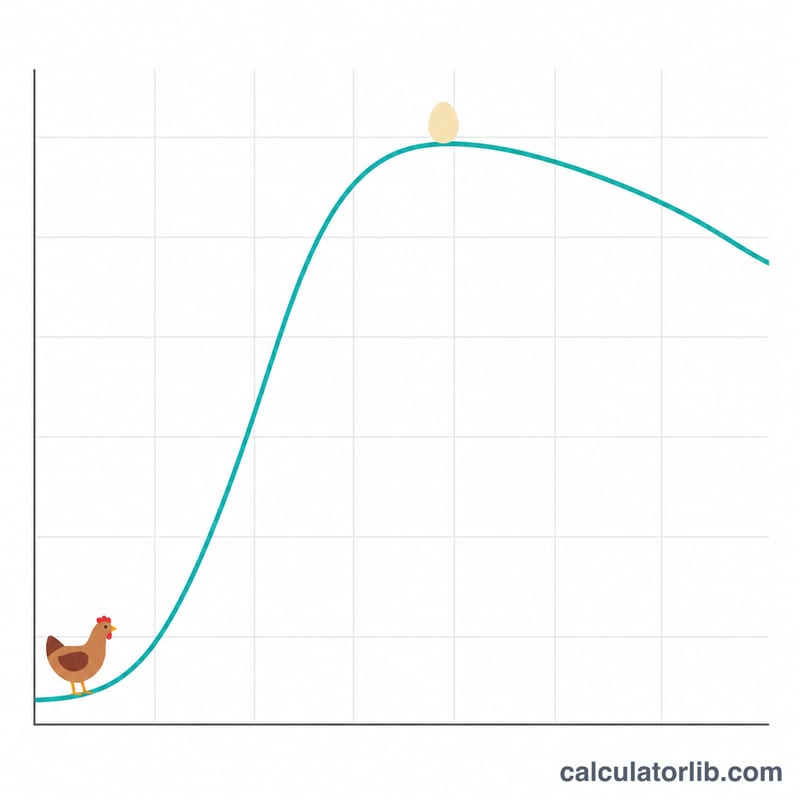
Laying rate is normally given as a hen-day rate: eggs collected divided by the number of hens present each day. It changes in a predictable way over a hen's productive life. The figures below are approximate. They are based on the general production curves in commercial breeder management guides, such as those from Hy-Line and Hendrix Genetics (ISA), and on university extension material on small and backyard flocks. Your actual results will depend on strain, nutrition, housing, climate, lighting and health.
| Production stage | Approx. hen age | Typical hen-day rate (commercial hybrids) | Notes |
|---|---|---|---|
| Point of lay | ~18–22 weeks | Rising quickly from 0% toward 50%+ | The first eggs are often small or irregular, and the rate climbs week by week. |
| Peak lay | ~25–35 weeks | ~90–95% | Well-managed modern hybrids can hold near-peak production for several weeks. |
| Mid-lay | ~40–60 weeks | ~80–90% | A slow, steady decline. Eggs get larger and shells may get thinner. |
| Late lay | 70+ weeks | ~65–75% | Many commercial flocks are replaced or molted at this stage. |
| Molting | Any age (often after the first laying year or in autumn) | Near 0% | Hens replace their feathers and stop laying for several weeks before production resumes. |
Commercial hybrids vs. dual-purpose and heritage breeds
| Hen type | Examples | Approx. eggs per hen per year | Approx. average laying rate |
|---|---|---|---|
| Commercial layer hybrids | ISA Brown, Hy-Line Brown, Hy-Line W-36, Lohmann Brown | About 300+ in the first laying year | About 80–90% averaged over the year, with peaks of 90–95% |
| Dual-purpose and heritage breeds | Rhode Island Red (heritage lines), Plymouth Rock, Sussex, Orpington, Wyandotte | About 150–250 | Roughly 40–70% |
You can convert an annual egg count into an average rate by dividing by 365. For example, \(250 \div 365 \approx 0.68\), which is about 68%, and \(150 \div 365 \approx 0.41\), which is about 41%. Heritage breeds usually start laying later, peak lower, and slow down or stop more sharply in winter than commercial hybrids.
Lighting: Laying is driven by day length. The usual standard for sustained production is 14–16 hours of light per day. Breeder guides recommend increasing light gradually at point of lay and never cutting day length for laying hens. Flocks kept on natural daylight often show a clear drop in laying rate as days get shorter.
Practical Tips for Accurate Measurement and Projection
- Observe for at least 7–14 days. A single hen rarely lays every day, and daily totals can swing a lot. A longer observation period averages out this noise and gives a more reliable rate.
- Count only hens of laying age. Leave out pullets that have not started laying, cockerels and roosters, and hens that are broody or clearly out of lay. If you include them, the calculated rate will understate how your productive hens are actually doing. If you want a whole-flock figure instead, note that it measures something different.
- Collect eggs at consistent times. Collecting at the same time or times each day stops eggs from shifting between days. It also cuts down on eggs lost to breakage, egg-eating or hidden nests.
- Count a double-yolk egg as one egg. The calculator measures eggs laid, not yolks. Count soft-shelled or broken eggs you find as laid eggs too, because they still show what the hens produced.
- Treat long projections as optimistic. The projection assumes the current rate stays constant. In reality, rates drop with age, stop during molting, and fall in shorter winter days. The longer the projection period, the more it is likely to overestimate.
- Build in a decline when planning supply. If you are planning sales or household supply, project with a lower rate than you see today. For an older flock, for example, use the late-lay rate of about 65–75% rather than the current peak figure. For a flock on natural light, allow for the winter dip.
- Recalculate regularly. Rerun the calculation every week or two and compare the results. A sudden drop that you can't explain by age or season can point to stress (predators, heat, overcrowding), nutrition problems (low protein or calcium, water interruptions), parasites or disease. Investigate it promptly.
Example: planning with a realistic rate
Say you have 20 laying hens and collect 196 eggs over 14 days. The hen-day rate is:
$$r = \frac{196}{20 \times 14} = \frac{196}{280} = 0.70 \quad (70\%)$$The projected output for the next 30 days at that rate is:
$$\text{Projected Eggs} = 0.70 \times 20 \times 30 = 420$$The calculator gives 420 eggs. If these hens are older, or the days are getting shorter, plan for somewhat fewer. For example, at 65% the projection is \(0.65 \times 20 \times 30 = 390\) eggs.
This is general information to help with flock record-keeping, not veterinary or professional advice. If production drops sharply or your hens show signs of illness, talk to a poultry veterinarian or your local agricultural extension service.

FAQ
What is a good laying rate? Healthy laying breeds in peak production often reach 80-90%. Rates fall with molting, short winter daylight, age, or poor nutrition.
Can the rate exceed 100%? Normally no, since a hen lays at most one egg per day. A value above 100% usually means a miscount or double-yolk eggs.
Does breed matter? Yes. Prolific production hybrids out-lay most heritage or ornamental breeds.