What this calculator does
Fluid therapy is one of the most common treatments in small-animal practice. A fluid plan has three parts: maintenance (the water a resting animal needs each day), the dehydration deficit (the water already lost), and ongoing losses such as vomiting, diarrhoea or polyuria. This calculator adds the three parts and turns them into an infusion rate in mL/hr and a drip rate in drops per minute. It is a planning aid only. It does not replace clinical judgement or regular reassessment of the patient.

How to use it
Choose the species and enter the body weight in kilograms. Enter the estimated dehydration as a percentage, using skin turgor, mucous membranes and other clinical signs. Then choose how many hours to replace the deficit over (often 12–24 hours). Enter any measured or estimated ongoing losses per day, and pick the drip set used by your giving set.
The formula explained
Maintenance uses the allometric formula from the AAHA fluid therapy guidelines:
$$M = k \times BW^{0.75}$$Here \(k = 132\) for dogs and \(k = 80\) for cats, and \(BW\) is body weight in kg. The deficit in mL is \(BW \times D \times 10\), where \(D\) is the dehydration percentage. The infusion rate is:
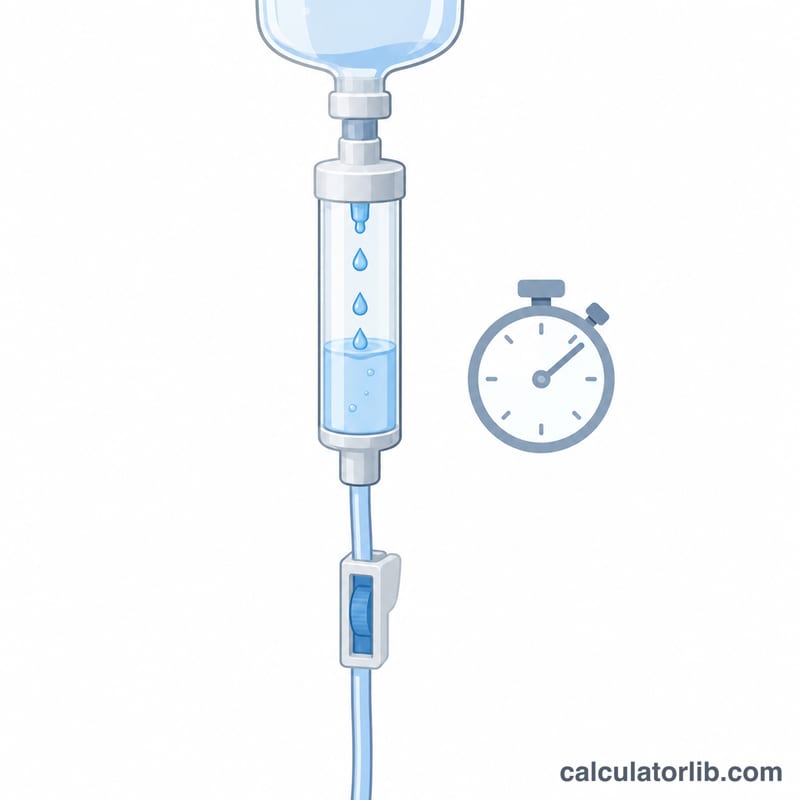
$$R = \frac{M}{24} + \frac{BW \times D \times 10}{h} + \frac{L}{24}$$\(h\) is the number of hours used to replace the deficit, and \(L\) is ongoing losses in mL/day. Drops per minute equal \(R \times f / 60\), where \(f\) is the drip factor.
Worked example
Take a 10 kg dog that is 5% dehydrated, with the deficit replaced over 24 hours and no ongoing losses:
$$M = 132 \times 10^{0.75} = 742.3\,\text{mL/day}$$$$\text{Deficit} = 10 \times 5 \times 10 = 500\,\text{mL}$$$$R = \frac{742.3 + 500}{24} = 51.8\,\text{mL/hr}$$With a 20 drops/mL set, this gives about 17.3 drops per minute.
Estimating Dehydration Percentage from Clinical Signs
The dehydration percentage you enter drives the deficit term \(D = \text{Weight} \times \frac{\text{Dehydration}}{100} \times 1000\). Clinicians usually estimate it from a physical exam. The bands below are the ones most often cited in veterinary textbooks. Each one is an approximate range, not a precise measurement.
| Estimated dehydration | Typical clinical signs |
|---|---|
| <5% | Not detectable on examination. Suspected only from the history, such as vomiting, diarrhoea or reduced intake. |
| 5–6% | Subtle loss of skin elasticity; tacky mucous membranes. |
| 6–8% | Clearly delayed return of the skin tent; slightly prolonged capillary refill time (CRT); eyes possibly slightly sunken; dry mucous membranes. |
| 10–12% | Skin tent stays up; prolonged CRT; sunken eyes; early signs of shock. |
| 12–15% | Hypovolaemic shock, collapse; life-threatening. |
Some important limits apply:
- These are estimates. Two examiners can easily differ by a few percent, so check the patient again during treatment. Use body weight, urine output, mucous membranes and lab values such as PCV/total solids to adjust the plan.
- Skin turgor can mislead. Cats often have looser skin, and skin tent is hard to read in them. Obese animals can look better hydrated than they are because of subcutaneous fat. Emaciated and older animals can look more dehydrated than they are because their skin has lost elasticity.
- Shock is a different problem. An animal showing signs of hypovolaemic shock needs immediate intravenous bolus resuscitation to restore circulating volume, guided by a veterinarian. Do not just put it on a calculated rehydration rate. This calculator is for planning rehydration and maintenance once the patient is stable.
This is general information, not veterinary advice. Fluid plans should be set and monitored by a veterinarian.
Common Drip Factors for Giving Sets
The drip factor (\(f\)) is the number of drops that make up 1 mL for a given administration set. The drip rate is:
$$\text{Drops/min} = \frac{\text{IV Rate (mL/hr)} \times f}{60}$$The worked example is a 10 kg dog that is 5% dehydrated, with the deficit replaced over 24 hours and no ongoing losses. Its rate is about 51.8 mL/hr: maintenance \(132 \times 10^{0.75} \approx 742.3\) mL/day gives \(742.3 / 24 \approx 30.9\) mL/hr. The deficit of \(10 \times 0.05 \times 1000 = 500\) mL over 24 hours adds \(\approx 20.8\) mL/hr. At each standard drip factor, that rate becomes:
| Set type | Drip factor (drops/mL) | Calculation | Drops/min at 51.8 mL/hr |
|---|---|---|---|
| Macro-drip | 10 | \(51.8 \times 10 / 60\) | 8.6 |
| Macro-drip | 15 | \(51.8 \times 15 / 60\) | ≈ 13.0 |
| Macro-drip | 20 | \(51.8 \times 20 / 60\) | ≈ 17.3 |
| Micro-drip (paediatric) | 60 | \(51.8 \times 60 / 60\) | 51.8 |
With a 60 drops/mL micro-drip set, drops per minute equals mL per hour, which makes it easy to check. Cats and small dogs usually need low hourly rates. With a macro-drip set those rates come out to only a few drops per minute, which is hard to count and set accurately. For these patients a micro-drip set, or ideally an infusion or syringe pump, is generally preferred. Drip factors vary by manufacturer, so always read the factor printed on the giving set's packaging before calculating.
FAQ
Why is the deficit replaced over several hours?
Replacing the deficit slowly lets fluid move between body compartments and lowers the risk of overload. Hypovolaemic shock is different. It needs bolus resuscitation first, which this tool does not cover.
Can I use 60 mL/kg/day instead?
Linear rules of thumb work for mid-sized animals. The allometric formula is more accurate for very small and very large patients.
Is this suitable for cats with heart disease?
Cats, and patients with cardiac or renal disease, are prone to fluid overload. Use conservative rates and monitor weight, respiratory rate and lung sounds closely.