What does dry hopping add to bitterness?
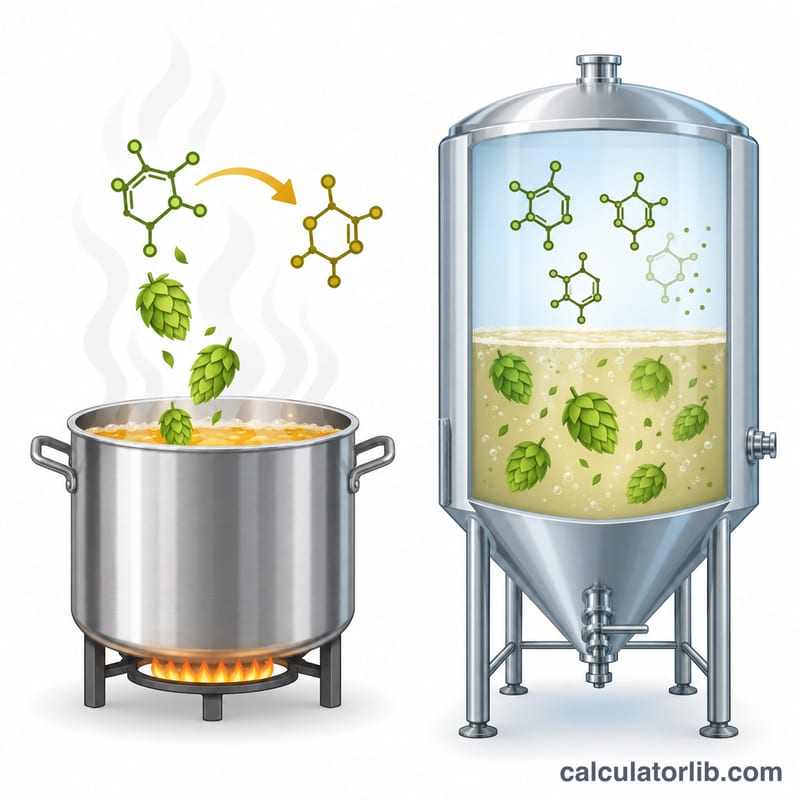
Dry hops go into cold, fermenting or finished beer, so the alpha acids are not isomerized the way they are in the boil. Dry hopping still adds some bitterness, though. Oxidized alpha acids (humulinones) and polyphenols dissolve into the beer, and lab tests show heavily dry hopped beers gaining measurable IBU. This calculator estimates that contribution using a simple, adjustable utilization model. It also reports your dry hop rate, which is the main driver of aroma intensity.
How to use the calculator
Enter the weight of your dry hop charge in grams, the alpha acid percentage from the packet, and the volume of beer being dry hopped in litres. Leave utilization at about 2 to 4% unless you have your own lab data. Add your boil and whirlpool IBU to get an estimated total.
The formula
First, find how much alpha acid you added per litre, then apply the utilization fraction:
$$\text{IBU}_{dry} = \frac{W \times \frac{AA}{100} \times 1000}{V} \times \frac{U}{100}$$Here \(W\) is hop weight in grams, \(AA\) is alpha acid in percent, \(V\) is batch volume in litres and \(U\) is dry hop utilization in percent. The dry hop rate is \(R = W / V\) in g/L. To convert it, 1 lb/bbl is about 3.87 g/L and 1 oz/gal is about 7.49 g/L.
Worked example
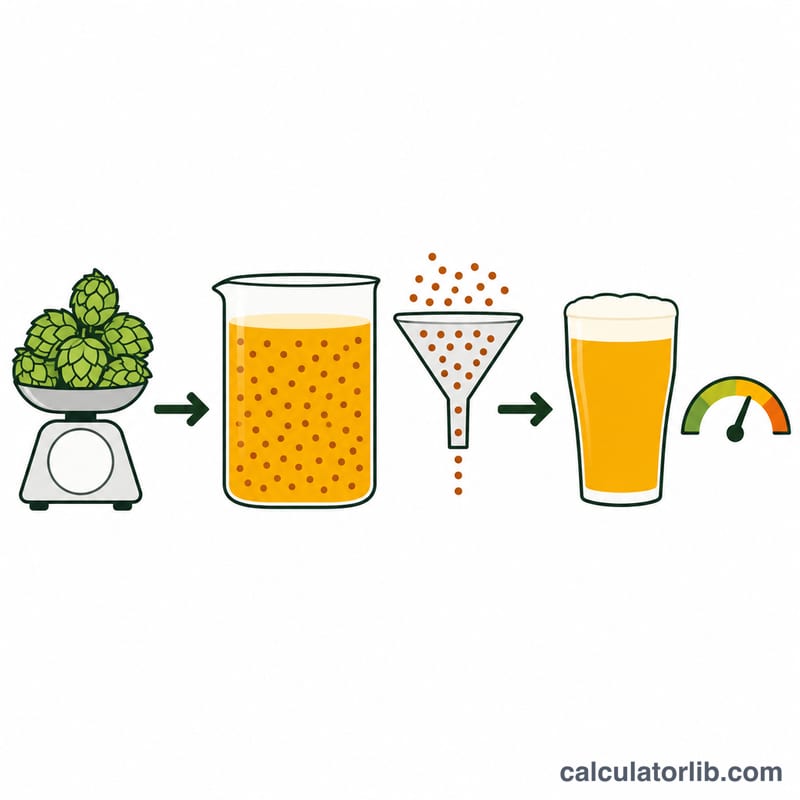
Say you add 100 g of a 12% alpha hop to 20 L of beer, with 3% utilization and 40 IBU from the boil:
$$\frac{100 \times 0.12 \times 1000}{20} = 600\,\text{mg/L}$$$$\text{IBU}_{dry} = 600 \times 0.03 = 18$$That gives an estimated total of \(40 + 18 = 58\) IBU. The dry hop rate is \(100 / 20 = 5\) g/L, which is about 1.29 lb/bbl, a typical rate for a hazy IPA.
Typical Dry Hop Rates by Beer Style
The ranges below are rates often quoted by homebrewers and craft brewers. They are not fixed standards. Recipes vary with hop variety, oil content, contact time and how intense the brewer wants the aroma. Use them as a starting point and adjust to taste. The table converts between units with 1 lb/bbl ≈ 3.87 g/L (US beer barrel) and 1 oz/US gal ≈ 7.49 g/L.
| Style / purpose | g/L | lb/bbl (US) | oz/gal (US) |
|---|---|---|---|
| Light aroma touch (pale ale, lager) | 0.5–2 | 0.13–0.52 | 0.07–0.27 |
| American pale ale | 2–4 | 0.52–1.03 | 0.27–0.53 |
| American IPA | 4–8 | 1.03–2.07 | 0.53–1.07 |
| NEIPA / hazy IPA and DIPA | 8–16+ | 2.07–4.13+ | 1.07–2.14+ |
To convert yourself, divide g/L by 3.87 to get lb/bbl, or by 7.49 to get oz/gal. For example, 4 g/L ÷ 3.87 ≈ 1.03 lb/bbl.
Dry hop utilization
Hops added after the boil are not boiled, so their alpha acids barely isomerize. Published estimates of dry hop utilization usually fall between about 1% and 5%. Some of the measured bitterness comes from compounds such as humulinones rather than iso-alpha acids. A value of 2–4% is a sensible default. Use the low end for short, cold contact times or low-alpha aroma hops. Use the high end for long, warm contact times or heavy charges in beers with little boil bitterness.
Dry Hop IBU Across Common Scenarios
Every scenario below uses a 20 L batch and the calculator's formula with the boil/whirlpool IBU set to zero. The IBU figures therefore show only what the dry hop adds:
$$\text{Dry hop IBU} = \frac{W \times \frac{\alpha}{100} \times 1000}{V} \times \frac{U}{100}$$For example, the IPA charge of 80 g at 10% AA works out as follows. Alpha acids = 80 × 0.10 × 1000 ÷ 20 = 400 ppm. At 4% utilization, 400 × 0.04 = 16 IBU.
| Scenario (20 L) | Hops | g/L | lb/bbl | Alpha acids (ppm) | IBU at 2% | IBU at 4% |
|---|---|---|---|---|---|---|
| Light pale ale charge | 30 g at 6% AA | 1.5 | 0.39 | 90 | 1.8 | 3.6 |
| Standard pale ale | 60 g at 7% AA | 3.0 | 0.78 | 210 | 4.2 | 8.4 |
| American IPA | 80 g at 10% AA | 4.0 | 1.03 | 400 | 8.0 | 16.0 |
| Hazy IPA / NEIPA | 200 g at 12% AA | 10.0 | 2.58 | 1,200 | 24.0 | 48.0 |
| High-alpha DIPA | 300 g at 15% AA | 15.0 | 3.88 | 2,250 | 45.0 | 90.0 |
Doubling the utilization assumption doubles the estimate. On heavy charges, that one assumption can shift the result by 20–45 IBU. Treat these figures as rough ranges, not precise predictions.
Note: the formula simply adds dry hop IBU to the base IBU. Real beers do not always behave that way. In beers that already carry high boil bitterness, measured IBU often levels off as the dry hop rate rises, and can even fall. One cause is that hop material absorbs some of the iso-alpha acids already in the beer. The added bitterness is largest in beers with little boil bitterness. For high-IBU IPAs and DIPAs, the calculated total is likely an upper bound.
FAQ
Why is utilization so low?
Without boiling, very little of the alpha acid turns into bitter compounds that stay dissolved in the beer. Published measurements usually fall at a few percent.
Can dry hopping lower IBU?
Yes. In beers with high boil IBU, dry hops can absorb some iso-alpha acids, so the measured IBU may fall even as perceived bitterness changes. Treat this result as an estimate.
Does contact time matter?
Most extraction happens within the first 24 to 72 hours. Longer contact mainly adds grassy flavours rather than more bitterness.