What this calculator does
Scope: United States only. This calculator uses the Federal Motor Carrier Safety Administration (FMCSA) Hours of Service rules for property-carrying commercial drivers (49 CFR Part 395), as in force since the 2020 update. It does not cover passenger carriers, the adverse driving conditions extension, the short-haul exemption, the sleeper-berth split, or state intrastate rules. Your ELD log is the record that counts. Use this tool for planning only.
How to use it
Choose your carrier cycle: 60 hours in 7 days or 70 hours in 8 days. Then enter the hours you have driven since your last 10 consecutive hours off duty, the hours elapsed since your duty day started, the hours driven since your last 30-minute break, and the on-duty hours already logged in your 7- or 8-day cycle. The result shows how long you can still drive legally and which rule limits you first.
The formula
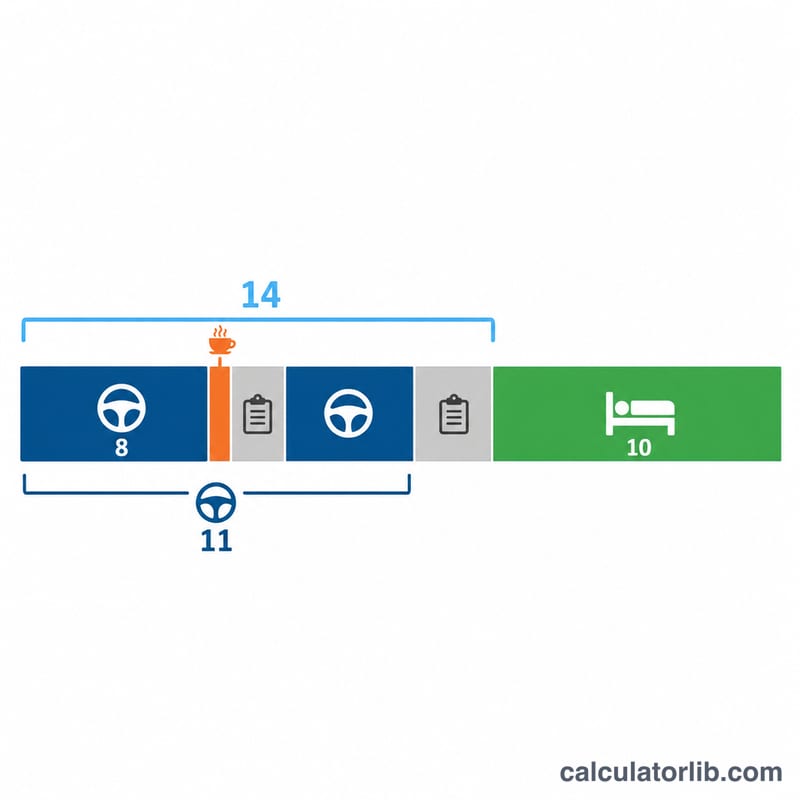
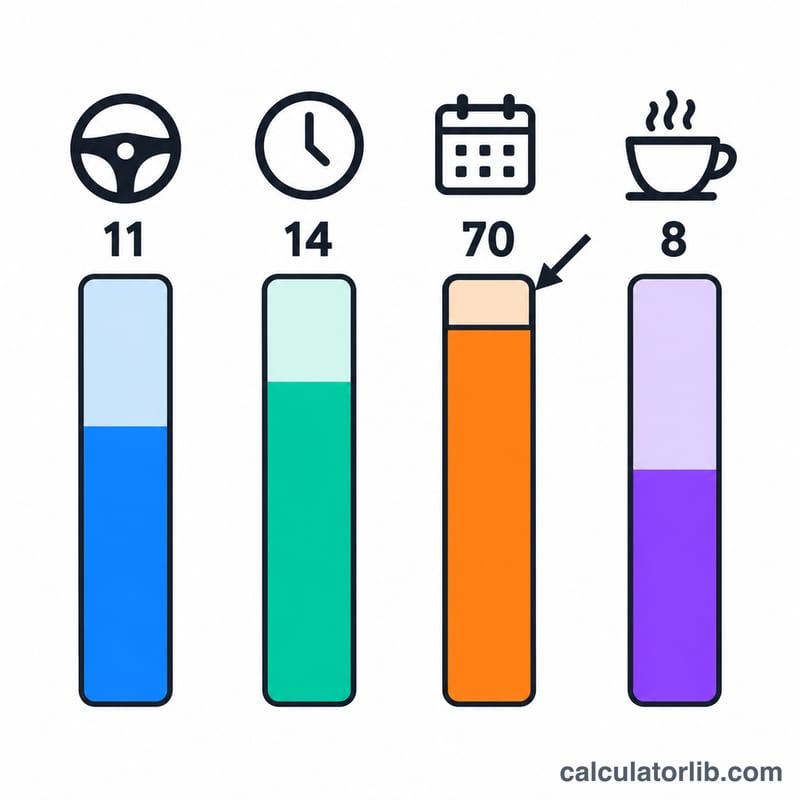
Three limits apply at the same time, and the tightest one wins:
$$D_{\text{avail}} = \min\left(11 - D,\; 14 - W,\; C - U\right)$$Here \(D\) is driving hours since the 10-hour break, \(W\) is elapsed time in the 14-hour window (including breaks and off-duty time), \(C\) is the cycle limit (60 or 70), and \(U\) is on-duty hours used in the cycle. A separate check works out how much driving is left before the required 30-minute break: \(B = 8 - D_b\), where \(D_b\) is driving time since your last break.
Worked example
A driver on the 70/8 cycle has driven 6.5 hours, started the duty day 9 hours ago, has driven 5 hours since a break, and has logged 52 on-duty hours this cycle:
$$D_{\text{avail}} = \min(11 - 6.5,\; 14 - 9,\; 70 - 52) = \min(4.5,\; 5,\; 18) = 4.5\,\text{h}$$The 11-hour limit applies first. The break check gives \(8 - 5 = 3\) hours, so the driver must take a 30-minute break within the next 3 hours of driving.
FMCSA Hours of Service Limits at a Glance (Property Carriers)
These limits are US federal rules from the Federal Motor Carrier Safety Administration (FMCSA), set out in 49 CFR Part 395. They apply to drivers of property-carrying commercial motor vehicles in interstate commerce. Passenger carriers have different limits, and so may intrastate rules set by individual US states. Other countries have their own driving-time regulations. The figures below are the ones in force since the 2020 FMCSA rule took effect.
| Rule | Limit | What counts | 49 CFR reference |
|---|---|---|---|
| Driving limit | 11 hours | Driving time only. You may drive up to 11 hours after 10 consecutive hours off duty. | §395.3(a)(3) |
| On-duty window | 14 hours | Clock time that starts when you first come on duty after 10 hours off. Breaks, meals and other off-duty time do not pause it. You may not drive after the 14th hour, but you may still do non-driving work. | §395.3(a)(2) |
| 30-minute break | Required after 8 cumulative hours of driving | Any 30 consecutive minutes not driving: on duty (not driving), off duty or sleeper berth. Only driving time counts toward the 8 hours. | §395.3(a)(3)(ii) |
| Off-duty reset | 10 consecutive hours off duty | Off-duty or sleeper-berth time (or a combination) before a new duty day. Resets the 11-hour and 14-hour limits. | §395.3(a)(1) |
| Weekly cycle | 60 hours in 7 days, or 70 hours in 8 days | All on-duty time, both driving and not driving, over a rolling 7 or 8 consecutive days. The 60/7 limit is for carriers that do not operate every day of the week. The 70/8 limit is for carriers that do. | §395.3(b) |
| Cycle restart (optional) | 34 or more consecutive hours off duty | Sets the 60- or 70-hour cycle back to zero. | §395.3(c) |
The calculator combines the first three limits and the cycle limit as \(\text{Drive}_{\text{avail}} = \min(11 - D,\; 14 - W,\; C - U)\). Here D is hours driven today, W is hours elapsed in the 14-hour window, C is 60 or 70, and U is cycle hours used. It also shows separately how much driving is left before the 30-minute break is due (\(8 - D_b\)).
Scope note: The calculator's existing scope exclusions still apply. It does not model the adverse driving conditions exception, the short-haul exception or the sleeper-berth split options, all of which change these limits. Always check your ELD or logbook and the current regulation text. This is general information, not legal or compliance advice.
Which Limit Applies First: Scenario Comparison
Each row puts realistic values into \(\text{Drive}_{\text{avail}} = \min(11 - D,\; 14 - W,\; C - U)\). D is hours driven today, W is hours elapsed in the 14-hour window, C is the cycle limit (60 or 70), U is cycle hours used, and \(D_b\) is hours driven since the last qualifying 30-minute break. All values are in hours.
| Scenario | Inputs | 11 − D | 14 − W | C − U | Davail = min(...) | Limiting rule | Driving before 30-min break is due (8 − Db) |
|---|---|---|---|---|---|---|---|
| 1. Long stops early in the day (detention at the shipper) | D = 5, W = 10, C = 70, U = 40, Db = 3 | 11 − 5 = 6 | 14 − 10 = 4 | 70 − 40 = 30 | min(6, 4, 30) = 4 | 14-hour window | 8 − 3 = 5 |
| 2. Near the end of the weekly cycle (70/8) | D = 3, W = 4, C = 70, U = 66, Db = 3 | 11 − 3 = 8 | 14 − 4 = 10 | 70 − 66 = 4 | min(8, 10, 4) = 4 | 70-hour / 8-day cycle | 8 − 3 = 5 |
| 3. Carrier on the 60/7 cycle | D = 6, W = 7, C = 60, U = 40, Db = 1 | 11 − 6 = 5 | 14 − 7 = 7 | 60 − 40 = 20 | min(5, 7, 20) = 5 | 11-hour driving limit | 8 − 1 = 7 |
| 4. Fresh day, long run ahead | D = 1, W = 1.5, C = 70, U = 20, Db = 1 | 11 − 1 = 10 | 14 − 1.5 = 12.5 | 70 − 20 = 50 | min(10, 12.5, 50) = 10 | 11-hour limit (30-min break due first, after 7 h) | 8 − 1 = 7 |
Reading the rows:
- Scenario 1: Only 5 hours have been driven, but long waits used up 10 hours of the 14-hour window, and off-duty time does not pause it. The window allows only 4 more hours of driving, less than the 6 the 11-hour rule would allow.
- Scenario 2: The day has barely started, but 66 of the 70 cycle hours are used. Only 4 hours of on-duty time are left, and that covers all on-duty work, not just driving. Any fueling or inspection time reduces it further. A 34-hour restart would reset the cycle.
- Scenario 3: On the 60/7 cycle there are still 20 hours of cycle time left. The 11-hour rule is the tightest limit at 5 hours. The break is not an issue because 7 hours of driving are allowed before it is due.
- Scenario 4: Up to 10 hours of driving are available, but a 30-minute non-driving period must come after 7 more hours of driving, at 8 cumulative hours. The break still uses window time: 7 h driving + 0.5 h break + 3 h driving = 10.5 h, which fits within the 12.5 hours left in the window.
These scenarios are illustrations. They do not cover the adverse-conditions exception, the short-haul exception or the sleeper-berth split provisions. This is general information, not compliance advice.
FAQ
Does the 14-hour window pause for breaks? No. Lunch, fuel stops and the 30-minute break all count against the 14-hour window. Only a qualifying sleeper-berth split can exclude time from it.
Can I work after the 14-hour window closes? Yes, you can do on-duty work that is not driving. You cannot drive again until you take 10 consecutive hours off duty.
How do I reset my 60/70 hours? Take a 34-hour restart, meaning 34 or more consecutive hours off duty. Without a restart, hours roll off as old days drop out of your 7- or 8-day lookback.