What is the Pediatric Glasgow Coma Scale?
The Pediatric Glasgow Coma Scale (pGCS) is an adaptation of the adult Glasgow Coma Scale designed for infants and young children who cannot yet follow commands or speak in full sentences. Clinicians use it to objectively describe a child's level of consciousness after head trauma, illness, or during critical-care monitoring. Three responses are graded separately and then added together into a single score that supports triage, communication between caregivers, and trend tracking over time.
How the formula works
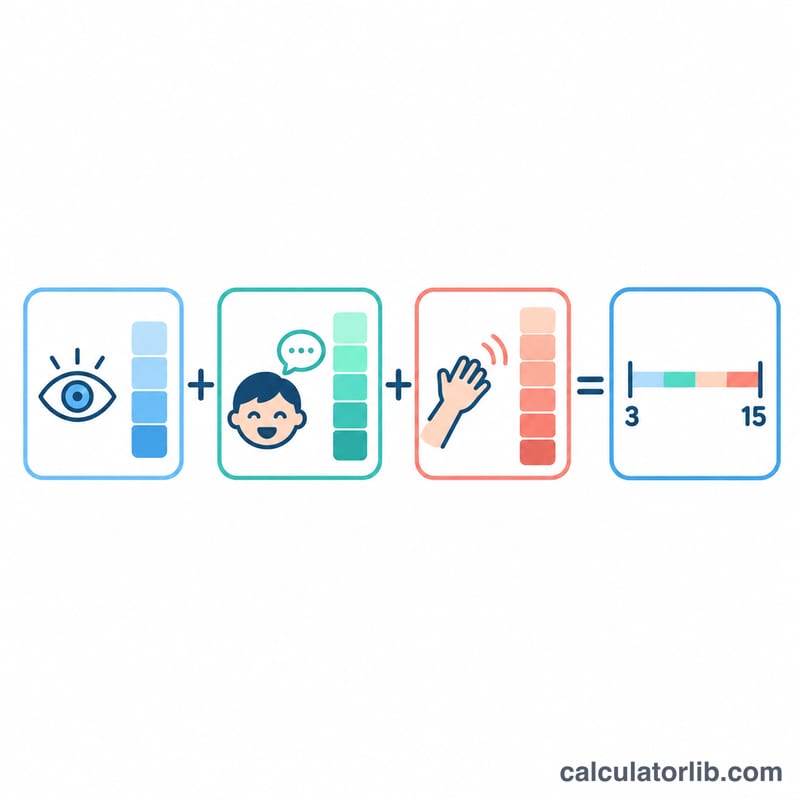
The total score is simply the sum of the three best observed responses:
$$\text{pGCS} = \text{E} + \text{V} + \text{M}$$where \(\text{E}\) = eye-opening response (1-4), \(\text{V}\) = age-adjusted verbal response (1-5), and \(\text{M}\) = age-adjusted motor response (1-6). The lowest possible total is \(1+1+1 = 3\) and the highest is \(4+5+6 = 15\). A child who is fully awake and interacting scores 15.
How to use this calculator
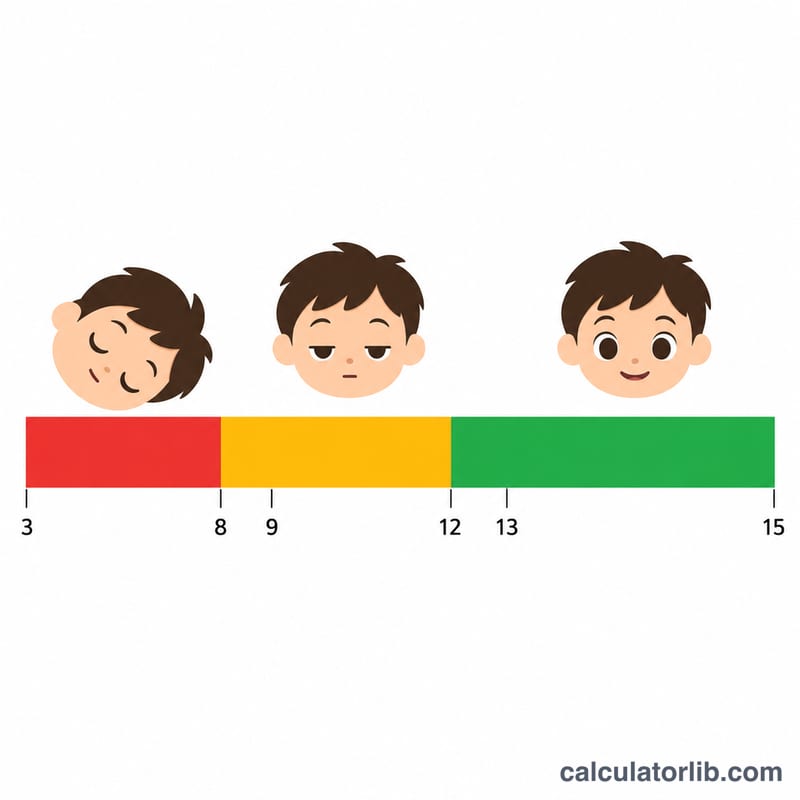
Select the single best response you observe in each of the three categories, using the descriptions tuned for preverbal and young children. The calculator adds the three values and grades severity: \(13\text{-}15\) is mild, \(9\text{-}12\) is moderate, and \(3\text{-}8\) is severe head injury. Record the component scores (for example E3 V4 M5) alongside the total, because the breakdown carries more clinical meaning than the sum alone.
Worked example
Suppose an infant opens the eyes only to pressure (E = 2), moans to pain (V = 2), and withdraws to pain (M = 4). The total is:
$$\text{pGCS} = 2 + 2 + 4 = 8$$A score of \(8\) falls in the \(3\text{-}8\) band, indicating a severe head injury that typically warrants airway protection and urgent evaluation.
Pediatric GCS Scoring Criteria (Eye, Verbal, Motor)
The pediatric Glasgow Coma Scale (pGCS) adds three component scores: Eye (1–4), Verbal (1–5) and Motor (1–6). Totals range from 3 to 15:
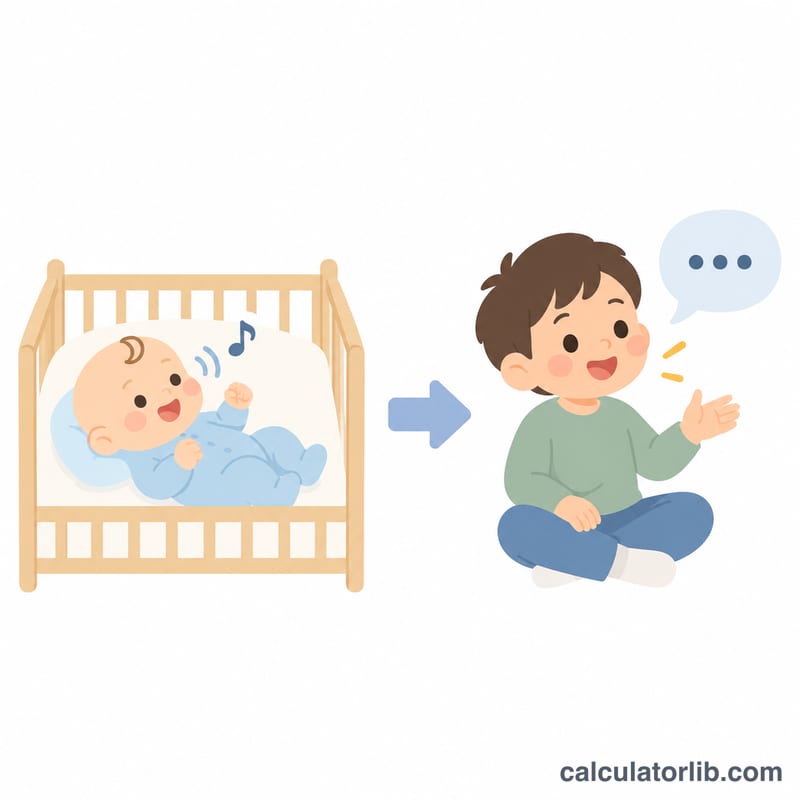
$$\text{pGCS} = E + V + M$$The verbal and motor descriptors change with age. Preverbal infants are scored on cooing, crying and spontaneous movement. Older children who can talk and follow commands are scored much like adults.
Eye Opening (E)
| Points | Response (all ages) |
|---|---|
| 4 | Opens eyes spontaneously |
| 3 | Opens eyes to sound / voice |
| 2 | Opens eyes to pain / pressure |
| 1 | No eye opening |
Verbal Response (V)
| Points | Preverbal infant | Verbal child |
|---|---|---|
| 5 | Coos and babbles | Oriented, appropriate words |
| 4 | Irritable crying that can be consoled | Confused |
| 3 | Cries to pain | Inappropriate words or persistent crying |
| 2 | Moans to pain | Incomprehensible sounds |
| 1 | No verbal response | No verbal response |
Motor Response (M)
| Points | Infant | Older child |
|---|---|---|
| 6 | Moves spontaneously and purposefully | Obeys commands |
| 5 | Withdraws to touch | Localizes pain |
| 4 | Withdraws to pain | Withdraws to pain |
| 3 | Abnormal flexion to pain (decorticate posturing) | Abnormal flexion to pain (decorticate posturing) |
| 2 | Extension to pain (decerebrate posturing) | Extension to pain (decerebrate posturing) |
| 1 | No motor response | No motor response |
Notes: Each component records the child's best response. For example, if one side of the body localizes pain and the other only withdraws, the motor score is 5. Published versions of the pediatric scale differ slightly in wording and in the age cut-off between the infant and verbal-child columns. Use the version adopted by your institution or training program.
For example, a child who opens their eyes only to pain (E2), moans to pain (V2) and withdraws from pain (M4) scores \(2 + 2 + 4 =\) 8. This is usually written as E2V2M4 = 8.
Interpreting a pGCS Score
- It is a snapshot. A pGCS describes a child's level of consciousness at one moment. It is most useful when repeated and tracked over time. A drop of 2 or more points is generally treated as clinically significant deterioration and calls for prompt reassessment.
- Severity bands. In head injury, totals are commonly grouped as mild (13–15), moderate (9–12) and severe (8 or less). Exact cut-offs vary slightly between guidelines.
- Score of 8 or less. A total of 8 or below is commonly linked to concern that the child may not be able to protect their own airway.
- Motor carries the most weight. Of the three components, the motor score is the strongest single predictor of outcome. It is also the component that can still be assessed when eye or verbal responses cannot.
- Report the components, not just the total. The same total can come from very different patterns. E4V1M3 and E1V3M4 both total 8, but they describe different clinical pictures. Recording E, V and M separately (for example, E3V4M5) makes changes easier to understand.
Factors that can lower or invalidate a score
- Sedative drugs or neuromuscular blocking agents (paralytics)
- Intubation or a tracheostomy, which prevents speech. The verbal component is often recorded as "T" rather than a number, for example E3VTM5.
- Severe swelling around the eyes, which prevents eye opening
- Hypoglycemia, hypothermia or other metabolic problems
- Seizures or the post-ictal state that follows them
- Developmental delay, hearing loss, or language barriers. Compare the score with the child's usual baseline where possible.
This is general information for education, not medical advice. A pGCS score supports clinical assessment but does not replace it. Decisions about a child's care should be made by qualified clinicians examining the child. If you are worried about a child after a head injury, seek emergency medical care.
Frequently asked questions
Is the pGCS a substitute for clinical judgment? No. It is a structured bedside tool that supports, but never replaces, examination and imaging decisions by a qualified clinician.
Why are the verbal and motor scales different from the adult version? Young children cannot be assessed for oriented speech or command-following, so those tiers are replaced with age-appropriate behaviors such as cooing, irritable crying, and spontaneous movement.
What if a component cannot be tested? Note which component is untestable (for example a child who is intubated) rather than guessing, because an incomplete total can be misleading.