What is the MAC Anesthesia Calculator?
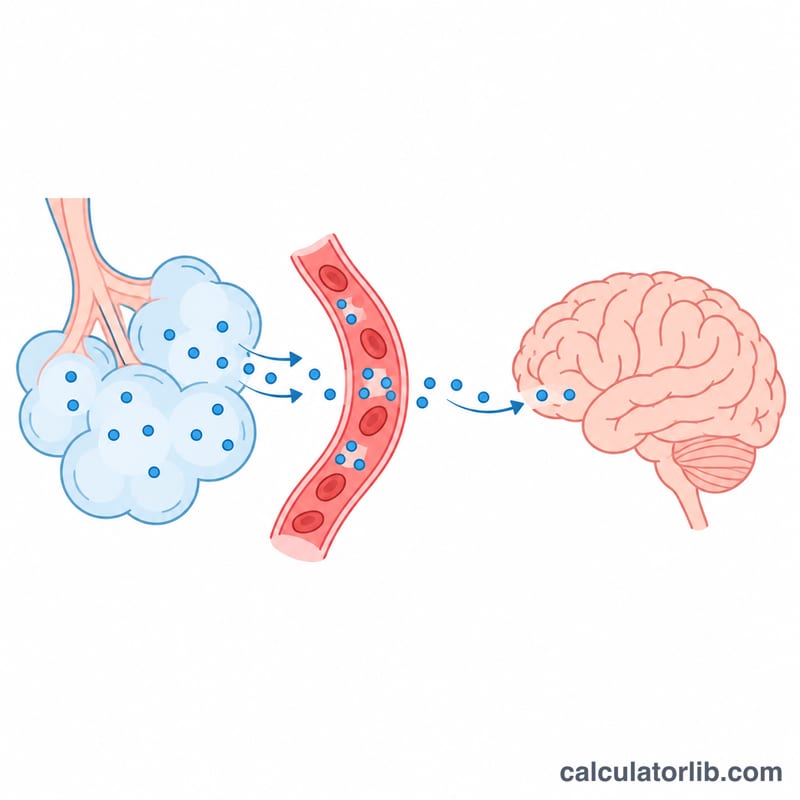
The minimum alveolar concentration (MAC) is the steady-state concentration of an inhaled anesthetic, at one atmosphere, that prevents movement in 50% of patients in response to a surgical incision. Because anesthetic requirement falls steadily with age, this calculator converts the published reference MAC measured at age 40 into an age-adjusted value for your individual patient.
How to use it
Select the inhaled agent and enter the patient age in years. The tool returns the concentration, in volumes percent, that represents 1.0 age-adjusted MAC. Multiply that result by your target depth (for example 1.2 to 1.3 MAC) to set the vaporizer, remembering that nitrous oxide and opioids reduce the volatile requirement further.
The formula explained
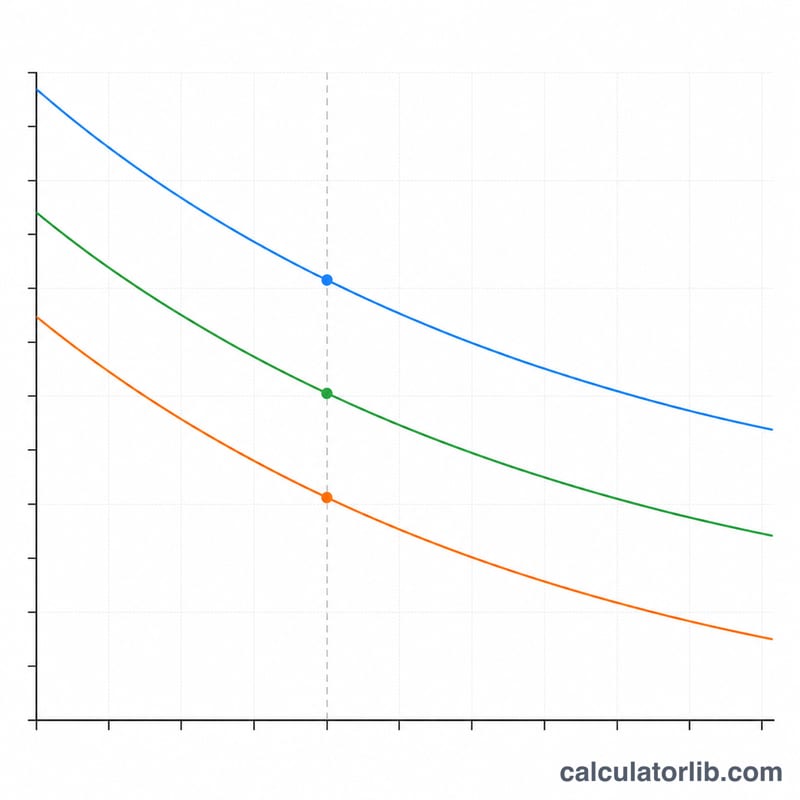
The calculator uses the Mapleson age-correction, in which MAC declines by about 6% per decade:
$$\text{MAC}_{\text{age}} = \text{MAC}_{40} \times 10^{-0.00269(\text{age} - 40)}$$Here \(\text{MAC}_{40}\) is the agent reference value at age 40 (sevoflurane \(1.80\%\), isoflurane \(1.17\%\), desflurane \(6.60\%\), enflurane \(1.63\%\), halothane \(0.75\%\)) and \(\text{age}\) is the patient age in years.
Worked example
For sevoflurane in an 80-year-old patient:
$$\text{MAC}_{\text{age}} = 1.80 \times 10^{-0.00269(80 - 40)} = 1.80 \times 10^{-0.1076} = 1.40\%$$So about \(1.40\%\) end-tidal sevoflurane delivers one age-adjusted MAC, noticeably less than the \(1.80\%\) needed by a 40-year-old.
Age-Adjusted MAC by Age and Agent
The table applies the Mapleson age-correction formula to three common volatile anesthetics, using reference MAC values at age 40 of 1.80% for sevoflurane, 1.17% for isoflurane and 6.60% for desflurane:
$$\text{MAC}_{\text{age}} = \text{MAC}_{40} \times 10^{-0.00269 \times (\text{age} - 40)}$$MAC falls by about 6% for each decade after age 40 and rises by a similar amount for each decade before it. Take sevoflurane at age 80 as an example: \(1.80 \times 10^{-0.00269 \times 40} = 1.80 \times 10^{-0.1076} \approx 1.80 \times 0.781 \approx 1.40\%\).
| Age (years) | Age factor | Sevoflurane (%) | Isoflurane (%) | Desflurane (%) |
|---|---|---|---|---|
| 20 | 1.132 | 2.04 | 1.32 | 7.47 |
| 30 | 1.064 | 1.92 | 1.24 | 7.02 |
| 40 | 1.000 | 1.80 | 1.17 | 6.60 |
| 50 | 0.940 | 1.69 | 1.10 | 6.20 |
| 60 | 0.883 | 1.59 | 1.03 | 5.83 |
| 70 | 0.830 | 1.49 | 0.97 | 5.48 |
| 80 | 0.781 | 1.40 | 0.91 | 5.15 |
| 90 | 0.734 | 1.32 | 0.86 | 4.84 |
Values are rounded to 2 decimal places. The table covers adults only. Mapleson's equation was fitted to data from age 1 year upward; it does not apply to infants under 1 year, whose MAC is considerably higher. The values assume a pressure of 1 atm, normal body temperature, and no nitrous oxide (N₂O), opioids or other drugs that reduce anesthetic requirement. MAC is expressed as an end-tidal concentration in volume percent.
Interpreting Your Result
What 1.0 MAC means. 1.0 MAC is the end-tidal (alveolar) concentration of an inhaled anesthetic that stops 50% of patients from moving in response to surgical skin incision. Because it is a median value, about half of patients would still move at exactly 1.0 MAC. Roughly 1.2–1.3 MAC is needed to prevent movement in about 95% of patients.
Other MAC thresholds.
- MAC-awake is the concentration at which patients stop responding to a verbal command. It is about 0.3–0.5 MAC, well below the level needed to prevent movement.
- MAC-BAR (blockade of adrenergic response) is the concentration that blunts the heart-rate and blood-pressure response to a surgical stimulus. It is about 1.5–2.0 MAC.
Additivity. MAC fractions from different inhaled agents roughly add together. Nitrous oxide has a MAC of about 104%, so it cannot produce 1.0 MAC by itself at normal atmospheric pressure. For example, 60% N₂O gives about \(60 / 104 \approx 0.58\) MAC, so only about 0.42 MAC more of a volatile agent is needed to reach a combined 1.0 MAC.
Factors that lower MAC (less anesthetic needed):
- increasing age (the effect this calculator models)
- hypothermia
- opioids and other sedatives
- pregnancy
- acute alcohol intoxication
Factors that raise MAC (more anesthetic needed):
- hyperthermia
- chronic alcohol use
- infancy (MAC peaks in the first months of life)
Important note. This calculator is for education only and is not medical advice. Age-adjusted MAC is a population estimate. Individual patients differ, and many factors affect anesthetic depth at the same time. In clinical practice, anesthetic delivery is titrated by qualified clinicians to monitored end-tidal concentrations and the patient's response, and should not be based on a calculated value alone.
FAQ
Does MAC increase in children? Yes. MAC is highest in infancy and then declines with age. Mapleson's equation is valid from age 1 year, so the calculator gives no value for younger patients: measured sevoflurane MAC is about 3.3% in neonates and 3.2% at 1–6 months, falling to about 2.5% from 6 months to 12 years (Lerman et al., 1994).
What about body temperature? MAC falls roughly 2 to 5% for each degree Celsius of hypothermia, which this calculator does not model.
Does it replace clinical judgment? No. Always titrate to measured end-tidal concentrations and to the individual patient and procedure.