
What is the Baluster Calculator?
Balusters (also called spindles) are the vertical posts that fill the space between a railing's top rail and bottom rail or floor. This calculator works out how many balusters you need for a given run of railing and the even gap that should sit between each one. It applies to deck rails, stair rails, porch rails and balcony guards.
How to use it
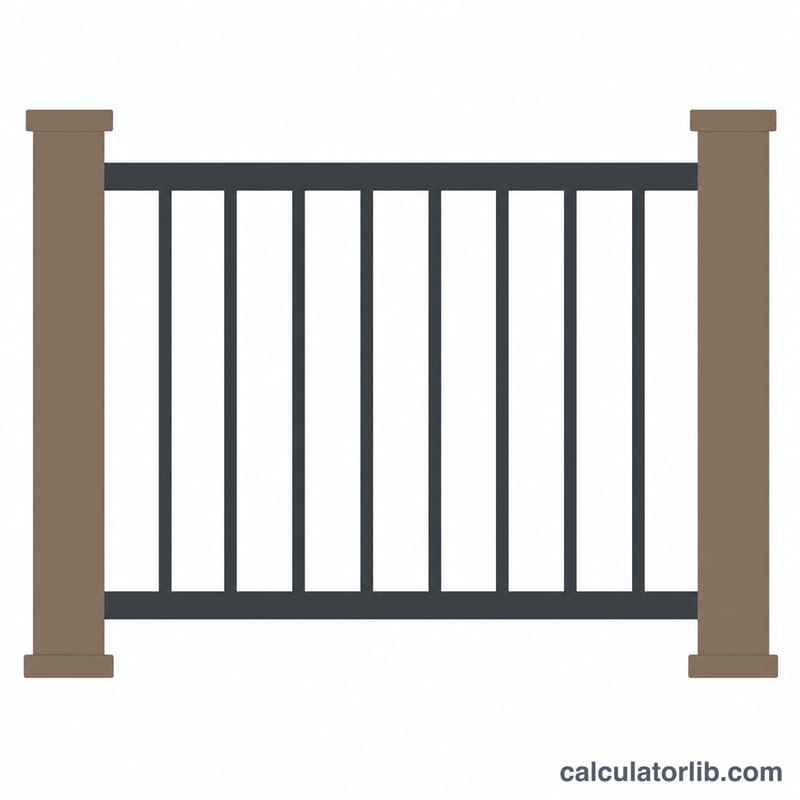
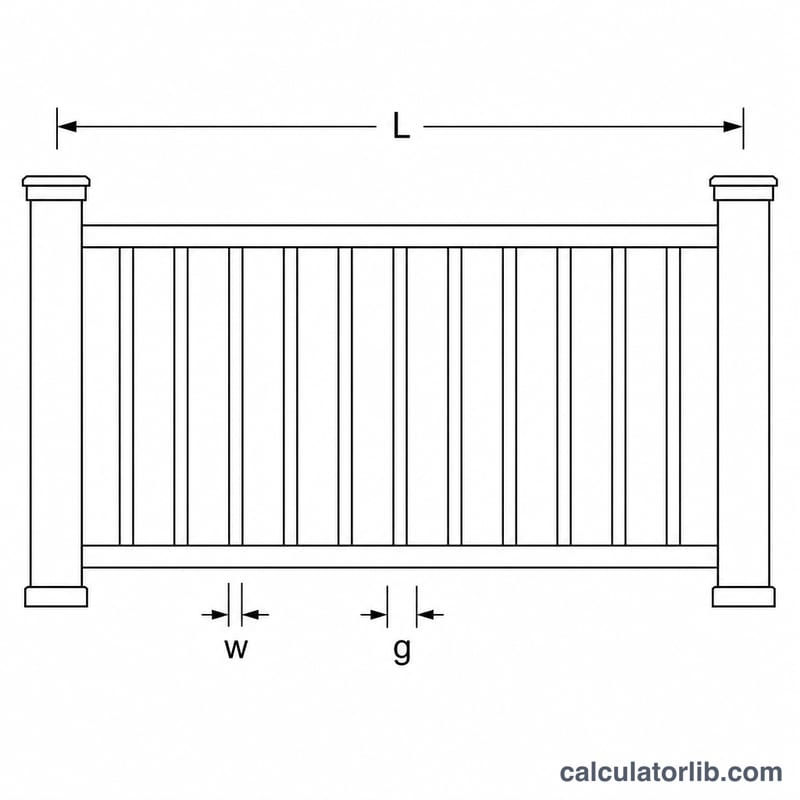
Enter three measurements in inches: the total railing length (the clear span you are filling), the baluster width (the thickness of one spindle), and the maximum gap you want between balusters. Many building codes limit the gap so a 4-inch sphere cannot pass through, so 4 inches is a common safe maximum. The calculator returns the baluster count plus the actual gap once the spindles are spaced evenly.
The formula explained
The number of balusters is $$N = \left\lfloor \frac{L - w}{w + g} \right\rfloor + 1$$ The term \(w + g\) is the repeating "pitch" of one baluster plus one gap. We subtract one baluster width from the length, divide by the pitch to count how many full gaps fit, round down, then add one because a run always ends with a baluster. The actual gap is then recomputed as $$\frac{L - N \cdot w}{N - 1}$$ so the spindles are distributed evenly.
Worked example
For a 96-inch railing with 1.5-inch balusters and a 4-inch maximum gap: pitch = \(1.5 + 4 = 5.5\). Then $$\left\lfloor \frac{96 - 1.5}{5.5} \right\rfloor + 1 = \lfloor 17.18 \rfloor + 1 = 17 + 1 = 18 \text{ balusters}$$ The actual even gap becomes $$\frac{96 - 18 \times 1.5}{18 - 1} = \frac{96 - 27}{17} \approx 4.06 \text{ in}$$ close to the target with even distribution.
Standard Baluster Sizes & Code Gap Limits
Balusters (also called spindles or pickets) come in several common widths. The width you choose directly affects how many you need and the spacing between them.
| Nominal width (in) | Typical use |
|---|---|
| 0.75 | Slim metal or iron balusters |
| 1.0 | Standard round metal balusters |
| 1.25 | Square iron / aluminum balusters |
| 1.5 | Square wood spindles (common deck/stair size) |
| 2.0 | Larger turned wood balusters |
The 4-Inch Sphere Rule
Under the International Residential Code (IRC), guard and baluster openings are limited so that a sphere of a given diameter cannot pass through:
- Guards (IRC R312.1.3): Required guards on open sides must not have openings that allow passage of a 4-inch (102 mm) diameter sphere.
- Stairs: On the open side of stairs, the triangular opening formed by the riser, tread, and bottom rail may allow passage of a 6-inch sphere, while balusters elsewhere on the stair guard follow a 4 3/8-inch (4.375 in) sphere limit.
Always confirm the limit with your local building department, as some jurisdictions adopt stricter values or amendments. When in doubt, design to the conservative 4-inch maximum, which satisfies the most common residential guard requirement.
Practical Tips for Ordering and Installing
- Round up and buy extras. The calculator gives the minimum count to satisfy the gap limit. Order a few additional balusters (about 5–10%) to cover miscuts, splits, and damaged pieces — especially with wood, where defects are common.
- Verify the gap against local code. The default 4-inch max gap reflects the IRC guard rule, but some inspectors require a tighter limit. If your code or HOA is strict, lower the max gap value (e.g., to 3.5 in) and recalculate — this adds balusters and reduces each opening.
- Use a spacer block for even installation. Cut a scrap block to the exact computed even gap and use it between each baluster as you fasten them. This guarantees uniform spacing without measuring every joint, and the eye notices uneven gaps far more than a slightly snug fit.
- Measure the clear span between end posts. Enter the actual open distance between the newel or end posts as the railing length — not the full rail length — so the count and spacing are correct for the section that actually holds balusters. Calculate each rail section separately if your railing turns corners or changes length.
- Check the end gaps too. The formula spaces balusters evenly across the span, leaving an equal gap at each end against the posts. Confirm those end openings also meet the sphere rule; if they are wider than allowed, add one more baluster or nudge the layout.
This is general guidance for planning purposes. Building codes vary by location — confirm requirements with your local building authority and follow manufacturer installation instructions before purchasing materials.
FAQ
Why is the actual gap sometimes larger than the maximum I entered? Rounding the count down can leave slightly more space; tighten the gap input or add one baluster if your code is strict.
Should I measure between posts? Yes — use the clear span between newel posts, not the full deck length.
Does this include the end balusters? Yes, the "+1" accounts for the closing baluster at the end of the run.