
What is the Cement Calculator?
The Cement Calculator estimates how many bags of cement you need for a concrete project. By combining the volume of your slab, footing or pour with the cement mix ratio and the size of a single bag, it gives a quick, practical bag count so you can order the right amount of material.
How to use it
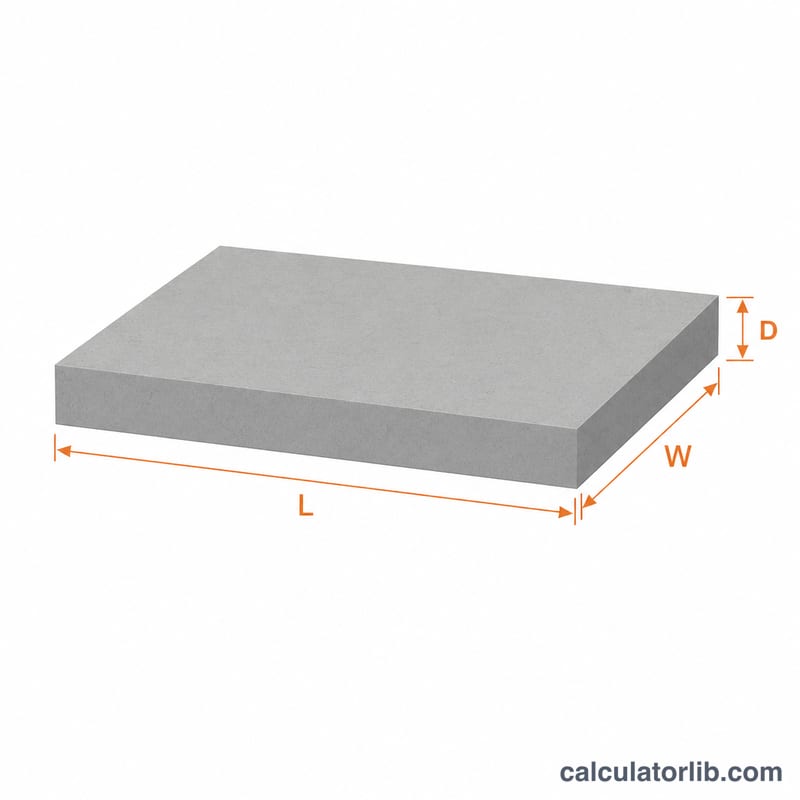
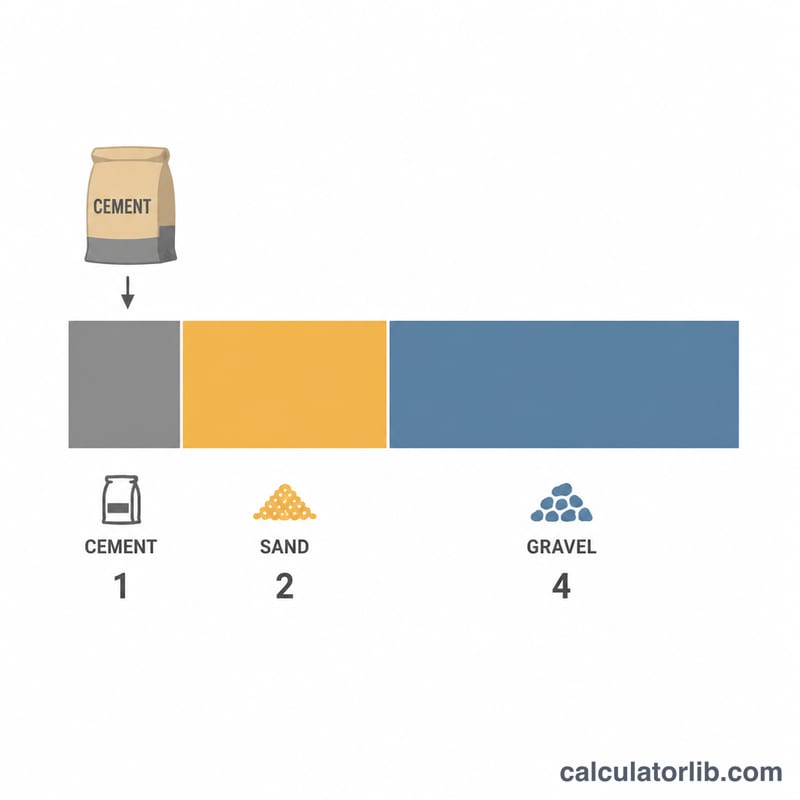
Enter the length, width and depth of your pour in metres. Then enter the mix ratio as parts of cement, sand and aggregate (for example 1:2:4 for general concrete). Finally enter the volume of one cement bag in cubic metres — a standard 50 kg bag is roughly 0.0347 m³. The calculator returns the number of bags plus the total and cement-only volumes.
The formula explained
First the concrete volume is found: \(V = L \times W \times D\). The fraction of that volume which is cement equals the cement parts divided by the total parts (cement + sand + aggregate). Dividing this cement volume by the volume of one bag gives the bag count:
$$\text{Bags} = \frac{V \cdot \dfrac{c}{c+s+a}}{\text{Bag Volume}}$$This is a dry-volume approximation and does not add a wastage allowance.
Worked example
A slab 5 m × 4 m × 0.1 m has a volume of 2 m³. With a 1:2:4 mix the cement share is 1/7, so cement volume = \(2 \times \frac{1}{7} \approx 0.2857\) m³. Dividing by a 0.0347 m³ bag gives about 8.23 bags — round up to 9 to be safe.
$$\text{Bags} = \frac{2 \cdot \dfrac{1}{1+2+4}}{0.0347} \approx 8.23$$FAQ
What bag volume should I use? A 50 kg bag of cement occupies about 0.0347 m³; a 25 kg bag about 0.0174 m³.
Does it include wastage? No. Add 5–10% extra and round up the bag count for spillage and uneven surfaces.
What mix ratio is normal? 1:2:4 is common for general concrete, while 1:1.5:3 is used for stronger structural work.