
What the Wood Fence Calculator Does
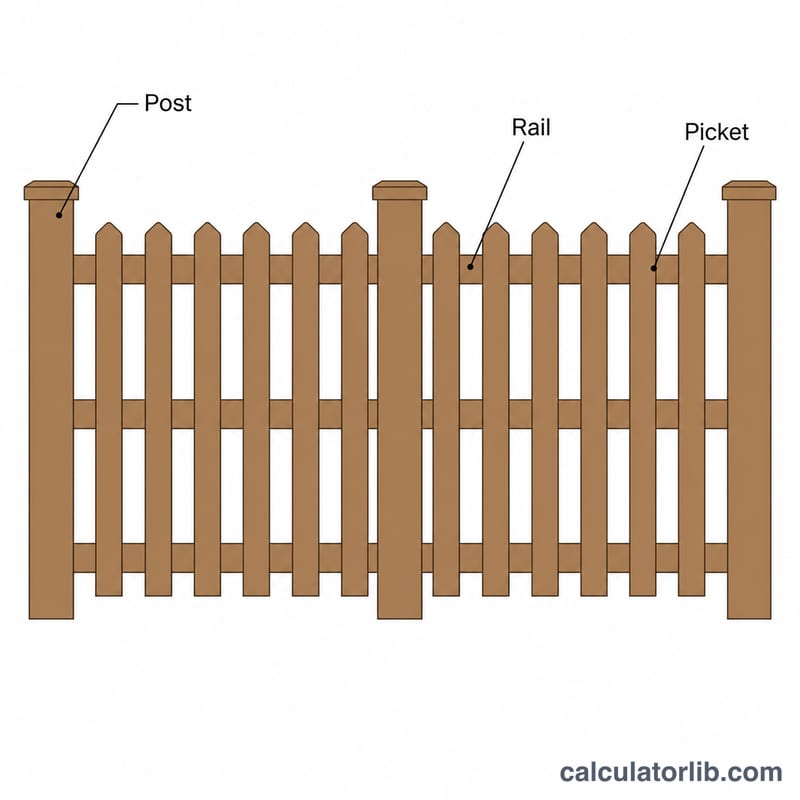
The Wood Fence Calculator estimates the core materials you need to build a standard wood privacy or picket fence: posts, rails, pickets, and bags of concrete. You enter three simple measurements and the calculator returns the quantities based on common construction conventions used in the United States (measurements are in feet and inches, and pickets are assumed to be standard 5.5-inch-wide boards).
The Inputs You Provide
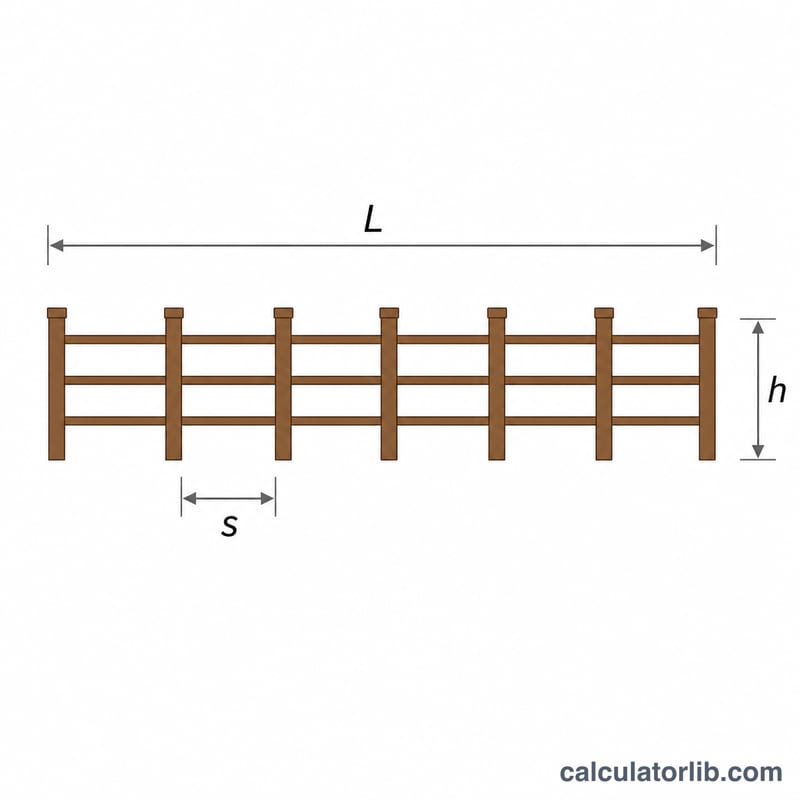
- Fence Length (feet): the total run of fence you plan to build.
- Fence Height (feet): how tall the fence will stand. This is used mainly to scale the on-screen visualization, not the material counts.
- Post Spacing (feet): the distance between posts. Common values are 6 or 8 feet.
The Formulas Explained
The calculator applies these rules:
- Posts = \(\left\lceil \frac{\text{Length}}{\text{Spacing}} \right\rceil + 1\). The "+1" accounts for the post at the very end of the run.
- Rails = \(\left\lceil \frac{\text{Length}}{16} \right\rceil \times 3\). Rails (the horizontal supports) are assumed to come in 16-foot lengths, with 3 rails running the full height for stability.
- Pickets = \(\left\lceil \frac{\text{Length} \times 12}{5.5} \right\rceil\). The length is converted to inches and divided by a standard 5.5-inch picket width.
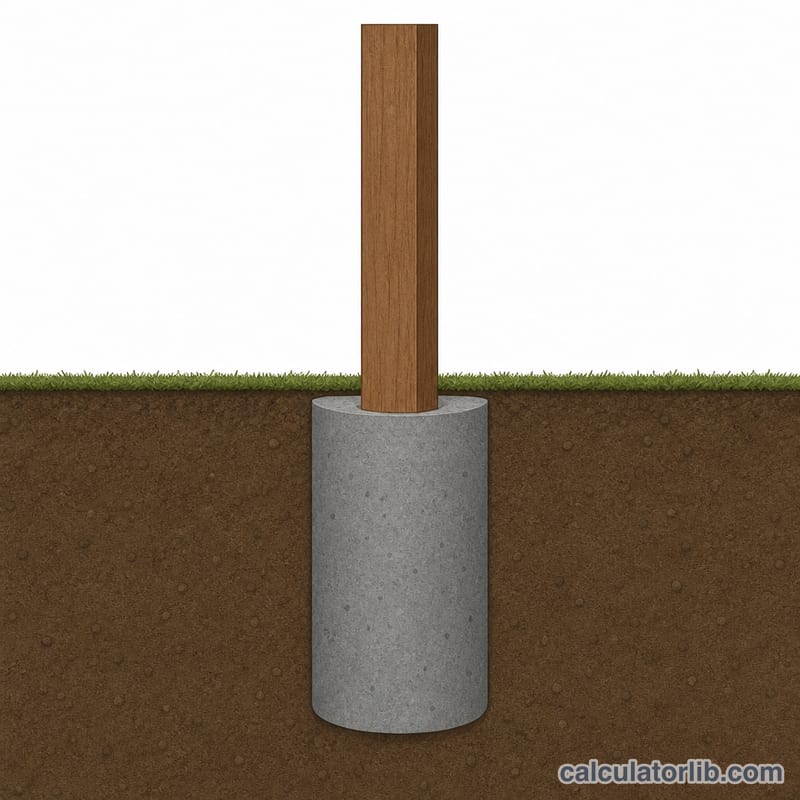
- Concrete = \(\text{Posts} \times 0.33\). Roughly one-third of a 60-lb bag per post hole.
$$\begin{gathered} \text{Posts} = \left\lceil \frac{\text{Length (ft)}}{\text{Spacing (ft)}} \right\rceil + 1 \\[1.2em] \text{Rails} = \left\lceil \frac{\text{Length (ft)}}{16} \right\rceil \times 3 \\[1.2em] \text{Pickets} = \left\lceil \frac{\text{Length (ft)} \times 12}{5.5} \right\rceil \\[1.2em] \text{Concrete} = \text{Posts} \times 0.33 \end{gathered}$$
Worked Example
Suppose you are building a fence that is 48 feet long, 6 feet tall, with posts spaced 8 feet apart:
- Posts = \(\left\lceil 48 \div 8 \right\rceil + 1 = 6 + 1 =\) 7 posts
- Rails = \(\left\lceil 48 \div 16 \right\rceil \times 3 = 3 \times 3 =\) 9 rails
- Pickets = \(\left\lceil (48 \times 12) \div 5.5 \right\rceil = \left\lceil 576 \div 5.5 \right\rceil =\) 105 pickets
- Concrete = \(7 \times 0.33 \approx\) 2.3 bags
Frequently Asked Questions
Does fence height change the material counts? Height is collected to scale the visual preview of your fence; the post, rail, picket, and concrete totals are driven by length and spacing.
Why does it always add one extra post? A fence section needs a post on both ends. If a 48-foot run has 6 spacings, you still need 7 posts to close off the final section.
Should I buy extra materials? Yes. The picket count assumes no gaps and the concrete figure is an estimate. Add about 10% for waste, cuts, and irregular terrain, and always round up to whole bags and boards.