
What the Fence Calculator Does
This fence calculator estimates how many posts, sections (panels), and rails you need to build a straight run of fencing. Just enter the total fence length and how far apart you want the posts, and it instantly returns the material counts so you can plan and budget your project with confidence.
How to Use It
Enter the fence length in feet (the total distance the fence will cover), the post spacing in feet (typical values are 6–8 ft for wood and 8–10 ft for chain-link), and the number of rails per section (commonly 2 for privacy or 3 for tall fences). Click calculate to see your posts, sections, and total rails.
The Formula Explained
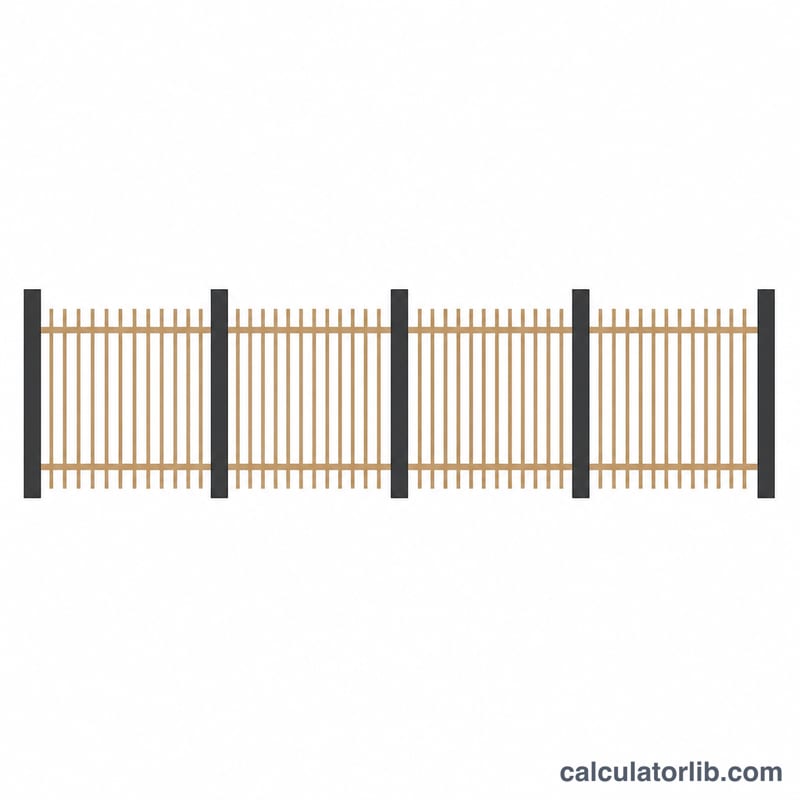
The number of sections is the length divided by the post spacing, rounded up so any leftover distance still gets its own panel: \(\text{sections} = \lceil L / s \rceil\). Because a straight fence needs a post at both ends of every section, the post count is one more than the section count: \(\text{posts} = \text{sections} + 1\). Total rails are simply \(\text{sections} \times \text{rails per section}\).
$$\begin{gathered} \text{Sections} = \left\lceil \frac{\text{Length (ft)}}{\text{Spacing (ft)}} \right\rceil \\[1.5em] \text{Posts} = \text{Sections} + 1 \qquad \text{Rails} = \text{Sections} \times \text{Rails / Section} \end{gathered}$$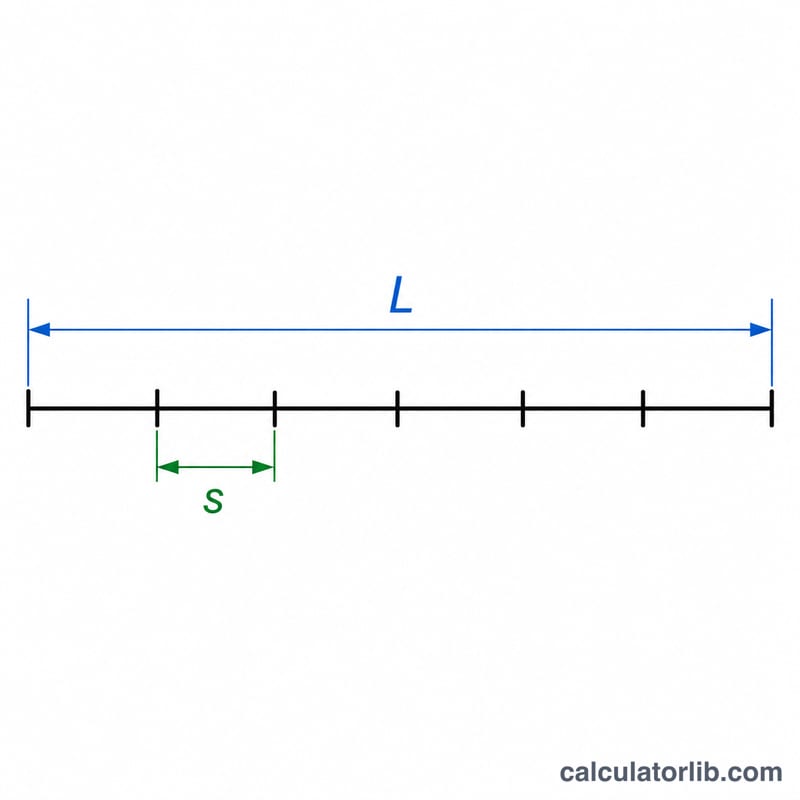
Worked Example
For a 100 ft fence with 8 ft spacing and 2 rails per section: sections = ceil(100 / 8) = ceil(12.5) = 13. Posts = 13 + 1 = 14. Rails = 13 × 2 = 26. You would need 14 posts, 13 panels, and 26 rails.
$$\text{Sections} = \left\lceil \frac{100}{8} \right\rceil = \lceil 12.5 \rceil = 13$$$$\text{Posts} = 13 + 1 = 14 \qquad \text{Rails} = 13 \times 2 = 26$$FAQ
Does this include corner or gate posts? The count assumes one straight run. Add one extra post for each corner or change of direction, and account for gate openings separately.
What post spacing should I use? Wood fences are usually 6–8 ft on center, while chain-link and vinyl often allow 8–10 ft. Always follow your panel manufacturer's spec.
Why is there always one extra post? A fence with N sections has a post between every pair of sections plus one at each end, giving N + 1 posts in total.