
What Is Floor Area Ratio?
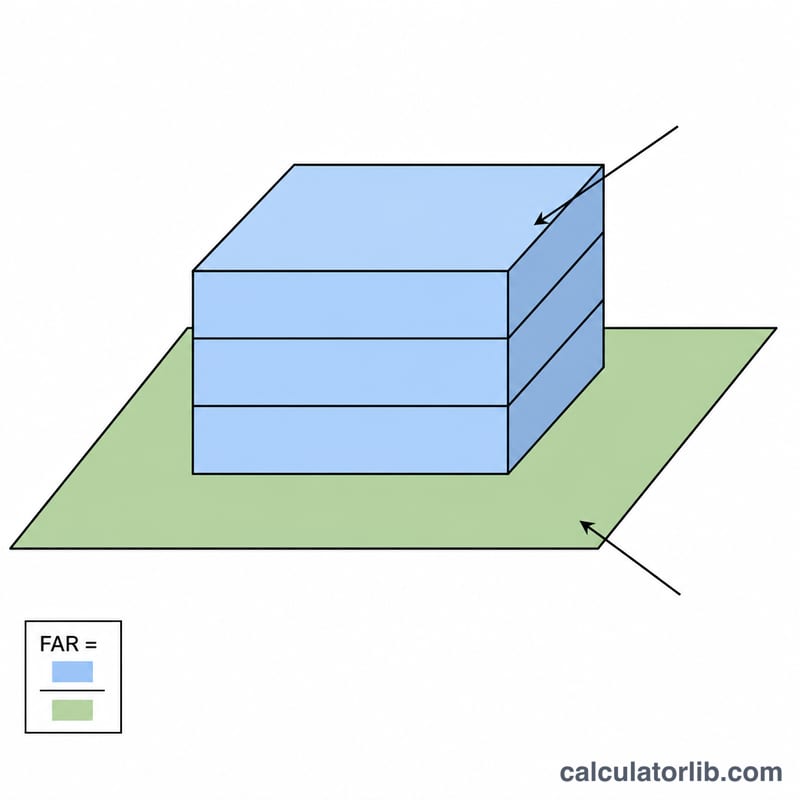
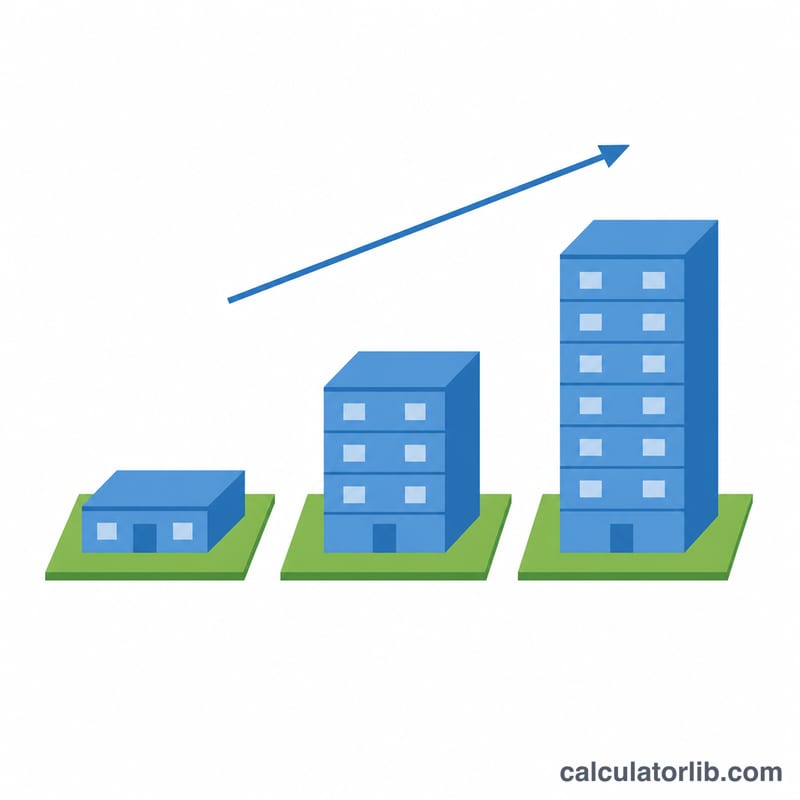
Floor Area Ratio (FAR), also called Floor Space Index (FSI) or plot ratio, measures how much total building floor area is permitted or built relative to the size of the land parcel. It is one of the most important zoning metrics used by planners and developers to control building density, bulk, and intensity of land use. A FAR of 1.0 means a building's combined floor area equals the lot size, while a FAR of 2.0 means twice the lot area is built — for example a two-story building covering the entire lot, or a four-story building covering half of it.
How to Use This Calculator
Enter the total building floor area (the sum of all floors' gross area) and the lot or land area, using the same units for both (square feet or square meters). The calculator divides floor area by lot area to return the FAR. Compare the result against the maximum FAR allowed in your local zoning code to confirm compliance.
The Formula Explained
The equation is simply $$\text{FAR} = \frac{\text{Total Floor Area}}{\text{Lot Area}}$$ Because it is a ratio of two areas, the units cancel out, so FAR is dimensionless — a value like \(1.5\) means nothing more or less than "1.5 times the lot area in floor space." Note that what counts as "floor area" (e.g. whether parking, balconies, or basements are included) is defined by each jurisdiction's code.
Worked Example
Suppose a building has 12,000 sq ft of total floor area across all stories and sits on an 8,000 sq ft lot. $$\text{FAR} = \frac{12{,}000}{8{,}000} = 1.5$$ If local zoning caps FAR at \(2.0\), the project is comfortably within the limit and could add up to 4,000 sq ft more floor area.
FAQ
Is a higher FAR better? Not inherently — higher FAR allows more buildable space and density, which can mean more value, but local codes set a maximum to manage congestion, light, and infrastructure.
Does FAR include parking? It depends on the jurisdiction. Many codes exclude structured parking, mechanical floors, and basements from the floor area count. Check your local definition.
What's the difference between FAR and lot coverage? Lot coverage is the building footprint as a percentage of the lot, while FAR counts all floors. A small footprint with many stories can have low coverage but high FAR.