
What is the Epoxy Calculator?
The Epoxy Calculator estimates how much epoxy resin you need to coat or cast a surface. It works by computing the pour volume from your project's length, width and desired thickness, then converting that volume into the common epoxy mixing units: US gallons, fluid ounces and liters. This is useful for resin tabletops, river tables, bar tops, garage floors, art pieces and deep pours.
How to use it
Enter the length and width of the surface in inches and the thickness of the epoxy layer in inches (a typical clear-coat is about 1/16" to 1/8", while a deep pour can be 1" or more). Set the number of coats if you plan to pour more than one layer. The calculator returns the total volume and the resin you should mix. Always buy 5–10% extra to account for spillage, absorption and waste.
The formula explained
Volume is simply length \(\times\) width \(\times\) thickness, giving cubic inches. Multiplying by the number of coats accounts for repeated pours of the same thickness. Because one US gallon equals exactly 231 cubic inches, dividing the volume by 231 converts it to gallons. Multiplying gallons by 128 gives fluid ounces, and one cubic inch equals roughly 0.0163871 liters.
$$\text{Gallons} = \frac{\text{Length} \times \text{Width} \times \text{Thickness} \times \text{Coats}}{231}$$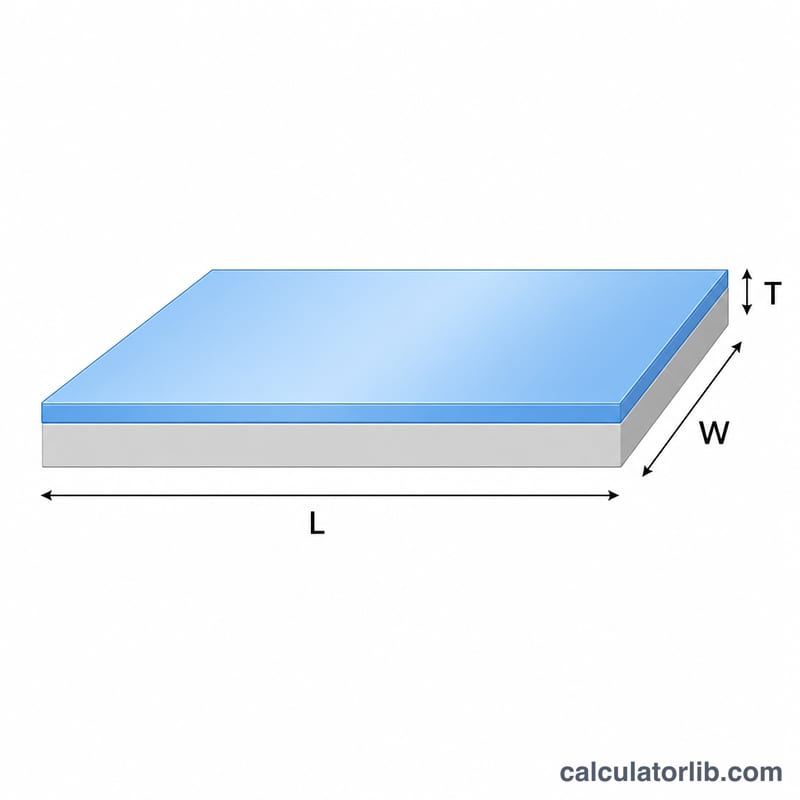
Worked example
For a 24" \(\times\) 24" tabletop with a 0.125" (1/8") flood coat: volume = $$24 \times 24 \times 0.125 = 72 \text{ cubic inches}.$$ Gallons = $$72 \div 231 \approx 0.312 \text{ gallons},$$ which is about 39.9 fluid ounces or 1.18 liters of mixed epoxy.
FAQ
Does this include resin and hardener? Yes — the result is the total mixed volume (resin plus hardener combined), which is what you pour.
How much extra should I buy? Add about 10% to be safe, especially for porous surfaces or first-time pours.
Can I use metric inputs? This tool expects inches; convert centimeters to inches (\(\div\) 2.54) first, then read the liters output.