What the Cheese Yield Calculator does
This cheese yield calculator estimates how many kilograms of cheese you can expect from a batch of milk, using only two easy inputs: the milk volume in liters and its fat content as a percentage. It is useful for home cheesemakers, small creameries, and students who want a fast, repeatable estimate before heating a single pot.
How to use it
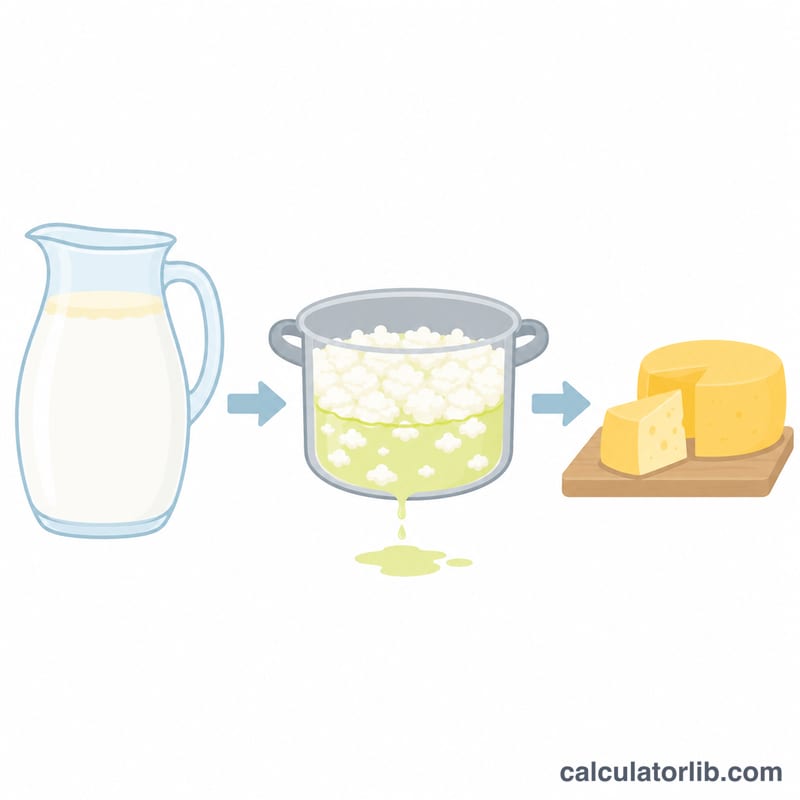
Enter the volume of milk you plan to use and the fat percentage printed on the carton or measured in your lab. Press calculate. The tool returns the estimated cheese mass in kilograms, the yield as a percent of milk mass, and the total milk mass it assumed. Because fat and casein travel together, casein is estimated from fat as \(C = 0.7F\).
The formula explained
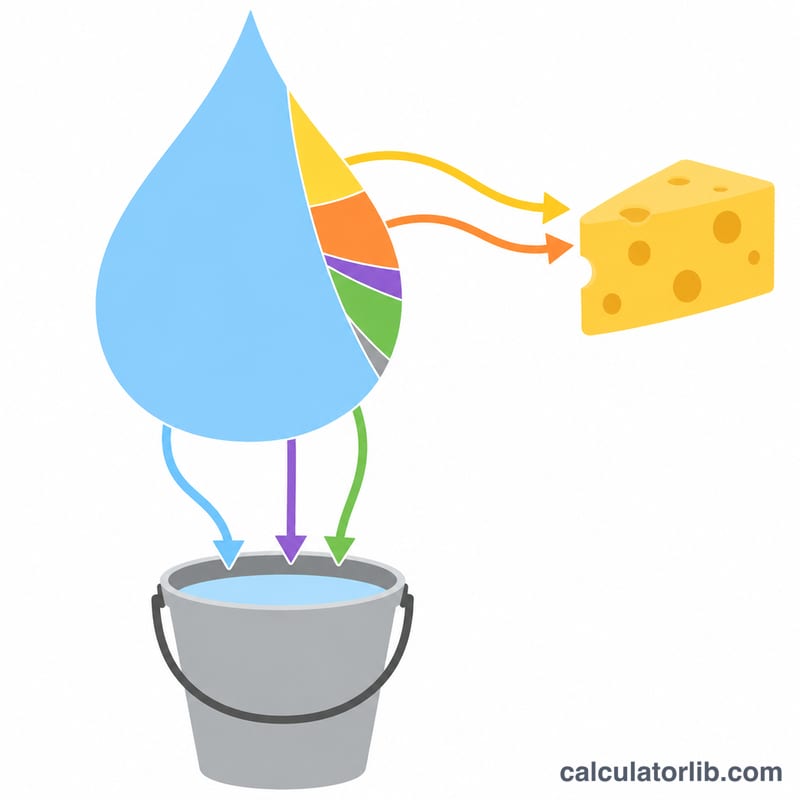
The calculator is built on the classic Van Slyke cheese yield equation. First it converts volume \(V\) (liters) to mass \(M\) using milk density, then applies the yield percent:
$$M = V \times 1.032$$ $$\text{Yield} = \frac{[(0.93F) + (C - 0.1)] \times 1.09}{1 - W}$$Here \(F\) = fat percent, \(C\) = casein percent, and \(W\) = moisture fraction retained in the cheese. The factor \(0.93\) is the share of fat recovered in the curd, \(1.09\) accounts for salt and minerals, and a moisture of \(W = 0.37\) reflects a semi-hard style. Final cheese mass is \(\text{Cheese} = M \times \frac{\text{Yield}}{100}\).
Worked example
Suppose you have 100 liters of milk at 4% fat:
$$M = 100 \times 1.032 = 103.2\,\text{kg}$$ $$C = 0.7 \times 4 = 2.8\%$$ $$\text{Yield} = \frac{[(0.93 \times 4) + (2.8 - 0.1)] \times 1.09}{1 - 0.37} = 11.11\%$$ $$\text{Cheese} = 103.2 \times \frac{11.11}{100} = 11.46\,\text{kg}$$So about 11.46 kg of cheese is expected from that batch.
Typical Milk Composition by Source
The calculator uses the Van Slyke cheese yield formula. It does not ask for casein. Instead it assumes casein is 70% of the fat percentage, \(C = 0.7F\). That assumption fits ordinary whole cow milk quite well, but it drifts as the casein:fat ratio moves away from about 0.7. The values below are approximate ranges from general dairy-science references. Real milk varies with breed, lactation stage, season and feed.
| Milk source | Fat (%) | Casein (%) | Approx. casein:fat ratio | How the calculator's C = 0.7F compares |
|---|---|---|---|---|
| Skim cow milk | 0.05–0.5 | 2.5–2.8 | 5 or more (very high) | Strongly underestimates casein. At 0.1% fat it assumes only 0.07% casein, so the estimated yield is close to zero, even though skim milk makes real cheese (e.g. cottage cheese or quark) |
| 2% (reduced-fat) cow milk | about 2 | 2.5–2.8 | about 1.3 | Underestimates casein (assumes about 1.4% instead of about 2.6%), so the yield shown is too low |
| Whole cow milk (e.g. Holstein) | 3.3–4.0 | 2.4–2.8 | 0.65–0.8 | Close match. This is the case the 0.7 factor is built for |
| Jersey / Guernsey cow milk | 4.5–5.5 | 2.9–3.3 | 0.55–0.65 | Slightly to moderately overestimates casein |
| Goat milk | 3.5–4.5 | 2.3–2.8 | 0.6–0.7 | Slight overestimate. Goat curd is also softer, so practical yields often run a little lower |
| Sheep milk | 6–8 | 4.2–5.2 | 0.6–0.7 | Modest overestimate. Absolute yields are still very high because both fat and casein are high |
| Water buffalo milk | 6.5–8.5 | 3.2–4.0 | 0.45–0.55 | Clearly overestimates casein (assumes about 5.3% at 7.5% fat against about 3.6% actual), so yield is overstated |
Practical takeaway: for standard whole cow milk the estimate is reasonable. For skim or reduced-fat milk, read the result as a floor, because real yield will be higher. For Jersey, buffalo and other high-fat milks, read it as a ceiling. If you know your milk's actual casein content from a lab test or dairy report, the full Van Slyke formula using measured casein will be more accurate than any fixed ratio.
Typical Cheese Yields and Moisture by Cheese Style
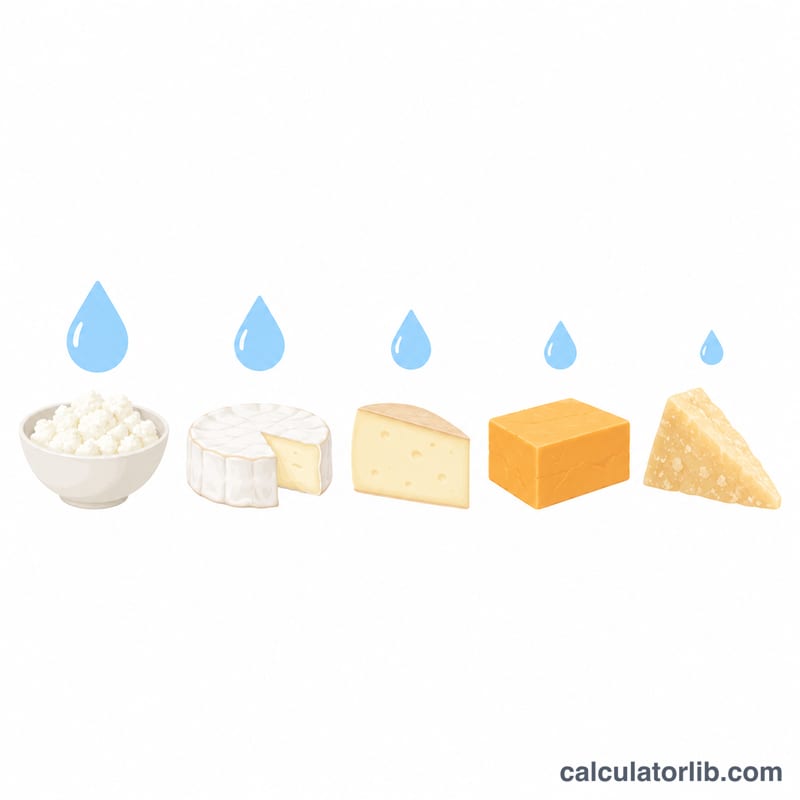
Moisture is the biggest single driver of yield. The more water a cheese keeps, the more kilograms you get from the same milk. The calculator uses a fixed target moisture of 37% (the \(1 - 0.37\) term), so its result matches semi-hard, Cheddar-type cheeses close to 37% moisture. The ranges below are approximate figures commonly cited for cow milk of normal composition (about 3.5–4% fat). Actual yields vary with milk quality, recipe, whey losses and ripening time.
| Cheese style | Typical moisture (%) | Typical yield (kg cheese per 100 kg milk) | Compared with the calculator |
|---|---|---|---|
| Ricotta | 70–80 | About 4–6 from whey. Roughly 12–20 when made from whole milk | Different process (heat/acid precipitation of whey proteins), so the formula does not apply |
| Cottage cheese | about 75–80 | about 13–17 (curd from skim milk) | Far higher than the formula predicts for skim milk |
| Cream cheese | about 50–55 | Varies widely with the cream content of the mix | Not comparable. The milk is usually cream-enriched |
| Mozzarella | 45–60 | about 11–14 | Higher than the calculator's result |
| Camembert / Brie | about 50–56 | about 12–14 | Higher than the calculator's result |
| Gouda | about 40–43 | about 10–11 | Slightly higher |
| Cheddar | about 36–39 | about 9.5–10.5 | Closest match (the formula's reference style) |
| Swiss / Emmental | about 34–38 | about 8–9 | Slightly lower (lower moisture, partly skimmed milk is common) |
| Parmesan (Parmigiano-type) | about 30–32 | about 6.5–7.5 (aged, from partly skimmed milk) | Noticeably lower |
Example: with 100 L of whole cow milk at 3.5% fat, the calculator first converts volume to mass, \(M = 100 \times 1.032 = 103.2\) kg. It then computes the yield percentage:
$$Y = \frac{(0.93 \times 3.5 + 0.7 \times 3.5 - 0.1) \times 1.09}{1 - 0.37} = \frac{5.605 \times 1.09}{0.63} \approx 9.70\%$$$$\text{Cheese} = \frac{103.2 \times 9.70}{100} \approx 10.01 \text{ kg}$$That gives about 10.01 kg of cheese, which falls inside the typical Cheddar range. To estimate a higher-moisture style, you can scale by dry matter: multiply the result by \((1 - 0.37) / (1 - W)\), where \(W\) is the target moisture as a decimal. For a mozzarella at 50% moisture, that gives roughly \(10.01 \times 0.63 / 0.50 \approx 12.6\) kg. This is a rough adjustment only, because each style also retains different amounts of fat and protein.
FAQ
Is this exact? No. It is a planning estimate. Real yield depends on milk protein, make procedure, cutting, and losses in whey.
Why does fat matter so much? Fat is trapped in the curd matrix, so higher-fat milk produces proportionally more cheese per liter.
Can I use skim milk? Yes, enter a low fat value such as 0.1%, though very low fat milks give thin, low yields.