What is a dovetail angle?
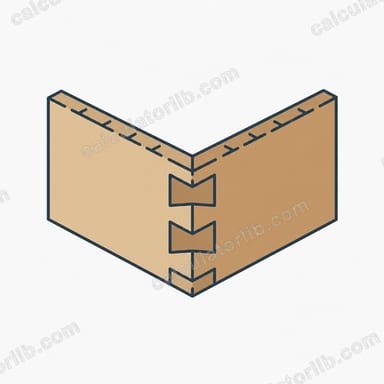
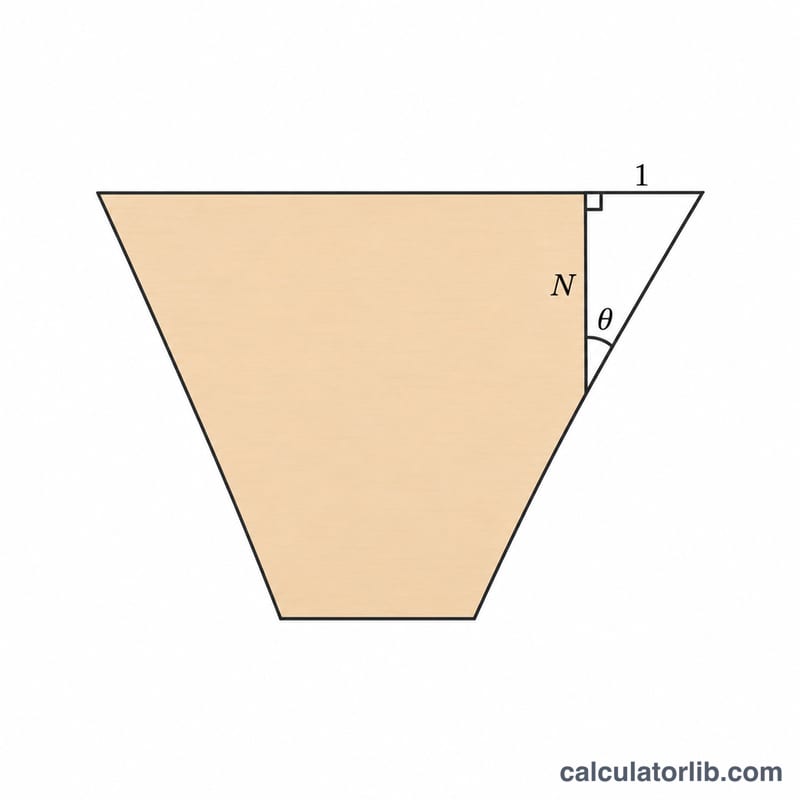
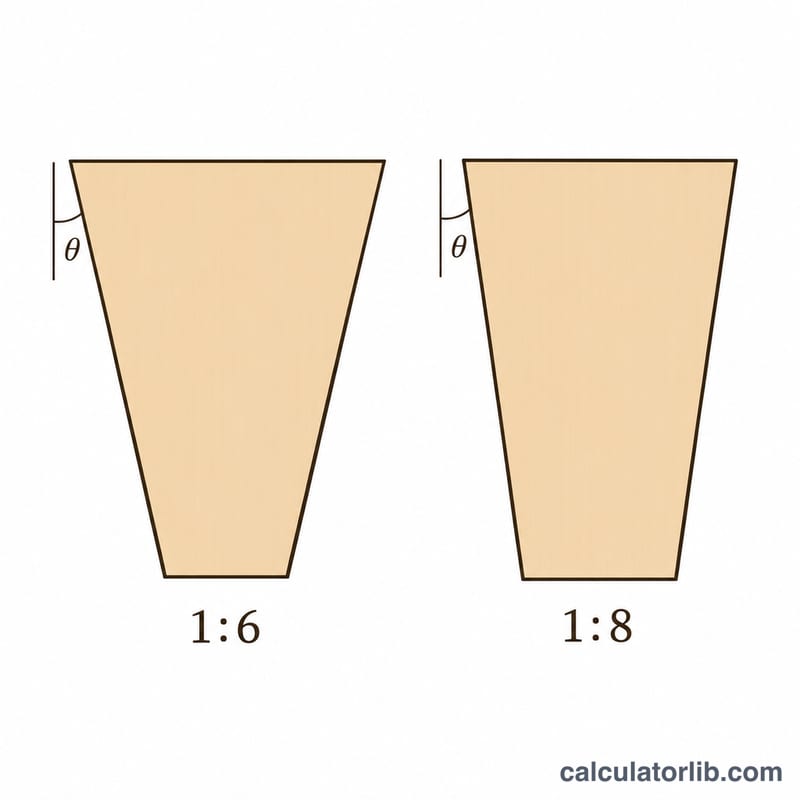
A dovetail joint locks two boards together with tapered tails and pins. The taper is usually given as a slope ratio, 1:N. This means the side moves 1 unit sideways for every N units of length. Woodworkers tend to use 1:6 for softwood and 1:8 for hardwood. This calculator turns the ratio into degrees for setting a sliding bevel. It also works out a simple, evenly spaced layout of tails and pins.
How to use it
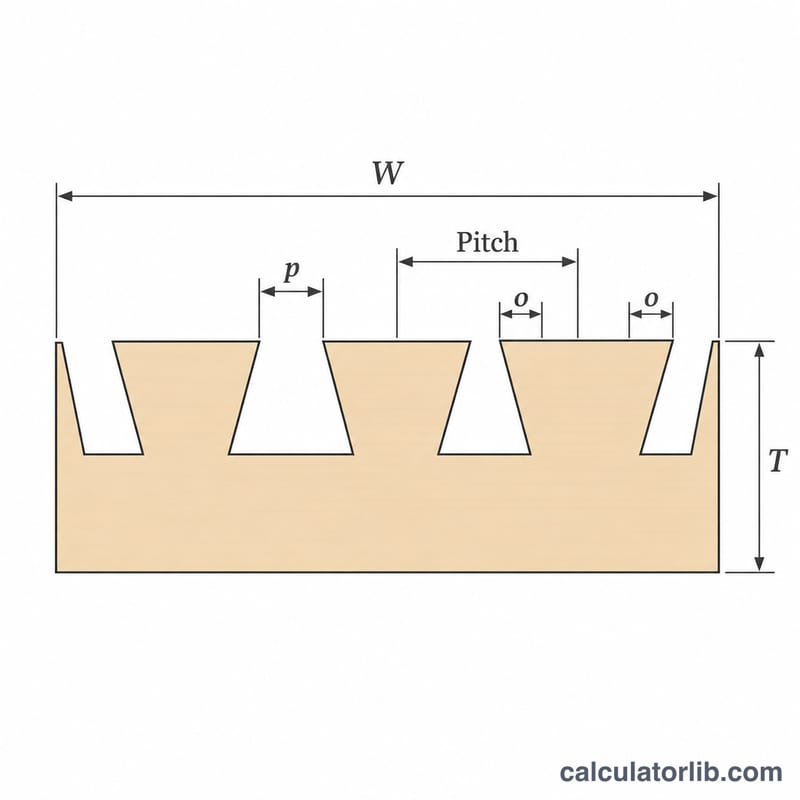
Enter the board width, the tail board thickness (which sets the length of the joint), the slope number N, how many tails you want and the width of each pin at its narrow end. The layout puts a half pin at each edge, each one half the width of a full pin. The pin centres are spaced evenly across the board.
The formulas
$$\theta = \arctan\left(\frac{1}{N}\right)$$Across a thickness \(T\), each sloped side shifts by \(T/N\). With board width \(W\), \(n\) tails and narrow pin width \(p\):
$$t_w = \frac{W - n p}{n}, \quad t_n = t_w - \frac{2T}{N}, \quad p_w = p + \frac{2T}{N}$$The pin spacing is \(W/n\).
Worked example
A 150 mm wide board, 20 mm thick, at 1:6 with 3 tails and 10 mm pins:
$$\theta = \arctan(1/6) = 9.46^{\circ}$$$$t_w = \frac{150 - 3 \times 10}{3} = 40\,\text{mm}, \quad t_n = 40 - \frac{40}{6} = 33.33\,\text{mm}$$Each full pin is 16.67 mm at its wide end, and the pins are 50 mm apart.
Common Dovetail Slope Ratios and Angles
A dovetail slope is written as a ratio 1:N. For every N units you measure along the board, the side of the tail moves sideways by 1 unit. To turn the ratio into an angle, use \(\theta = \arctan(1/N)\). The side offset is how far each sloped face moves sideways across the full thickness of the tail board, and it is \(o = T/N\). The table gives the offset for a 20 mm board and for a 3/4 in (19.05 mm) board.
| Ratio 1:N | Angle θ = arctan(1/N) | Offset T/N, T = 20 mm | Offset T/N, T = 3/4 in | Typical use |
|---|---|---|---|---|
| 1:4 | 14.04° | 5.00 mm | 0.188 in (3/16 in) | Decorative or very bold joints, very soft wood |
| 1:5 | 11.31° | 4.00 mm | 0.150 in | Decorative work, soft wood |
| 1:6 | 9.46° | 3.33 mm | 0.125 in (1/8 in) | Softwood |
| 1:7 | 8.13° | 2.86 mm | 0.107 in | A common compromise for mixed or medium-density wood |
| 1:8 | 7.13° | 2.50 mm | 0.094 in (3/32 in) | Hardwood |
| 1:10 | 5.71° | 2.00 mm | 0.075 in | Fine work and drawers |
Worked check for 1:6 on a 20 mm board: $$\theta = \arctan\left(\frac{1}{6}\right) \approx 9.46^\circ, \qquad o = \frac{20}{6} \approx 3.33\ \text{mm}$$
The ratio does not depend on units, so it works the same in inches and millimetres. Many guides describe 1:6 as a 1 in rise over a 6 in run, and 1:8 as a 1 in rise over an 8 in run. You can set a sliding bevel straight from these numbers with a square or a marked board, without reading a protractor. Use notes like "1:6 for softwood, 1:8 for hardwood" as traditional starting points, not as fixed rules. Plenty of good joints are cut at other slopes.
Practical Layout Tips
- Round the results to sizes you can mark. The calculator returns exact decimals, but you can't set a marking gauge or dividers to 35.33 mm. Round each width to the nearest mark you can set and reproduce, such as 0.5 mm or 1/32 in. Then step the spacing out with dividers so small errors don't add up across the board.
- Make the narrow end of each pin at least as wide as your narrowest chisel. The pin width p is measured at the narrow end. If it is narrower than your smallest chisel, you can't clean out the waste between the tails. Pick p to suit the tools you actually have.
- Set the sliding bevel from the ratio, not only from the degree reading. Small protractor scales are hard to read to a fraction of a degree. Mark N units along a straight edge and 1 unit across, set the bevel to the line between them, and then check it against the angle in the table.
- Mark the waste clearly and saw on the waste side. Hatch or label every waste area before you cut, because it's easy to saw the wrong side once the layout lines cross. Keep the kerf on the waste side so the line itself stays on the finished part.
- Check that the narrow tail width stays well above zero. The narrow tail width is \(w_{\text{tail}} = W_{\text{tail}} - 2\,o\). Example: a 200 mm board with 4 tails, p = 8 mm, T = 20 mm and a 1:6 slope gives \(W_{\text{tail}} = (200 - 4 \times 8)/4 = 42\) mm and \(o = 20/6 \approx 3.33\) mm. That makes \(w_{\text{tail}} \approx 42 - 6.67 = 35.33\) mm, which is plenty. If the result is small or negative, use fewer tails, narrower pins or a larger N (a shallower slope).
- Scribe the baseline a hair past the board thickness. Set the cutting gauge to the thickness T of the mating board plus a very small extra amount. The pins and tails then stand slightly proud after assembly, and you can plane them flush. A baseline set short leaves a recess that can't be fixed.
Before you cut a real piece, check your bevel setting, gauge setting and sawing on a test joint in scrap from the same stock.
FAQ
Is 1:6 or 1:8 better? Softwood crushes more easily, so a steeper 1:6 slope grips it better. Hardwood holds a finer 1:8 slope well, and many people think it looks neater. Both work in either wood.
Can I use inches? Yes. All the lengths scale together, so enter every length in inches and read the results in inches. The angle stays the same.
Why do my tails taper to nothing? The pins or the slope offset are too large for the spacing. Use fewer tails, narrower pins or a larger N.