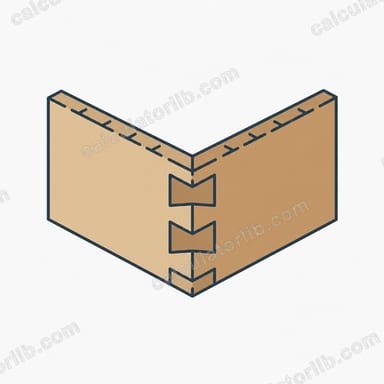
What the Dovetail Layout Calculator Does
Laying out dovetails by hand means dividing a board evenly into tails and pins so the joint looks balanced and cuts cleanly. This calculator takes your board width, the number of tails you want, and the baseline pin width, then returns the exact tail width, the two half-pin widths at the edges, the total number of pins, and the center-to-center pitch. It removes the guesswork and repeated dividers-and-arithmetic that usually go into a dovetail joint.
The Formula Explained
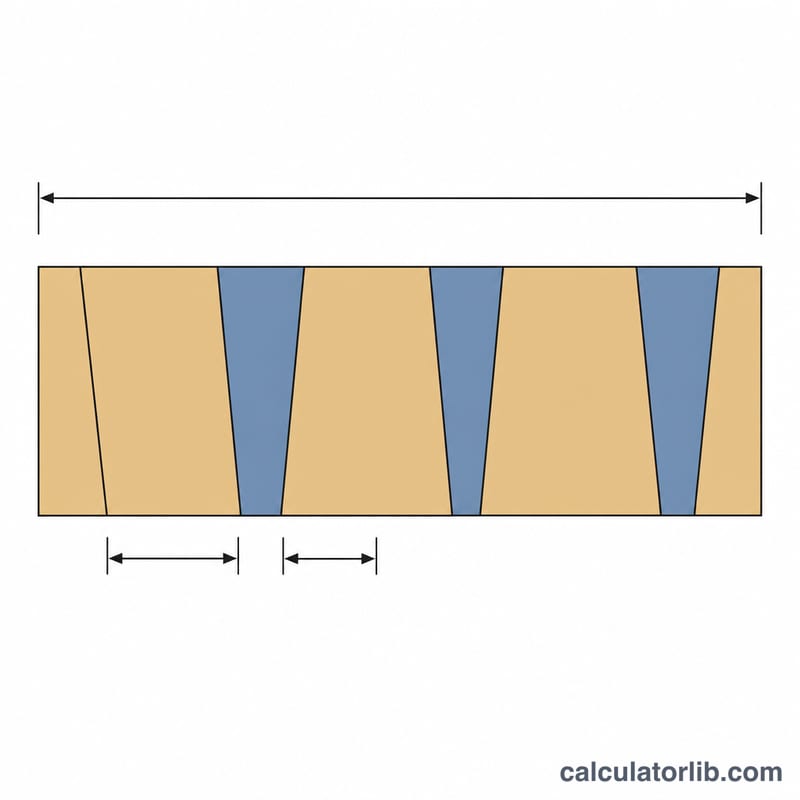
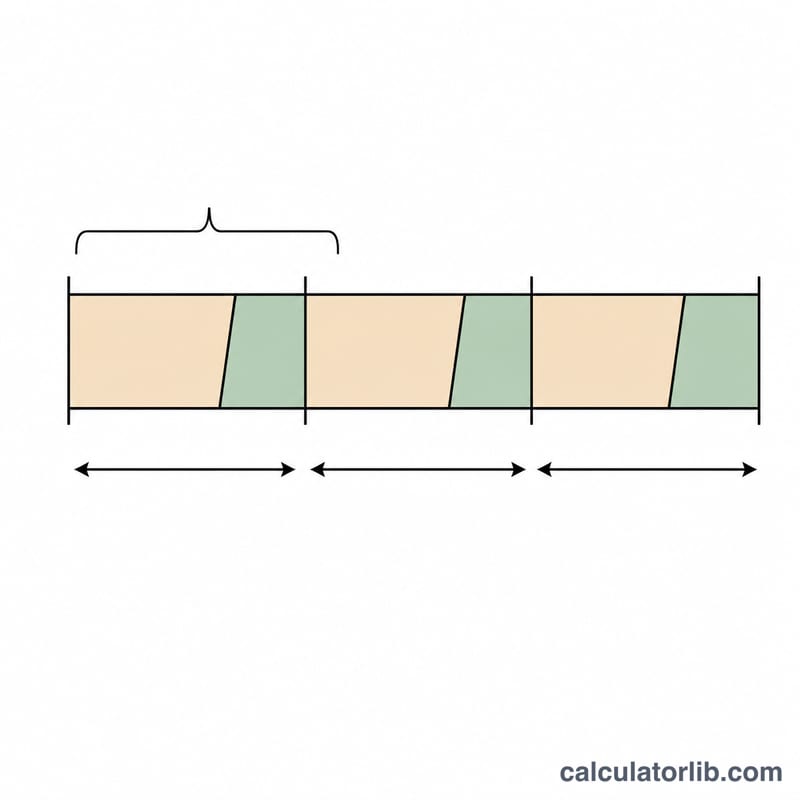
The layout uses \(N\) tails with \(N+1\) pins, where the two outer pins are half-pins of width \(P/2\). The full and half pins together consume \(N \times P\) of material, so the tails share the rest:
$$W_{tail} = \frac{W - (N \times P)}{N}$$Here \(W\) = board width in mm, \(N\) = number of tails, and \(P\) = pin width at the baseline. The tail pitch, or center-to-center spacing, is simply \(\text{Pitch} = \frac{W}{N}\), and each end half-pin measures \(\frac{P}{2}\).
How to Use It
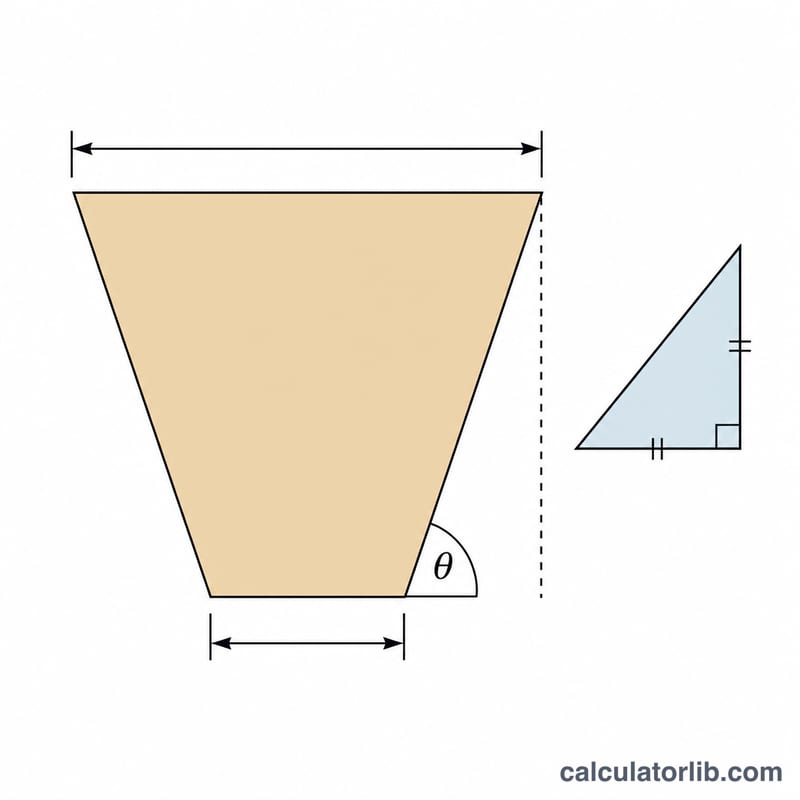
Enter the finished board width, choose how many tails you want (more tails give a finer, more decorative joint), and set the pin baseline width based on your chisel and stock. Read off the tail width and mark it with a marking gauge or dividers, then transfer the pin locations to the mating board.
Worked Example
For a \(150\,\text{mm}\) board with \(4\) tails and a \(12\,\text{mm}\) pin width:
$$W_{tail} = \frac{150 - (4 \times 12)}{4} = \frac{102}{4} = 25.5\,\text{mm}$$This gives \(5\) pins, end half-pins of \(6\,\text{mm}\), and a pitch of \(37.5\,\text{mm}\).
FAQ
How many tails should I use? Wider boards and finer work use more, smaller tails; utility joinery often uses fewer, larger tails.
Why half-pins at the edges? Half-pins at each end resist the edge of the board splitting and give a cleaner, stronger corner.
Can I use inches? Yes, treat the width and pin width in the same unit; the results come back in that unit.