What is the Compost Application Calculator?
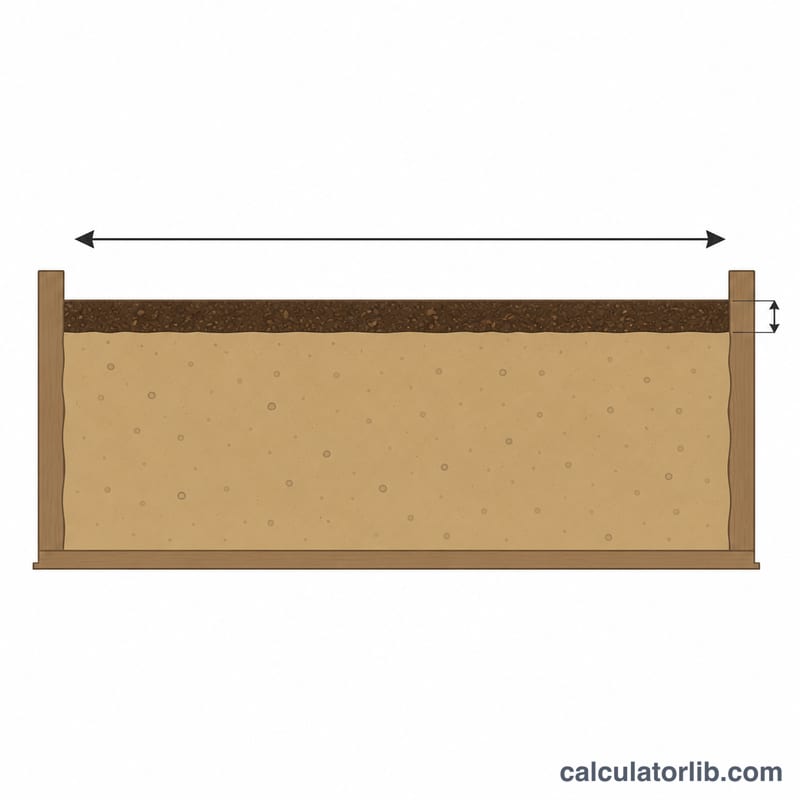
The Compost Application Calculator estimates how much compost you need to topdress or amend a plot of soil. Instead of guessing at bags or wheelbarrow loads, you enter the area you want to cover, the depth you want to spread the compost, and the compost bulk density. The tool returns the total volume in cubic feet and cubic yards, plus an approximate delivered weight in tons so you can order the right amount.
How to use it
Enter three values: the area in square feet (\(A\)), the spread depth in inches (\(d\)), and the compost bulk density in pounds per cubic yard (\(B\)). A typical topdressing is a \(0.25\) to \(1\) inch layer, while a soil-building amendment may be \(1\) to \(3\) inches. Bulk density for finished compost is often around \(800\) to \(1100\) lbs per cubic yard depending on moisture.
The formula explained
First the depth is converted from inches to feet by dividing by \(12\), then multiplied by the area to get cubic feet, and divided by \(27\) to convert cubic feet to cubic yards:
$$V_{yd^3} = \frac{A \times (d / 12)}{27}$$The weight is estimated from the volume and bulk density:
$$W_{tons} = \frac{V_{yd^3} \times B}{2000}$$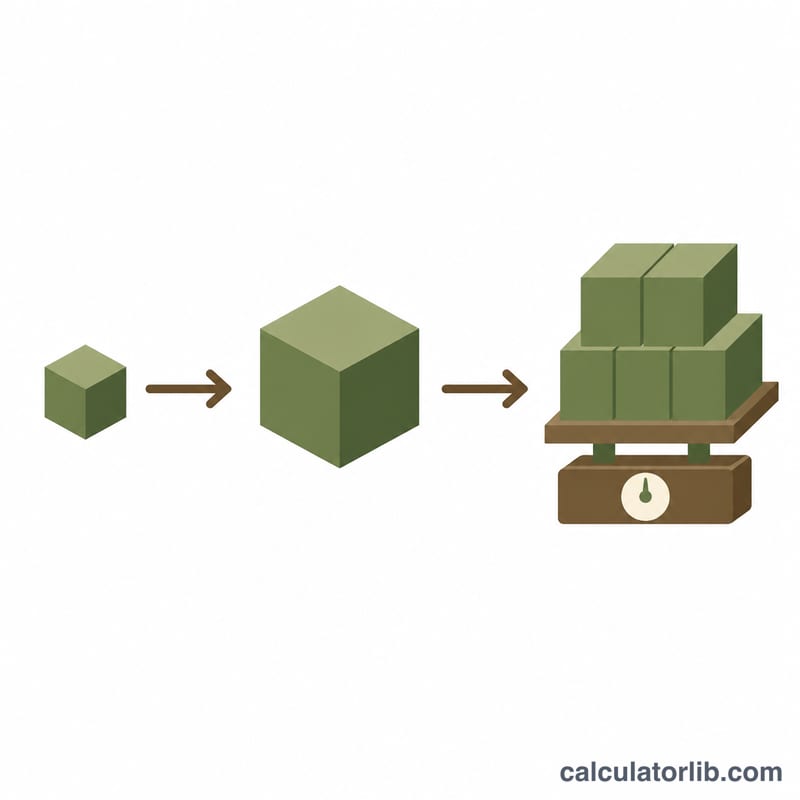
Worked example
Suppose you want to cover \(1000\) sq ft with a \(1\) inch layer using compost at \(1000\) lbs per cubic yard:
$$V_{yd^3} = \frac{1000 \times (1 / 12)}{27} = 3.09 \ \text{yd}^3$$The approximate weight is:
$$W_{tons} = \frac{3.086 \times 1000}{2000} = 1.54 \ \text{tons}$$FAQ
How deep should I apply compost? For lawns and topdressing, \(0.25\) to \(0.5\) inch is common; for garden beds, \(1\) to \(2\) inches worked into the soil is typical.
Why does weight vary? Compost bulk density changes with moisture and material. Wet compost is heavier, so adjust the bulk density input to match your supplier.
Can I use square meters? This version uses square feet and inches. Convert your measurements to those units before entering them.