What is the Pea Seed Rate Calculator?
The Pea Seed Rate Calculator tells you how much pea seed to sow per hectare to hit a target plant stand. Because seed size varies enormously between varieties and seasons, sowing a fixed weight per hectare gives inconsistent plant populations. Working from your target population, the thousand seed weight (TSW) and the expected establishment rate gives a far more accurate, agronomically sound seeding rate.
The formula explained
The seeding rate in kilograms per hectare is:
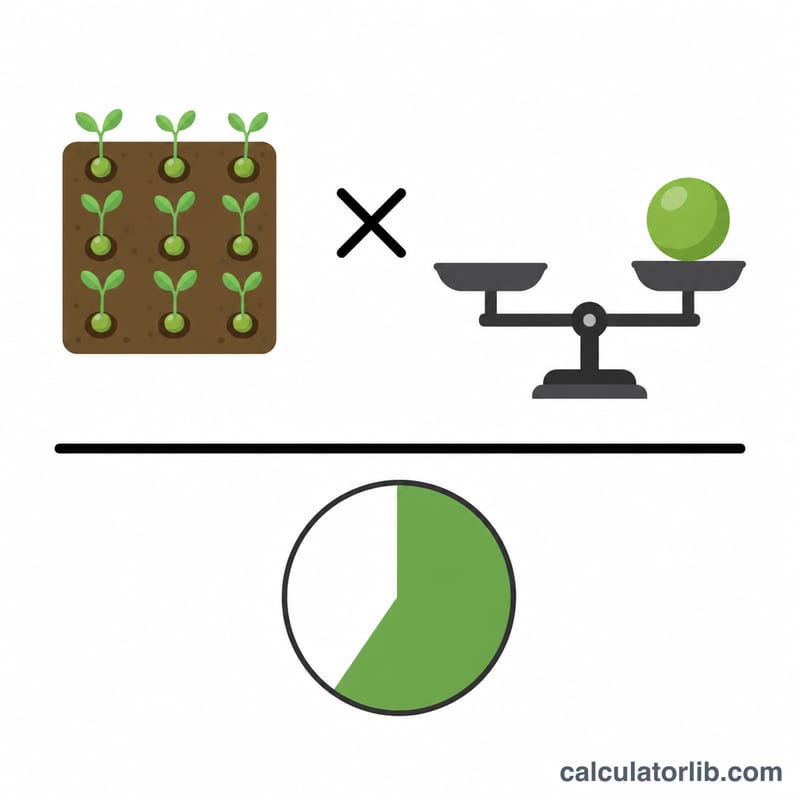
$$\text{Rate} = \frac{P \times \text{TSW}}{E}$$where \(P\) = target plant population in plants per m², \(\text{TSW}\) = thousand seed weight in grams (the mass of 1000 seeds), and \(E\) = expected establishment as a percentage. The number of seeds you must drill per m² is \( \tfrac{P \times 100}{E} \), which accounts for seeds lost to poor germination, pests and seedbed conditions. Multiplying the rate by field area gives the total seed to buy: $$\text{Total} = \text{Rate} \times \text{Area}$$
How to use it
Enter your target plant population (commonly 80–100 plants/m² for combining peas), the TSW printed on the seed label, your realistic establishment percentage, and the field area in hectares. The calculator returns the seeding rate, the seeds needed per m² and the total seed for the field.
Worked example
For \(P = 90\) plants/m², \(\text{TSW} = 250\) g and \(E = 85\%\):
$$\text{Rate} = \frac{90 \times 250}{85} = 264.7\;\text{kg/ha}$$Over a 10 ha field: \(264.7 \times 10 = 2647\) kg of seed.
FAQ
What establishment rate should I use? For good seedbeds 85–90% is typical; reduce it for cloddy, wet or pest-prone conditions.
Where do I find TSW? It is usually on the seed bag or test certificate; if not, weigh 1000 counted seeds in grams.
Does row width matter? This calculator uses population per m², so it works for any row spacing as long as your target population is set correctly.