What this calculator does
The Injection Moulding Cost Calculator estimates the manufacturing cost per part for a plastic component moulded in the UK. It combines the two biggest cost drivers in production: the plastic material consumed and the machine time used per shot. It is aimed at product designers, buyers and moulders who need a quick, defensible cost-per-part figure before requesting formal quotes.
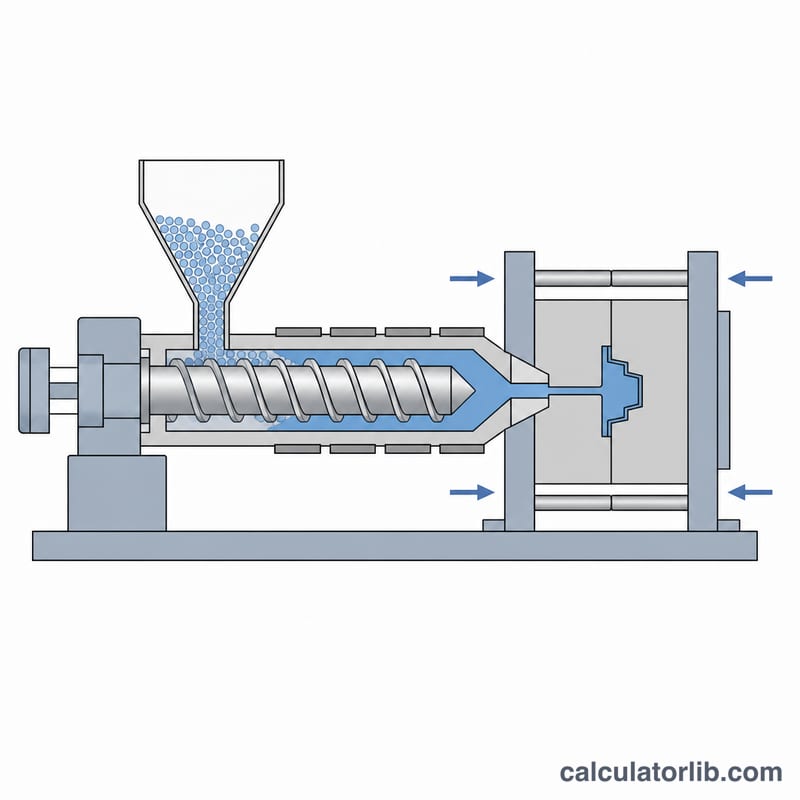
The formula explained
The total cost per part is the sum of a material cost and a machine cost:
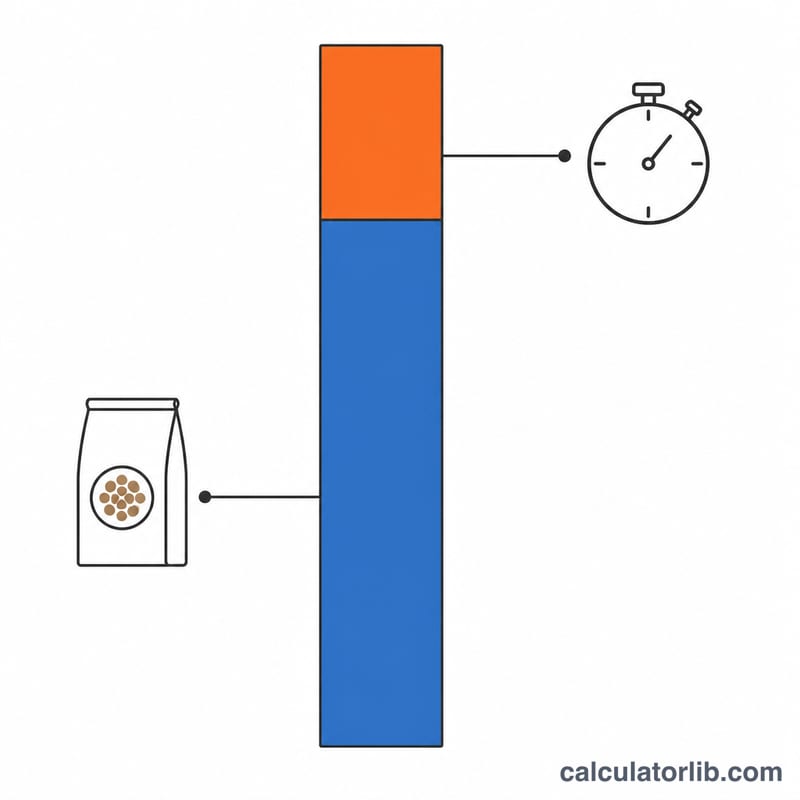
$$\text{Cost} = \frac{W}{1000}\times P \times \left(1 + \frac{s}{100}\right) + \frac{(t/3600)\times R}{n}$$Here \(W\) = part weight in grams, \(P\) = material price in £/kg, \(s\) = scrap rate in %, \(t\) = cycle time in seconds, \(R\) = machine rate in £/hour and \(n\) = number of mould cavities. Dividing weight by 1000 converts grams to kilograms, and dividing cycle time by 3600 converts seconds to hours. Because one cycle produces \(n\) parts, the machine cost is shared across all cavities.
How to use it
Enter the shot part weight, the price of your resin, the machine cycle time, the hourly machine rate quoted by your moulder, the number of cavities in the tool, and an allowance for scrap. The calculator returns the material cost, the machine cost and the combined cost per part.
Worked example
For a 50 g part in resin at £2.50/kg with 5% scrap, a 30 s cycle, a £40/hour machine and a single cavity:
$$C_{mat} = \frac{50}{1000}\times 2.5 \times 1.05 = 0.1313$$$$C_{mach} = \frac{(30/3600)\times 40}{1} = 0.3333$$$$C_{total} = 0.1313 + 0.3333 = 0.4646$$So the estimated cost is about £0.46 per part.
FAQ
Does this include tooling cost? No. This is a variable cost-per-part model. Amortise the mould cost separately over your expected volume and add it on top.
What machine rate should I use? Use the all-in hourly rate your moulder charges, which typically bundles labour, energy and overhead for the tonnage of press required.
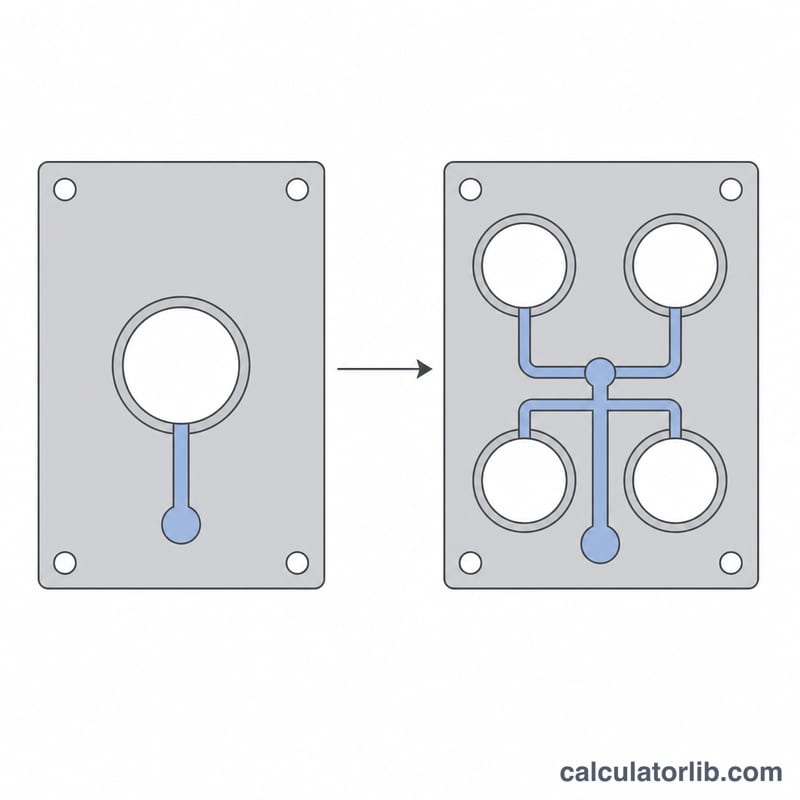
How do cavities affect cost? More cavities spread the machine time across more parts per cycle, lowering the machine cost per part, though material cost per part is unchanged.