What Is the Lathe Turning Speed Calculator?
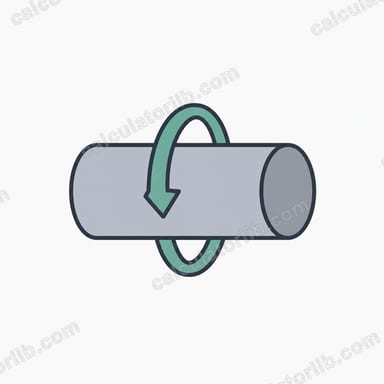
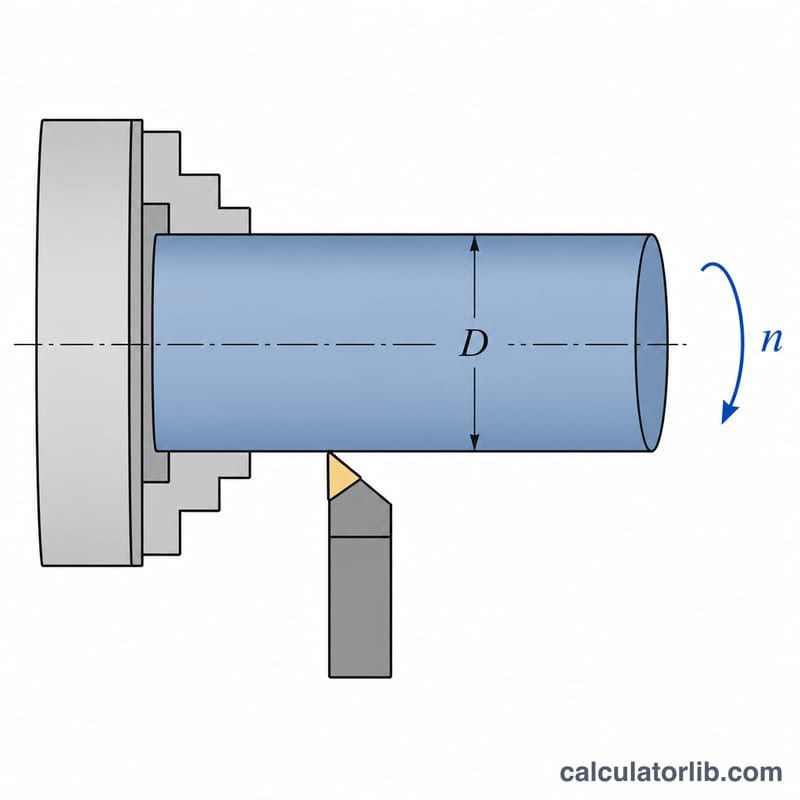
When you turn a part on a lathe, the tool removes material at a surface speed called the cutting speed, measured in metres per minute (m/min). This calculator converts a recommended cutting speed and the workpiece diameter into the spindle speed you should dial into the machine, measured in revolutions per minute (RPM). Choosing the right speed protects your tool, improves surface finish, and prevents overheating or premature wear.
The Formula Explained
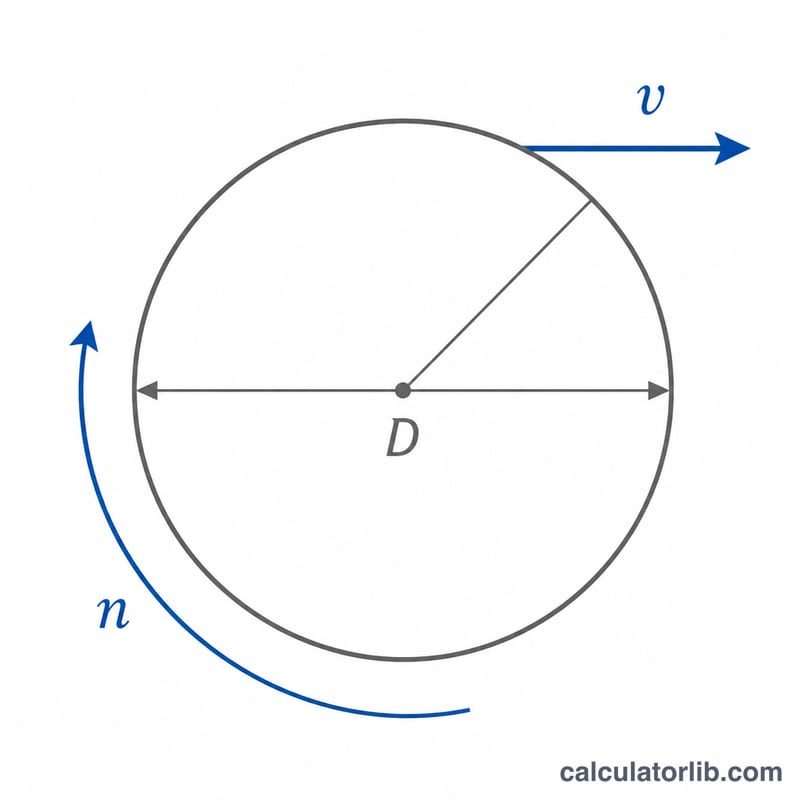
The spindle speed depends on how fast the surface of the part must move past the tool and how far that surface travels in one revolution (its circumference). The relationship is:
$$N = \frac{1000 \times V_c}{\pi \times D}$$where \(N\) = spindle speed in RPM, \(V_c\) = cutting speed in m/min, and \(D\) = workpiece diameter in mm. The factor \(1000\) converts metres to millimetres so the units cancel, and \(\pi \times D\) is the circumference the tool sweeps each revolution.
How to Use It
Look up the recommended cutting speed for your material and tool combination, enter it in m/min, then enter the largest diameter being cut in mm. The calculator returns the spindle speed to set. As the diameter decreases during facing or profiling, the required RPM rises to keep the surface speed constant.
Worked Example
Turning a bar of diameter \(D = 50\,\text{mm}\) at a cutting speed \(V_c = 100\,\text{m/min}\):
$$N = \frac{1000 \times 100}{\pi \times 50} = 636.62\,\text{RPM}$$So you would set the spindle to roughly 637 RPM.
FAQ
Why does smaller diameter need higher RPM? Because a smaller circumference means the tool covers less distance per turn, so the spindle must rotate faster to keep the same surface speed.
What cutting speed should I use? It depends on material and tool: soft aluminium allows high speeds, while hardened steel needs much lower speeds. Follow your tooling supplier chart.
Does this work for imperial units? This version expects metric inputs (m/min and mm). Convert imperial values first, or use the equivalent constant \(12\) with feet per minute and inches.