What is theoretical surface finish in turning?
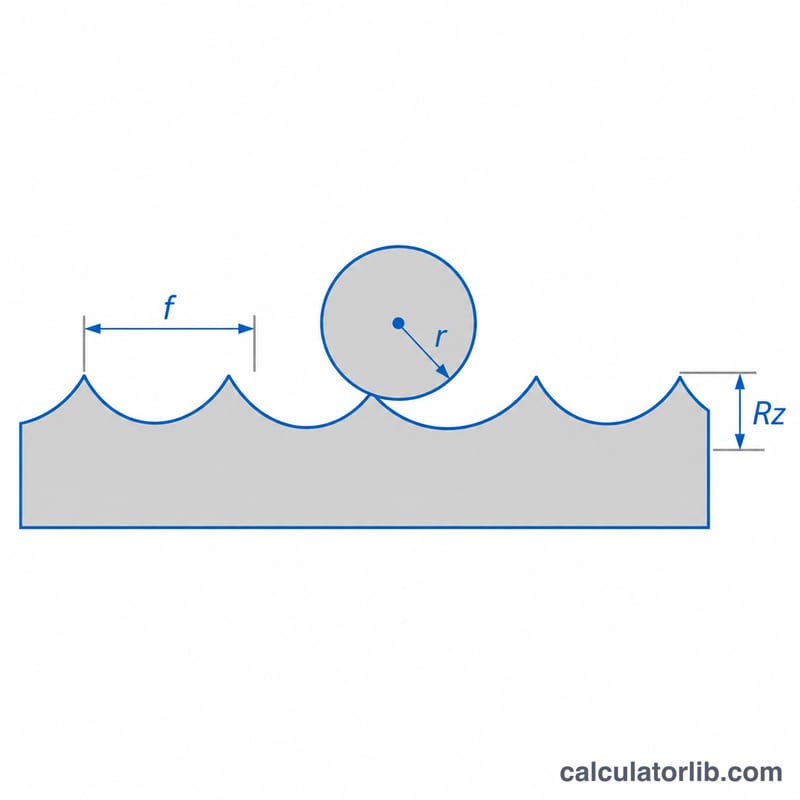
When a lathe tool with a rounded nose advances along a workpiece, it leaves a series of tiny scallops (feed marks). Their height depends almost entirely on the feed per revolution and the nose radius of the insert. This calculator estimates the ideal, geometric roughness of that profile, giving you a quick way to choose cutting parameters before you touch the machine.
How to use the calculator
Enter the feed per revolution in mm/rev, the nose radius of the insert in mm (for example 0.4, 0.8 or 1.2 mm), and the Ra you need in µm. The tool returns the theoretical Ra and Rz, Ra in microinches, the maximum feed that still meets your target, and a pass/fail indication.
The formula explained
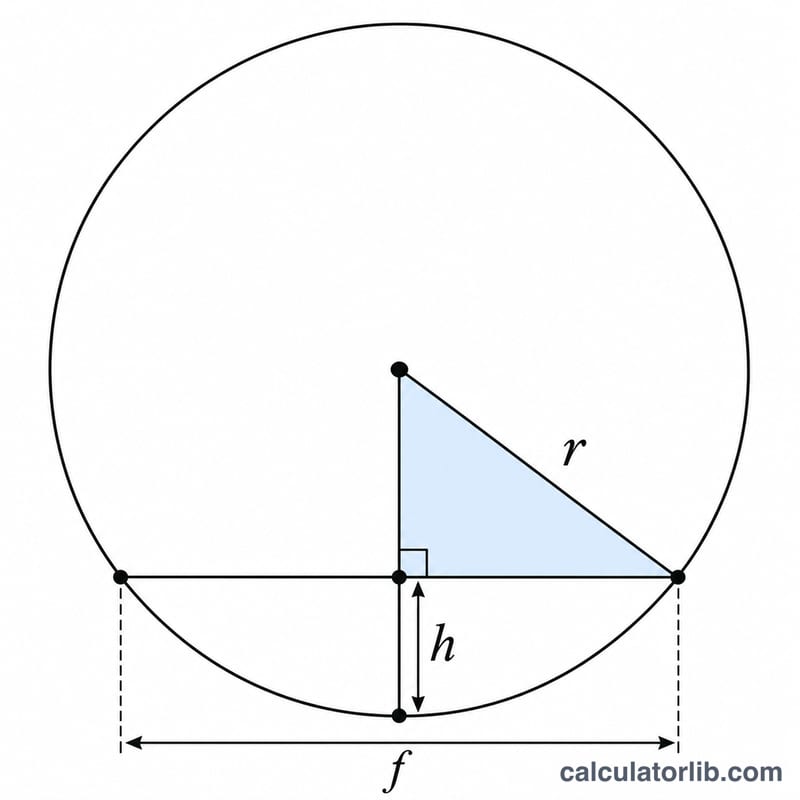
For a tool with nose radius \(r_\varepsilon\) and feed \(f\), where the feed is small compared with the radius:
$$R_a = \frac{f^2}{32\,r_\varepsilon}, \qquad R_z = \frac{f^2}{8\,r_\varepsilon}$$Here \(f\) is the feed in mm/rev and \(r_\varepsilon\) is the nose radius in mm; the result is in mm and is multiplied by 1000 for µm. Rearranging gives the largest feed for a target roughness:
$$f_{max} = \sqrt{32\,r_\varepsilon\,R_{a,target}}$$Because roughness grows with the square of the feed, halving the feed cuts Ra to a quarter, while doubling the nose radius only halves it.
Worked example
Take \(f = 0.2\) mm/rev and \(r_\varepsilon = 0.8\) mm:
$$R_a = \frac{0.2^2}{32 \times 0.8} = \frac{0.04}{25.6} = 0.0015625\,\text{mm} = 1.5625\,\mu\text{m}$$$$R_z = \frac{0.04}{6.4} = 6.25\,\mu\text{m}$$For a target of 1.6 µm, the maximum feed is \(\sqrt{32 \times 0.8 \times 0.0016} \approx 0.2024\) mm/rev, so this setup just meets the spec.
Typical Ra Values and Feed Ranges by Turning Operation
The table lists the Ra (arithmetic average roughness) usually achievable in each turning stage. These are general machining guidelines. Actual results vary with workpiece material, insert grade and geometry, cutting speed, machine rigidity, vibration and coolant.
| Operation | Typical achievable Ra (µm) |
|---|---|
| Rough turning | ≈ 6.3 – 25 |
| Semi-finish turning | ≈ 3.2 – 6.3 |
| Finish turning | ≈ 0.8 – 3.2 |
| Fine turning | ≈ 0.2 – 0.8 |
Common insert nose radii are 0.2, 0.4, 0.8, 1.2 and 1.6 mm. A larger radius allows a higher feed for the same theoretical Ra. As a rule of thumb, keep the feed at about 0.5 × nose radius or less. For finishing it is usually set well below that limit.
| Nose radius (mm) | Upper feed limit, 0.5 × r (mm/rev) | Typical finishing feed (mm/rev, approx.) |
|---|---|---|
| 0.2 | 0.10 | 0.03 – 0.08 |
| 0.4 | 0.20 | 0.05 – 0.15 |
| 0.8 | 0.40 | 0.10 – 0.25 |
| 1.2 | 0.60 | 0.15 – 0.35 |
| 1.6 | 0.80 | 0.20 – 0.40 |
The calculator gives the theoretical (geometric) roughness. Real surfaces are usually rougher because of built-up edge, tool wear, vibration and material tearing. Treat the result as a best-case estimate and check against trial cuts.
Feed vs. Nose Radius Comparison Table
Theoretical Ra in µm, from \(R_a = \frac{f^{2}}{32\,r_\varepsilon}\times 1000\), with feed \(f\) in mm/rev and nose radius \(r_\varepsilon\) in mm.
| Feed (mm/rev) | r = 0.4 mm | r = 0.8 mm | r = 1.2 mm |
|---|---|---|---|
| 0.05 | 0.20 | 0.10 | 0.07 |
| 0.10 | 0.78 | 0.39 | 0.26 |
| 0.15 | 1.76 | 0.88 | 0.59 |
| 0.20 | 3.13 | 1.56 | 1.04 |
| 0.30 | 7.03 | 3.52 | 2.34 |
Worked check for f = 0.1 mm/rev, r = 0.4 mm: \(R_a = \frac{0.1^{2}}{32 \times 0.4}\times 1000 = \frac{0.01}{12.8}\times 1000 = 0.78\ \mu m\).
Ra scales with the square of the feed and inversely with the nose radius. Halving the feed cuts Ra to a quarter, while doubling the radius only halves it. The theoretical peak-to-valley height is \(R_z = 4 R_a\), so f = 0.1 mm/rev with r = 0.4 mm gives Rz ≈ 3.13 µm.
Ra Roughness Conversion: µm, µin and ISO N Grades
The conversion factor is 1 µm = 39.37 µin, so 1 µin = 0.0254 µm. The table lists the ISO 1302 roughness grades (N numbers) with their Ra values and rounded µin equivalents. Drawings in inch units often use the rounded µin values.
| ISO grade | Ra (µm) | Ra (µin, approx.) |
|---|---|---|
| N12 | 50 | 2000 |
| N11 | 25 | 1000 |
| N10 | 12.5 | 500 |
| N9 | 6.3 | 250 |
| N8 | 3.2 | 125 |
| N7 | 1.6 | 63 |
| N6 | 0.8 | 32 |
| N5 | 0.4 | 16 |
| N4 | 0.2 | 8 |
| N3 | 0.1 | 4 |
| N2 | 0.05 | 2 |
| N1 | 0.025 | 1 |
Example: 1.6 µm × 39.37 ≈ 63 µin (N7). The µin column is rounded to the common drawing values, so exact conversions can differ slightly (for example 50 µm = 1969 µin, shown as 2000).
FAQ
Is the real finish equal to the theoretical value?
No. Built-up edge, tool wear, vibration, coolant and workpiece material usually make real roughness higher, often by a factor of 1.5 to 3. Treat the result as a best-case lower bound.
Does cutting speed matter?
Not in the geometric model, but in practice higher speeds often improve finish by suppressing built-up edge.
When is the formula invalid?
It assumes the depth of cut is larger than the nose radius edge contact and the feed is much smaller than the radius. Very large feeds or tiny depths of cut will deviate.