What is a pallet weight calculator?
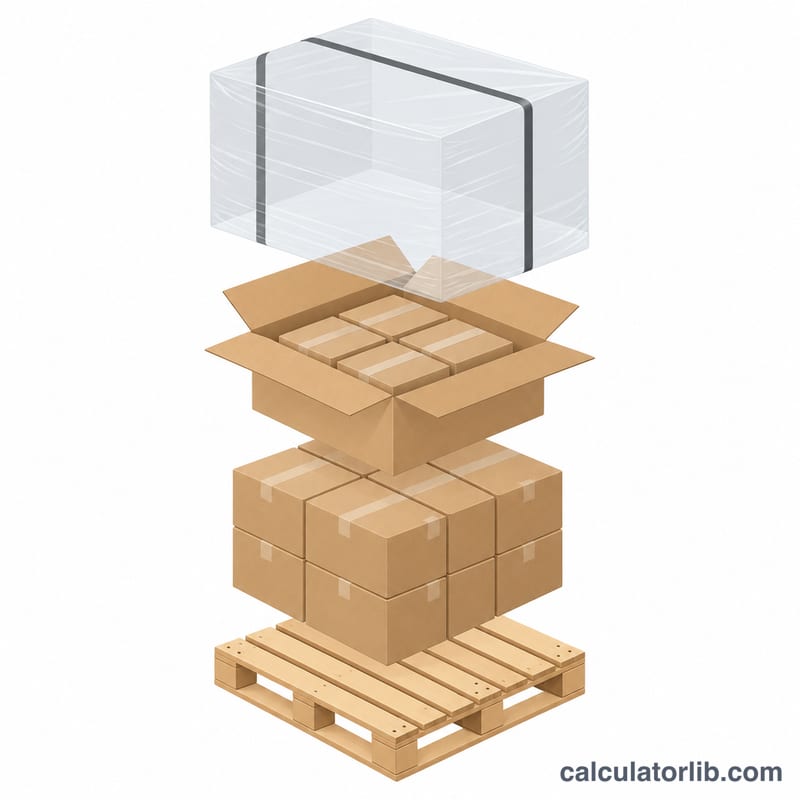
A pallet weight calculator adds up everything on a pallet: the products, the cartons holding them, the wooden or plastic pallet itself and any wrap or strapping. Knowing the loaded weight helps you choose the right carrier, stay within racking and truck limits, and quote freight accurately.
How to use it
Choose kilograms or pounds, then enter the weight of one product unit, the number of units in each carton, the empty carton weight, the number of cartons on the pallet, the empty pallet weight and any extras such as stretch wrap. Optionally enter a maximum allowed weight to see how much of the limit you are using. Use the same unit for every entry.
The formula explained
Let \(n\) be units per carton, \(w_u\) the unit weight, \(w_c\) the empty carton weight, \(N_c\) the number of cartons, \(W_p\) the pallet weight and \(W_e\) the extras.
$$W = N_c \times (n \times w_u + w_c) + W_p + W_e$$The percentage of a limit \(W_{max}\) used is:
$$P = \frac{W}{W_{max}} \times 100$$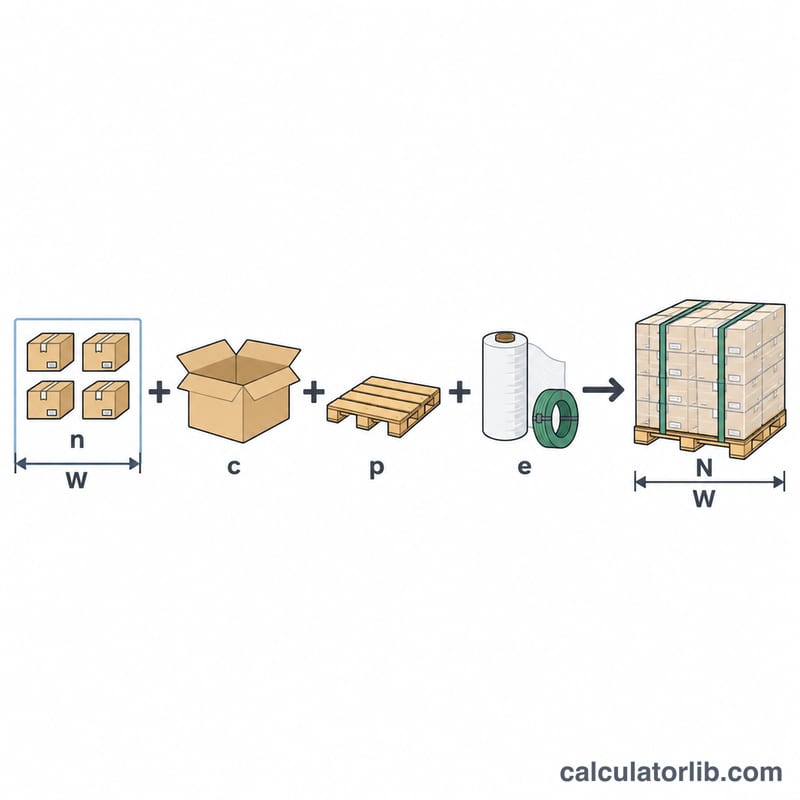
Worked example
A pallet holds 50 cartons. Each carton has 12 units of 0.5 kg and weighs 0.4 kg empty. The pallet weighs 20 kg and wrap adds 1 kg.
$$W = 50 \times (12 \times 0.5 + 0.4) + 20 + 1 = 50 \times 6.4 + 21 = 341\,\text{kg}$$Of this, 300 kg is product and 41 kg is packaging, pallet and extras.
Typical Pallet Sizes and Empty Weights
The values below are typical and approximate. Pallet weight varies with wood species, moisture content, board thickness, construction and manufacturer, so always weigh the actual pallet you use and enter that figure as the empty pallet weight.
| Pallet type | Typical dimensions | Typical empty weight |
|---|---|---|
| EUR / EPAL (Europe) | 1200 × 800 mm | about 20-25 kg (44-55 lb) |
| GMA / North American standard | 48 × 40 in (about 1219 × 1016 mm) | about 30-48 lb (roughly 14-22 kg) |
| Plastic pallet | Varies; often 1200 × 800 mm or 1200 × 1000 mm | about 10-20 kg (22-44 lb) |
| Lightweight / export pallet (e.g. thin wood, presswood, paper or light plastic) | Varies | often a few kg up to about 10 kg (roughly 7-22 lb) |
Extras reference
| Item | Typical weight |
|---|---|
| Stretch wrap per pallet | about 0.3-1 kg (0.7-2.2 lb) |
Straps, corner boards, top sheets, slip sheets and labels add further weight. Add them together in the "Wrap, straps and extras" field.
Typical Pallet Load Limits
The figures below are commonly cited, typical values, not guarantees. The real limit for your shipment depends on the specific pallet, racking system, carrier and truck rating.
| Context | Commonly cited figure |
|---|---|
| Standard GMA (48 × 40 in) pallet load capacity | about 2,000 lb (approx. 900 kg) in many guidelines |
| EUR pallet, dynamic load (moving, e.g. forklift) | about 1,500 kg |
| EUR pallet, static load | roughly 2,000-4,000 kg, depending on conditions such as floor versus racking support and load distribution |
| LTL freight and parcel/pallet courier services | Varies by carrier; many set a per-pallet maximum weight and height, so check the carrier's published rules |
What to check
- The manufacturer's rated capacity for the exact pallet, including whether it is dynamic, static or racking capacity.
- Racking beam ratings and whether the load is evenly distributed.
- The carrier's maximum pallet weight, height and dimensions, plus any surcharges.
- The truck or trailer payload rating and axle limits.
Enter your limit in the maximum weight field to compare it with the calculated total loaded weight. Never exceed the lowest applicable limit.
Kilogram and Pound Conversions
Exact relationships: 1 kg = 2.20462 lb (rounded) and 1 lb = 0.45359237 kg (exact by definition).
Kilograms to pounds
| kg | lb |
|---|---|
| 0.5 | 1.102 |
| 1 | 2.205 |
| 5 | 11.023 |
| 10 | 22.046 |
| 20 | 44.092 |
| 25 | 55.116 |
| 50 | 110.231 |
| 100 | 220.462 |
| 500 | 1,102.31 |
| 1000 | 2,204.62 |
Pounds to kilograms (typical pallet weights)
| lb | kg |
|---|---|
| 30 | 13.608 |
| 40 | 18.144 |
| 48 | 21.772 |
| 100 | 45.359 |
| 1,000 | 453.592 |
| 2,000 | 907.185 |
Use one unit consistently for every weight field in the calculator: unit weight, carton weight, pallet weight, extras and the maximum weight.
FAQ
Does the calculator include the pallet itself?
Yes. Enter the empty pallet weight; a standard wooden pallet often weighs roughly 15 to 25 kg, but weigh yours for accuracy.
Can I mix kilograms and pounds?
No. Enter all weights in the unit you selected, as the tool does not convert between them.
Is the result a legal shipping weight?
It is an estimate. Always confirm with a scale and check your carrier and equipment limits before shipping.