What is the Surface Roughness Ra Calculator?
The arithmetic average roughness, \(R_a\), is the most widely used parameter for describing the texture of a machined surface. It represents the average of the absolute vertical deviations of the measured profile from its mean line. This calculator computes \(R_a\) directly from a list of profile deviation measurements, so you can quickly quantify how smooth or rough a surface is.
The formula explained
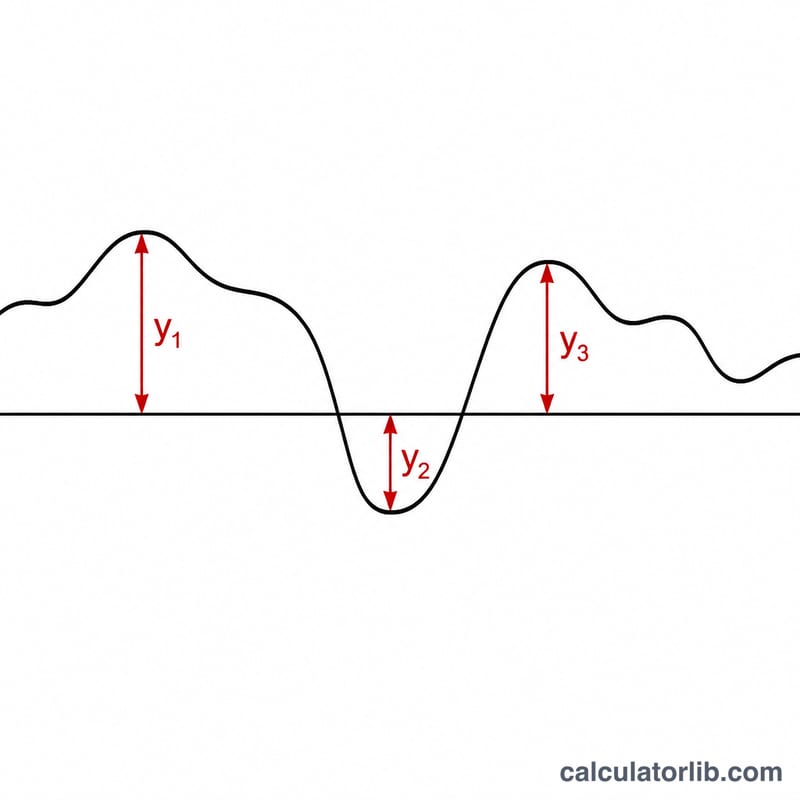
Given \(n\) sampled deviations \(y_i\) from the mean line, Ra is defined as:
$$R_a = \frac{1}{n}\sum_{i=1}^{n} \left| y_i \right|$$Here \(y_i\) is each individual deviation (positive above the mean line, negative below), \(\left| y_i \right|\) is its absolute value, and \(n\) is the total number of measurements. Taking absolute values ensures that peaks and valleys both add to the roughness rather than cancelling out.
How to use it
Enter your profile deviation measurements as a comma-separated list. The values should share consistent units, typically micrometers (\(\mu m\)) or microinches. The calculator sums the absolute values, divides by the number of readings, and returns Ra along with the count and the sum of absolute deviations.
Worked example
Suppose you measure five deviations: 1, -2, 3, -4, 5. Their absolute values are 1, 2, 3, 4, 5. The sum is:
$$\sum \left| y_i \right| = 1 + 2 + 3 + 4 + 5 = 15$$Dividing by \(n = 5\) gives:
$$R_a = \frac{15}{5} = 3$$So the arithmetic average roughness is \(R_a = 3\) in the same units as the input.
FAQ
Does the sign of each deviation matter? No. Ra uses absolute values, so a deviation of \(+2\) and \(-2\) contribute equally.
How is Ra different from Rq? Ra is the mean of absolute deviations, while \(R_q\) (RMS roughness) is the root mean square of the deviations, which weights larger peaks more heavily.
What units should I use? Any consistent unit works; the result is reported in the same unit as your inputs, commonly micrometers.