What this calculator does
The Welding Electrode Consumption Calculator estimates how many stick (MMA/SMAW) electrodes you will burn to complete a weld of a given length, size and joint type. It first works out the volume of deposited weld metal, converts that to a weight, and then divides by the amount of metal each electrode actually deposits. This helps welders, estimators and workshop managers order the right quantity of consumables and price a job accurately.
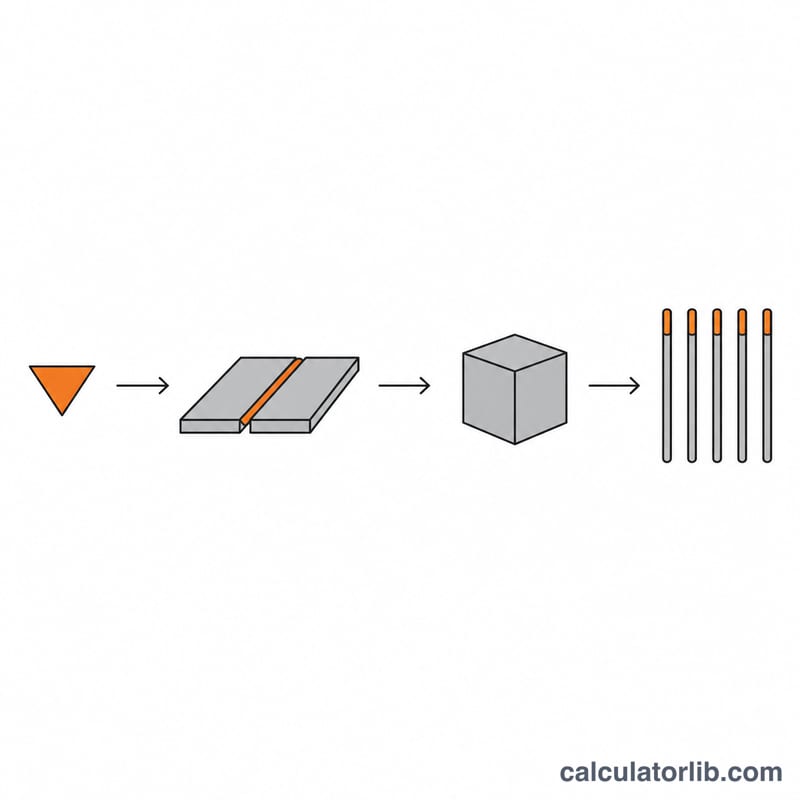
The formula explained
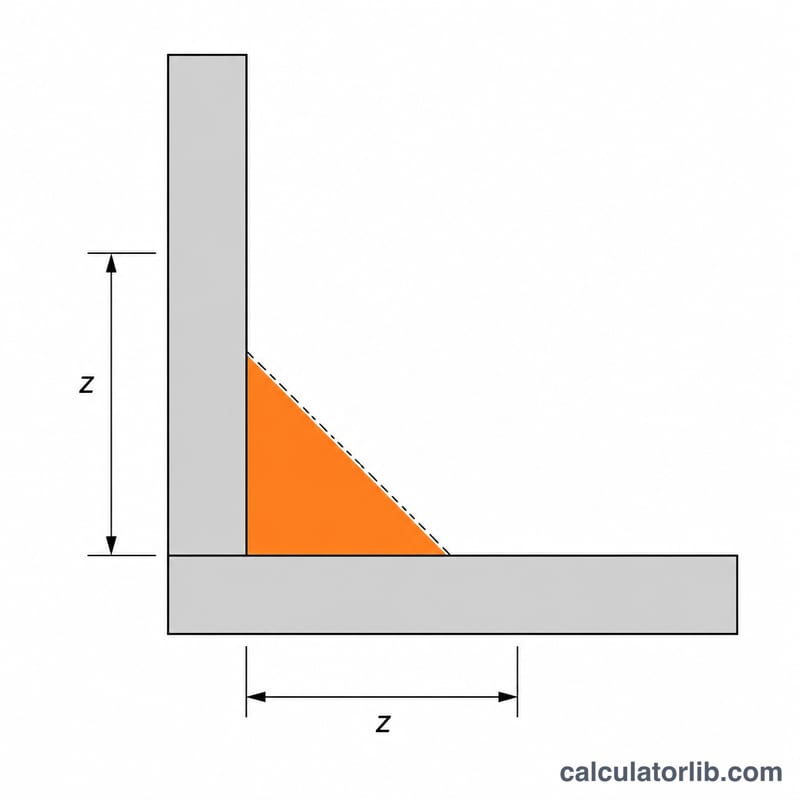
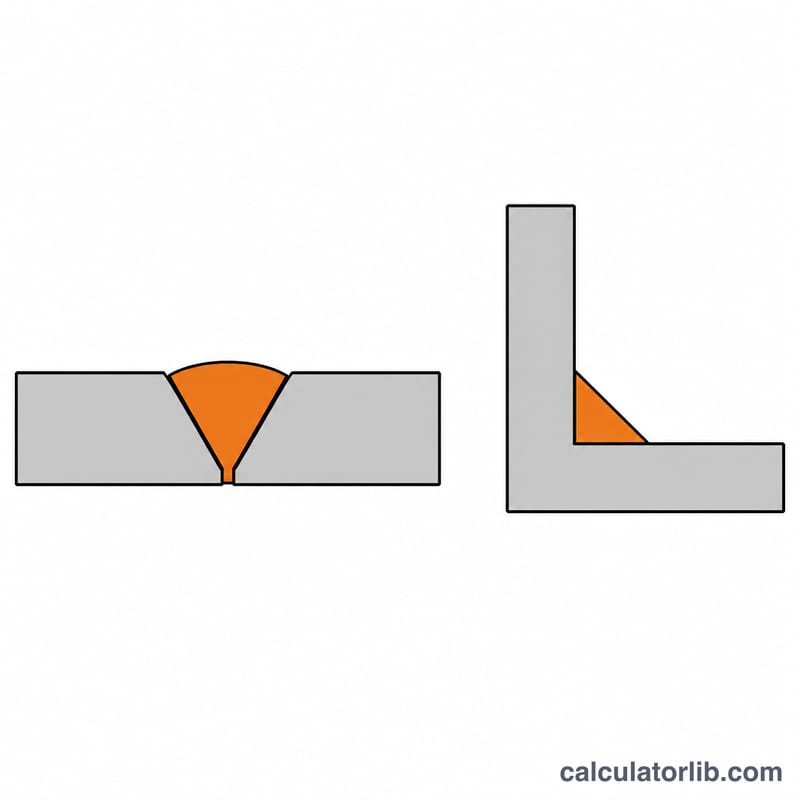
The deposited cross-sectional area depends on the joint. For a fillet weld the profile is a right triangle, so \(A = 0.5 \times s^2\); for a groove or butt weld a factor of \(1.0\) is used. The full model is:
$$A = k \times s^{2}, \qquad W = A \times L \times \rho, \qquad N = \left\lceil \frac{W}{m_e} \right\rceil$$where \(k\) = joint factor, \(s\) = weld size in mm, \(L\) = weld length in metres, \(\rho = 7.85\,\text{g/cm}^3\) (mild steel), and \(m_e\) = weld metal deposited per electrode in grams. Because area in mm² multiplied by length in m gives volume directly in cm³, the weight comes out neatly in grams.
How to use it
Select the joint type, enter the weld size (leg length for a fillet), the total weld length in metres, and the grams of weld metal one electrode deposits (from the electrode data sheet). The tool returns the weld metal weight and the number of electrodes, rounded up.
Worked example
A 6 mm fillet weld, 10 m long, using electrodes that each deposit 30 g:
$$A = 0.5 \times 6^{2} = 18\,\text{mm}^2$$$$W = 18 \times 10 \times 7.85 = 1413\,\text{g}$$$$N = \frac{1413}{30} = 47.1 \Rightarrow 48\ \text{electrodes}$$FAQ
Does this include stub loss and spatter? Use the metal actually deposited per electrode (which already accounts for deposition efficiency, stub end and spatter) for the most realistic count.
What density should I use? Mild steel is \(7.85\,\text{g/cm}^3\); adjust mentally for stainless or aluminium if needed.
Why round up? You cannot buy a fraction of an electrode, so the result is always rounded to the next whole electrode.