What Is Ore Grade?
Ore grade expresses how much valuable metal is contained in a rock sample relative to its total mass. It is the single most important number in mining economics, because it determines whether a deposit is worth extracting and processing. Grade is usually reported as a percentage for base metals such as copper, lead, and zinc, or in grams per tonne (g/t) for precious metals such as gold and silver.
How to Use This Calculator
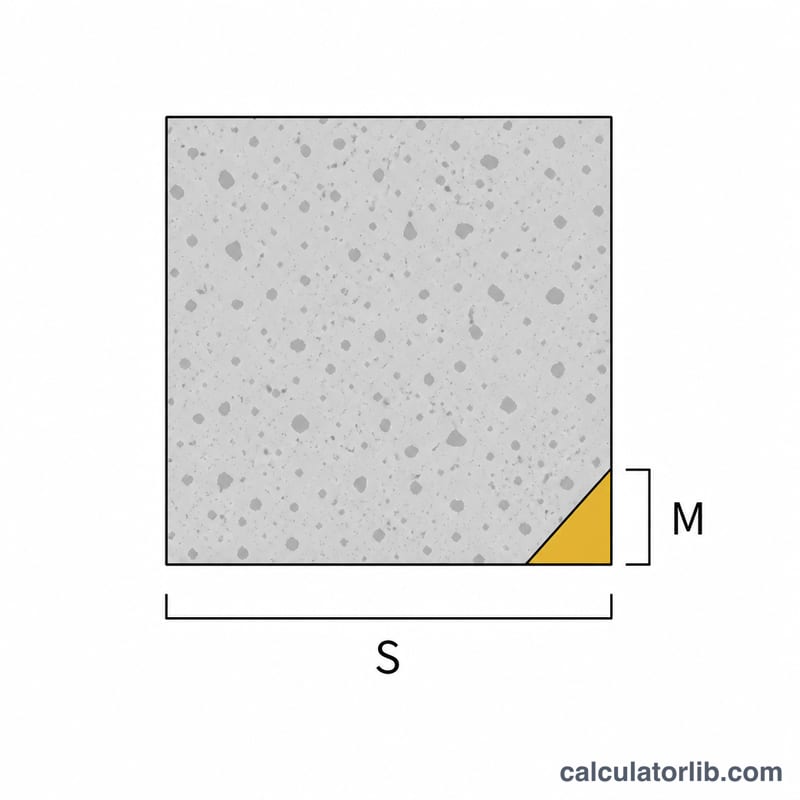
Enter the weight of your assay sample in grams, the mass of metal recovered or measured in that sample in grams, and optionally the total ore tonnage of your deposit. The calculator returns the grade as a percentage, the equivalent grade in grams per tonne, and an estimate of the total contained metal.
The Formula Explained
Grade is simply the ratio of metal mass to sample mass, scaled to a percentage:
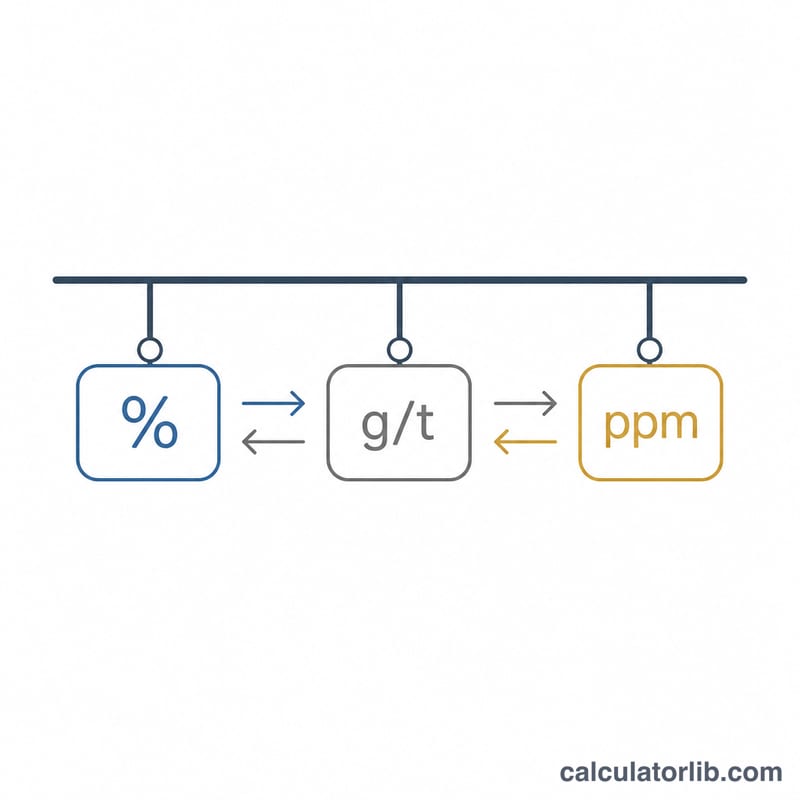
$$\text{Grade}\,(\%) = \frac{m_{metal}}{m_{sample}} \times 100$$where \(m_{metal}\) is the metal mass and \(m_{sample}\) is the sample mass, both in the same units. The grams-per-tonne value is \(\frac{m_{metal}}{m_{sample}} \times 10^{6}\), and contained metal is \(\frac{\text{Grade}}{100} \times T_{ore}\).
Worked Example
Suppose an assay sample weighs 1,000 g and contains 15 g of metal, from a deposit of 5,000 t. The grade is:
$$\text{Grade} = \frac{15}{1000} \times 100 = 1.5\%$$The contained metal is:
$$M = \frac{1.5}{100} \times 5000 = 75\,\text{t}$$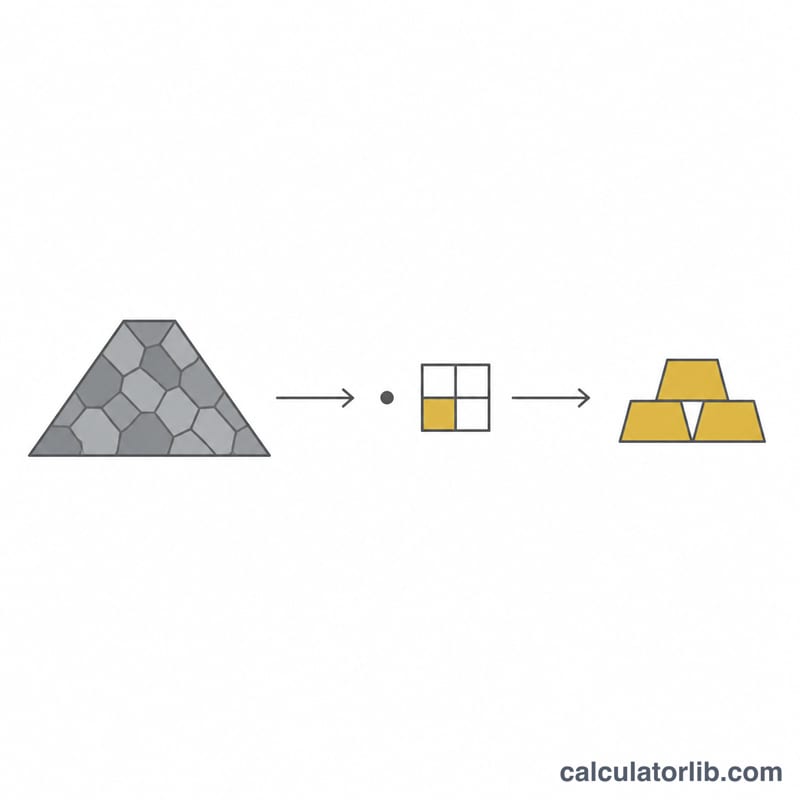
Typical Ore Grades by Metal
The values below are approximate, globally representative ranges for how rich mined ore commonly is, alongside indicative cut-off grades — the minimum grade at which material is worth processing rather than treating as waste. Units are shown as a percentage (%) or grams per tonne (g/t) to match this calculator's outputs. These figures are broad industry generalizations, not a standard tied to any single country, and actual numbers vary widely from one deposit to another.
| Metal | Typical mined grade | Approx. economic cut-off | Common notes |
|---|---|---|---|
| Copper (Cu) | ~0.4–2% | ~0.2–0.4% | Large open-pit porphyry deposits are mined at the lower end; underground vein/skarn deposits are typically higher grade. |
| Gold (Au) | ~1–10 g/t | ~0.3–0.5 g/t (open pit); ~2–5 g/t (underground) | Low cut-offs suit bulk open-pit heap-leach or milling; underground mining needs higher grades to justify cost. |
| Silver (Ag) | ~50–500 g/t | varies widely by deposit | Often a by-product of lead, zinc, gold, or copper ores, which affects its stand-alone cut-off. |
| Zinc (Zn) / Lead (Pb) | ~3–10% | ~2–4% | Commonly mined together in polymetallic (e.g. sediment-hosted or VMS) deposits, frequently with silver credits. |
| Nickel (Ni) | ~0.5–2% | ~0.3–0.5% (sulfide) | Sulfide ores are typically higher grade and cheaper to process than laterite ores. |
Cut-off grades are not fixed constants: they move with the metal price, mining method (open pit vs. underground), processing and recovery costs, depth, and by-product credits. A grade that is economic at one mine can be waste at another. Use these ranges only as a general orientation for the grade your assay produces, not as a threshold for any specific project.
Interpreting Your Ore Grade
The grade this tool reports — whether as a percentage or in grams per tonne — tells you the concentration of the target metal in your sample, using \(\text{Grade}\,(\%) = \frac{\text{Metal Mass}}{\text{Sample Mass}} \times 100\). It describes how rich the material is, but on its own it does not tell you whether the ore is profitable to mine.
A useful first step is to compare your computed grade against the typical mined grades and cut-off grades for that metal in the reference table above. As a general framing used in mining economics:
- High-grade ore sits well above the deposit's cut-off. It contains more metal per tonne, so fewer tonnes must be mined and processed for the same metal output — generally more forgiving of cost and price swings.
- Low-grade or marginal ore sits near the cut-off. It can still be economic at large scale or when prices are high, but it is more sensitive to changes in cost, recovery, and metal price.
- Material below the cut-off is generally treated as waste, because the metal it contains is worth less than the cost to extract and process it.
Grade is only one input to economic viability. The metal actually sold depends on the recovery rate (the fraction the processing plant can extract — often well below 100%), while whether that recovered metal earns a profit depends on the prevailing metal price and the combined mining and processing cost per tonne. A high grade with poor recovery, high costs, or a low price can be uneconomic, while a modest grade with cheap bulk mining and good recovery can be viable. This is a factual, general explanation of how grade is interpreted in mining economics and is not financial advice; project decisions rely on detailed technical and economic studies specific to each deposit.
FAQ
Why report grade in grams per tonne? For precious metals the percentage is tiny, so g/t gives more readable numbers. A 1.5% grade equals 15,000 g/t.
Does higher grade always mean profit? No. Recovery rate, metal price, and mining cost all matter, but higher grade generally lowers the cost per unit of metal.
Can I use any units? Yes, as long as metal mass and sample mass share the same unit, since the ratio cancels the units out.