
What is the LTL Shipping Cost Calculator?
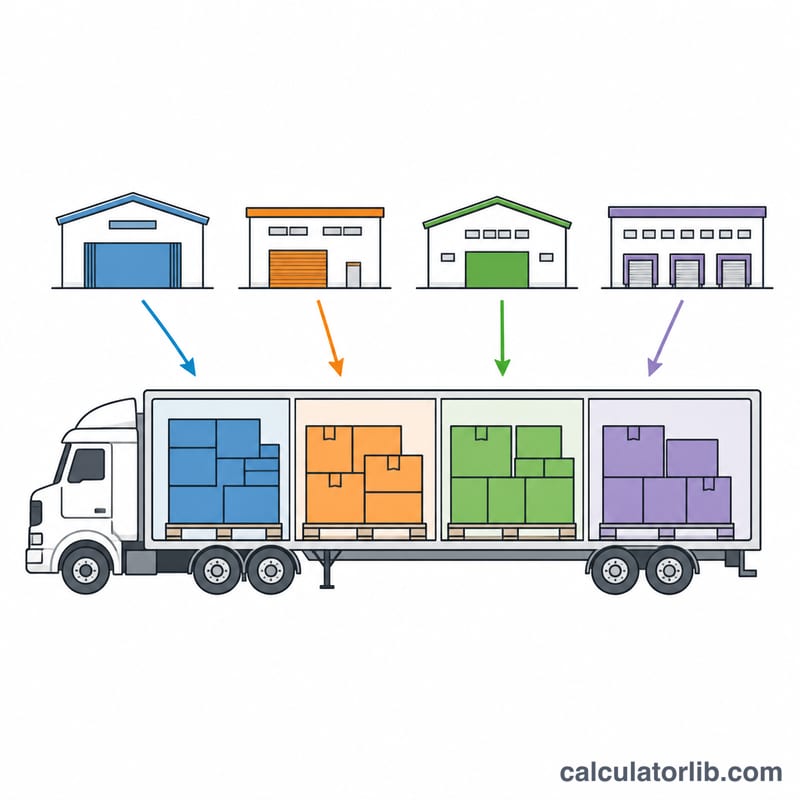
Less-than-truckload (LTL) shipping is used when a freight shipment is too large for parcel service but does not fill an entire trailer. Carriers price LTL freight using a blend of the shipment weight, the freight class of the commodity, the distance traveled, and a negotiated base rate. This calculator gives a fast, transparent estimate so you can budget a shipment or compare quotes before booking.
How the formula works
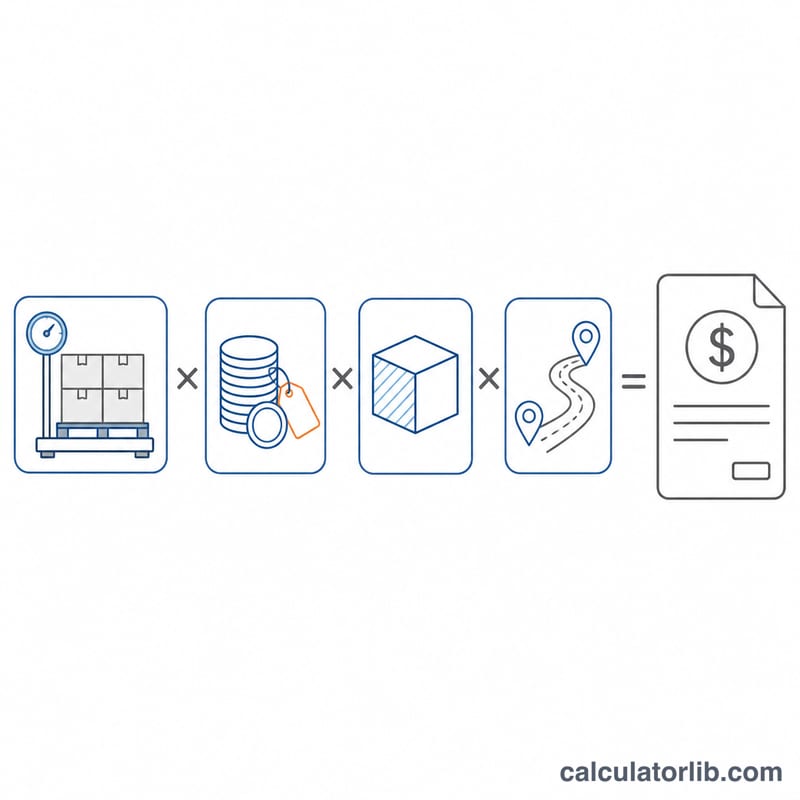
The estimate multiplies four drivers. Let \(W\) = weight in pounds, \(R\) = rate in dollars per hundredweight per 100 miles, \(C\) = freight class, and \(D\) = distance in miles. The full model is:
$$\text{Cost} = \frac{W}{100} \times R \times \frac{C}{100} \times \frac{D}{100}$$Weight is converted to hundredweight (CWT) with \(\frac{W}{100}\), the freight class is turned into a factor with \(\frac{C}{100}\) so that class 100 is neutral, and distance is scaled in 100-mile blocks. Higher freight classes describe lighter, bulkier, or higher-liability goods and therefore raise the cost.
How to use it
Select the freight class of your commodity, enter the total billable weight in pounds, the shipping distance in miles, and your carrier base rate. The calculator returns the estimated total charge plus the intermediate hundredweight, class factor, and distance units so you can see how the price is built.
Worked example
Ship 1,000 lbs of class 100 freight 500 miles at a rate of 10:
$$\text{Cost} = \frac{1000}{100} \times 10 \times \frac{100}{100} \times \frac{500}{100} = 10 \times 10 \times 1 \times 5 = \$500$$So the estimated freight charge is $500.
FAQ
Is this the exact price my carrier will charge? No. Real quotes include fuel surcharges, accessorial fees, and minimum charges. Use this as a planning estimate.
What is freight class? It is a standardized code from 50 to 500 based on density, stowability, handling, and liability. Lower classes cost less per hundredweight.
What does the rate represent? It is your base cost in dollars per hundredweight per 100 miles, typically set by your carrier contract or tariff.