What is the Animal Feed Ration Calculator?
The Animal Feed Ration Calculator estimates how much feed a single animal should receive each day based on its body weight and simple nutritional targets. It is a planning tool for farmers, ranchers, and animal science students who need a quick, defensible starting point for balancing a livestock diet before fine-tuning it with lab analysis or a nutritionist.
How to use it
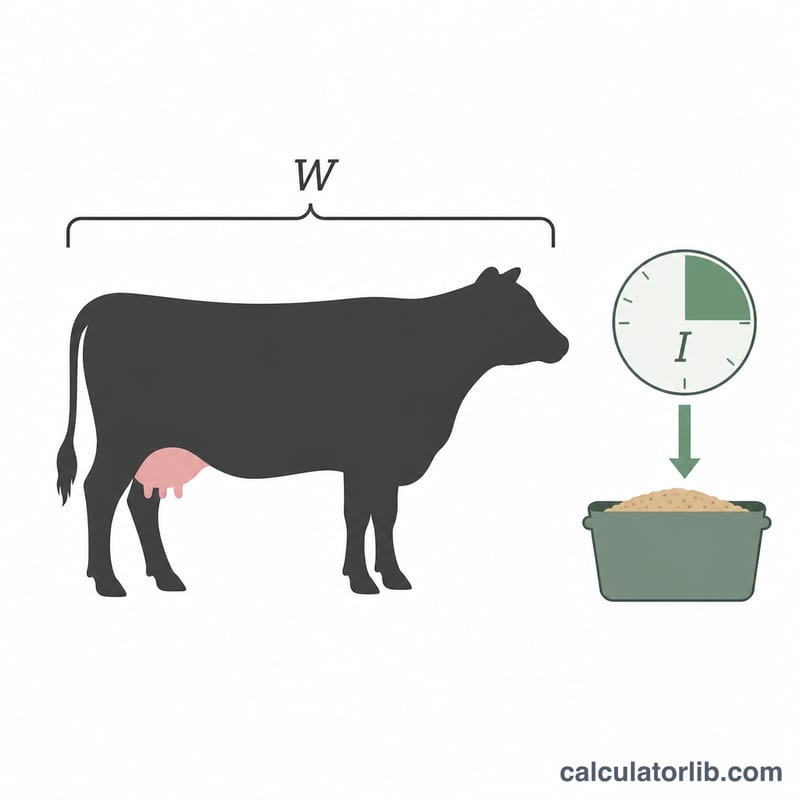
Enter the animal body weight \(W\) in kilograms, the target dry matter intake \(I\) as a percent of body weight (roughly 2%\ to 3% for mature cattle, higher for young or high-producing animals), the dry matter content \(D\) of the feed as offered, and the crude protein target \(C\) for the diet. The calculator returns the daily dry matter intake, the equivalent as-fed feed amount, and the crude protein required.
The formula explained
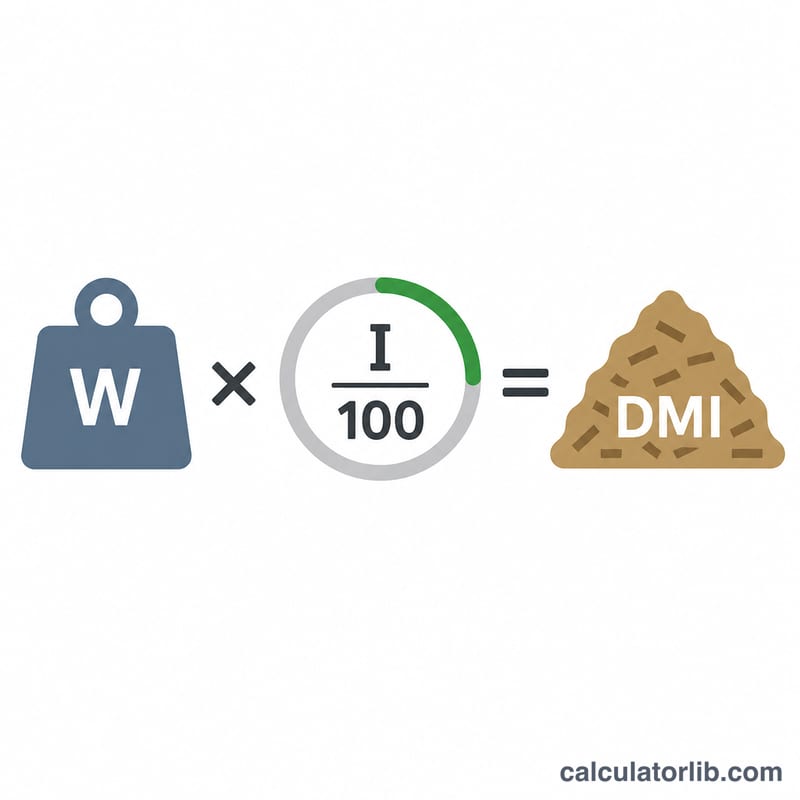
Dry matter intake scales directly with body weight:
$$\text{DMI} = W \times \frac{I}{100}$$Because feeds contain water, the as-fed amount is larger than the dry matter figure. Dividing by the dry matter fraction converts to the amount you actually weigh out:
$$\text{As-Fed} = \frac{\text{DMI}}{D/100}$$The daily crude protein need is the dry matter intake multiplied by the diet protein target, \(\text{CP} = \text{DMI} \times \tfrac{C}{100}\).
Worked example
For a 600 kg cow eating 2.5% of body weight, from an 88% dry matter feed at a 14% protein target:
$$\text{DMI} = 600 \times \frac{2.5}{100} = 15\,\text{kg}$$$$\text{As-Fed} = \frac{15}{0.88} \approx 17.05\,\text{kg}$$$$\text{CP} = 15 \times 0.14 = 2.1\,\text{kg}$$Feed & Livestock Reference Values
The tables below are general planning references only. Actual intake, feed dry matter, and protein needs vary with breed, body condition, environment, feed quality, and production level. Always verify against a local feed analysis and, where possible, guidance from a livestock nutritionist or extension service before finalizing a ration.
Typical Dry Matter Intake (DMI) Rates
Expressed as a percentage of body weight, on a dry matter basis. These feed into the calculator as the intake rate.
| Livestock class / stage | Typical DMI (% of body weight) |
|---|---|
| Mature beef cow (dry, maintenance) | 2.0–2.5% |
| Lactating beef cow | 2.3–2.7% |
| Growing calf / stocker | 2.5–3.0% |
| Lactating dairy cow | 3.0–4.0% |
| Sheep (ewe, maintenance) | 2.0–3.0% |
| Lactating ewe | 3.0–4.0% |
| Goat (maintenance) | 2.0–3.0% |
| Lactating / growing goat | 3.0–4.0% |
Dry Matter Content of Common Feeds
The remainder of each feed is moisture. Lower dry matter content means more as-fed weight is needed to deliver the same dry matter. This feeds into the calculator as the feed dry matter value.
| Feed | Approximate dry matter content |
|---|---|
| Fresh / lush pasture | ~20% (often 15–25%) |
| Silage | ~30–40% |
| Hay | ~85–90% |
| Grain / concentrate | ~88–90% |
Common Crude Protein (CP) Targets
Expressed as a percentage of the ration on a dry matter basis. Requirements rise sharply with lactation and rapid growth.
| Class / stage | Typical CP target (% of dry matter) |
|---|---|
| Dry cow / maintenance | ~8–10% |
| Growing animal | ~12–16% |
| Lactating animal | ~14–18% |
The core calculation for dry matter intake is \(\text{DMI} = W \times \frac{I}{100}\), where \(W\) is body weight and \(I\) is the intake rate as a percent of body weight. To convert a dry matter amount to an as-fed amount, divide by the feed's dry matter fraction: \(\text{As-fed} = \dfrac{\text{DMI}}{\,\text{DM}\%/100\,}\).
Practical Feeding Recommendations
Once you have the calculated as-fed amount, use these steps to turn it into a workable daily feeding plan:
- Add a margin for refusals and waste. Offer roughly 5–10% more than the calculated amount, since animals sort feed and some is trampled, soiled, or left in the bunk.
- Round up to a practical weighable amount. Adjust to something you can measure reliably with your scale, bucket, or bale (for example, to the nearest 0.5 kg or whole flake) rather than an exact fractional figure.
- Split the daily ration into two or more feedings. Dividing the total into two or more meals per day supports steadier intake and rumen function, especially for higher-producing animals and concentrate-heavy rations.
- Transition ration changes gradually. When switching feeds or increasing concentrate, phase the change in over about 7–14 days to let rumen microbes and appetite adjust and to reduce digestive upset.
- Ensure constant access to clean water. Water intake drives feed intake; a shortage of clean water quickly reduces how much an animal eats.
- Reweigh and recalculate regularly. Body weight, growth, and production stage change over time, so update the inputs and re-run the calculation as animals grow, move between stages, or as pasture and feed quality shift.
This is general planning information, not veterinary or professional nutrition advice. Ration needs vary by animal, feed quality, and local conditions, so confirm plans with a qualified livestock nutritionist, veterinarian, or extension service and base them on an actual feed analysis.
FAQ
What intake rate should I use? Around \(2.5\%\) of body weight is typical for mature ruminants; growing, lactating, or lightweight animals often eat more per kilogram.
Why is as-fed higher than dry matter? As-fed feed still contains moisture, so you must offer more total weight to deliver the same dry matter.
Is this a complete ration balancer? No. It gives quantity and a single protein target; balance energy, minerals, and vitamins with full feed analysis for production diets.