What is hull displacement?
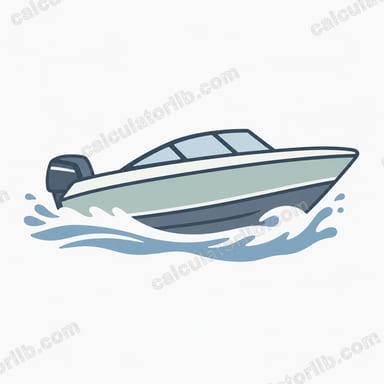
A floating boat pushes aside a volume of water whose weight exactly equals the weight of the boat. That weight is called the hull displacement. This calculator estimates it from four hull dimensions so you can size a design, check trailer or crane capacity, or compare vessels. The submerged shape is approximated with a block coefficient \(C_b\), which describes how full or fine the hull is relative to a rectangular box.
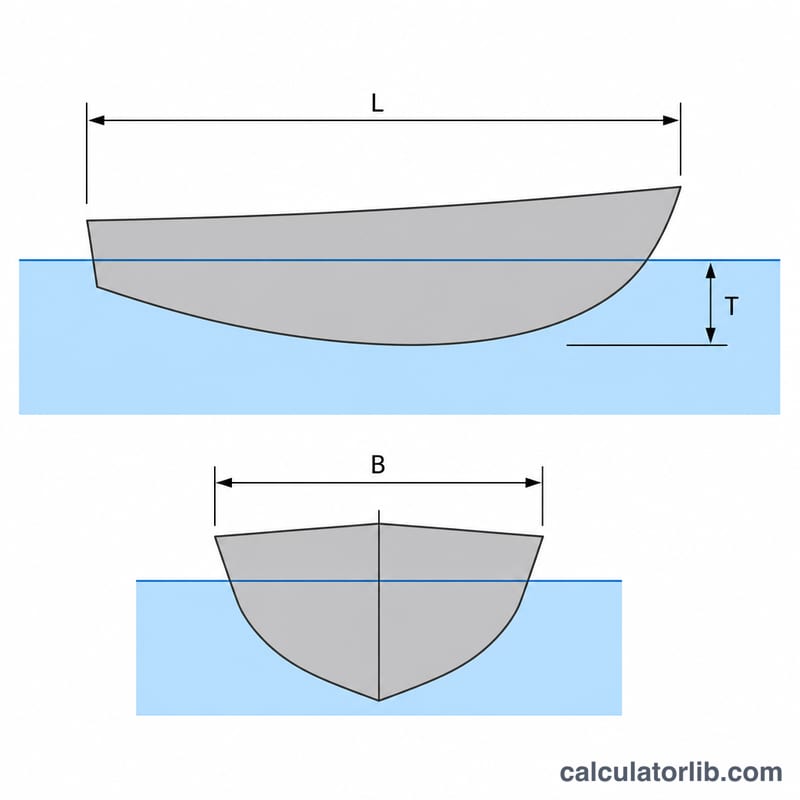
The formula
First the submerged volume is found, then it is multiplied by water density \(\rho\):
$$V = L \times B \times T \times C_b$$ $$\Delta = V \times \rho$$Here \(L\) = waterline length in metres, \(B\) = beam (width) in metres, \(T\) = draft (submerged depth) in metres, \(C_b\) = block coefficient (typically \(0.4\) for fine sailing hulls to \(0.8\) for full barges), and \(\rho\) = water density (\(1025\) kg/m3 for seawater, \(1000\) kg/m3 for freshwater).
How to use it
Enter the waterline length, beam and draft at the loaded condition, pick a block coefficient for your hull type, and choose the water. The result shows the displaced volume in cubic metres and the displacement as mass in kilograms and metric tonnes.
Worked example
A hull with \(L = 10\) m, \(B = 3\) m, \(T = 1\) m, \(C_b = 0.5\) in seawater:
$$V = 10 \times 3 \times 1 \times 0.5 = 15\,\text{m}^3$$ $$\Delta = 15 \times 1025 = 15375\,\text{kg} = 15.375\,\text{t}$$Typical Block Coefficients by Hull Type
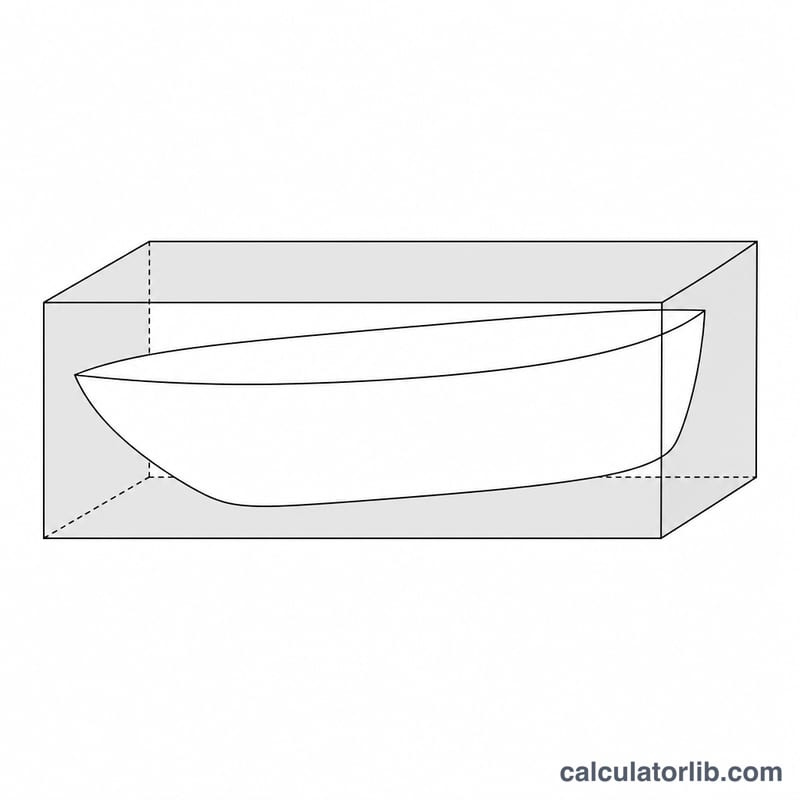
The block coefficient \(C_b\) describes how "full" or boxy a hull is below the waterline. It is defined as the ratio of the submerged hull volume to the volume of the enclosing rectangular block formed by the waterline length \(L\), beam \(B\) and draft \(T\):
$$C_b = \frac{\nabla}{L \times B \times T}$$
A value near 1.0 describes an almost box-shaped hull; the fine, tapered hulls of fast vessels have much lower values. The ranges below are general engineering rules of thumb used in preliminary naval-architecture estimates — always use a measured or design value for \(C_b\) when one is available, as an individual hull can fall outside its category's typical band.
| Hull / vessel type | Typical \(C_b\) |
|---|---|
| Fine sailing yacht / racing hull | 0.35 – 0.45 |
| Cruising sailboat | 0.45 – 0.55 |
| Planing motorboat | 0.45 – 0.55 |
| Trawler / displacement motor cruiser | 0.55 – 0.65 |
| Coastal cargo / fishing vessel | 0.65 – 0.75 |
| Full-form barge / tanker | 0.80 – 0.90 |
Lower coefficients (finer hulls) reduce resistance and suit higher speeds, while higher coefficients maximize cargo volume for a given set of dimensions. When entering a value in the calculator's block_coef field, pick the figure that best matches your hull form, or refine it if you know the actual submerged volume.
FAQ
What block coefficient should I use? Fine, fast hulls sit near \(0.4\)-\(0.5\); cargo and displacement hulls sit near \(0.6\)-\(0.8\).
Why does seawater differ from freshwater? Seawater is denser, so the same hull displaces slightly more weight in the sea than in a lake.
Is this exact? It is an estimate. Real hulls have curved sections, so a measured lines plan gives the most accurate volume.