What this calculator does
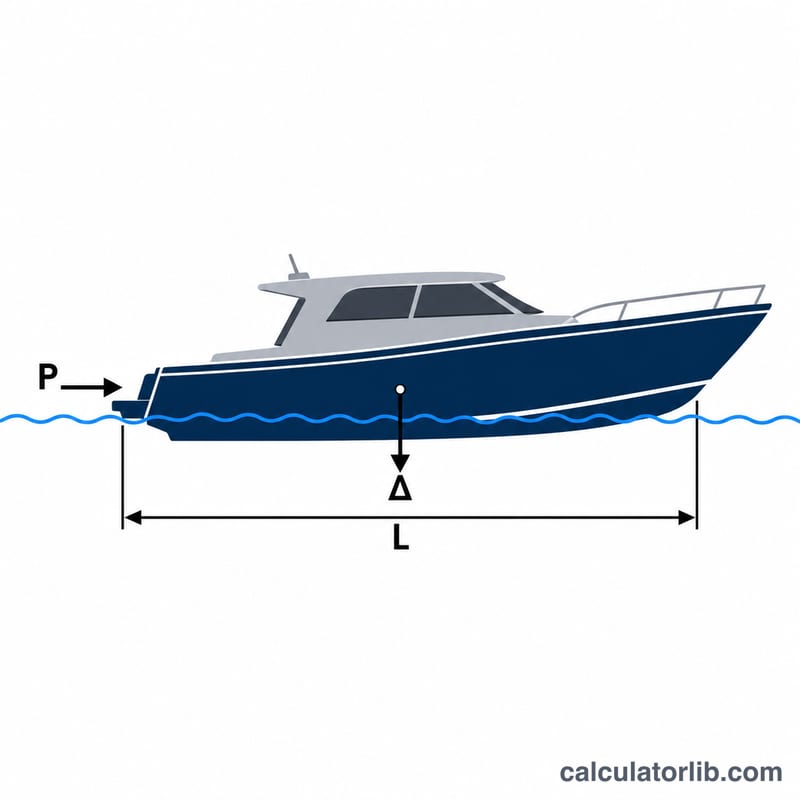
A semi-displacement hull runs between the classic displacement limit and full planing. It is partly supported by buoyancy and partly by dynamic lift, so its top speed depends on both waterline length and the power available per unit of weight. This calculator estimates the achievable speed in knots from waterline length (LWL, feet), displacement (pounds) and engine power at the propeller (horsepower), then reports the speed-length ratio and the operating regime.
How to use it
Enter the waterline length, the loaded displacement, the delivered horsepower and a hull constant C. Typical values are about 120-150 for heavier semi-displacement cruisers and 150-190 for lighter, finer hulls and fast runabouts. Use shaft horsepower rather than the crankshaft rating if you know it, because gearbox and shaft losses reduce what reaches the propeller.
The formulas
Speed is estimated with the Crouch relation, where \(\Delta\) is displacement in pounds, \(P\) is power in horsepower and \(C\) is the hull constant:
$$V = \frac{C}{\sqrt{\Delta / P}}$$The speed-length ratio and the traditional displacement hull speed are:
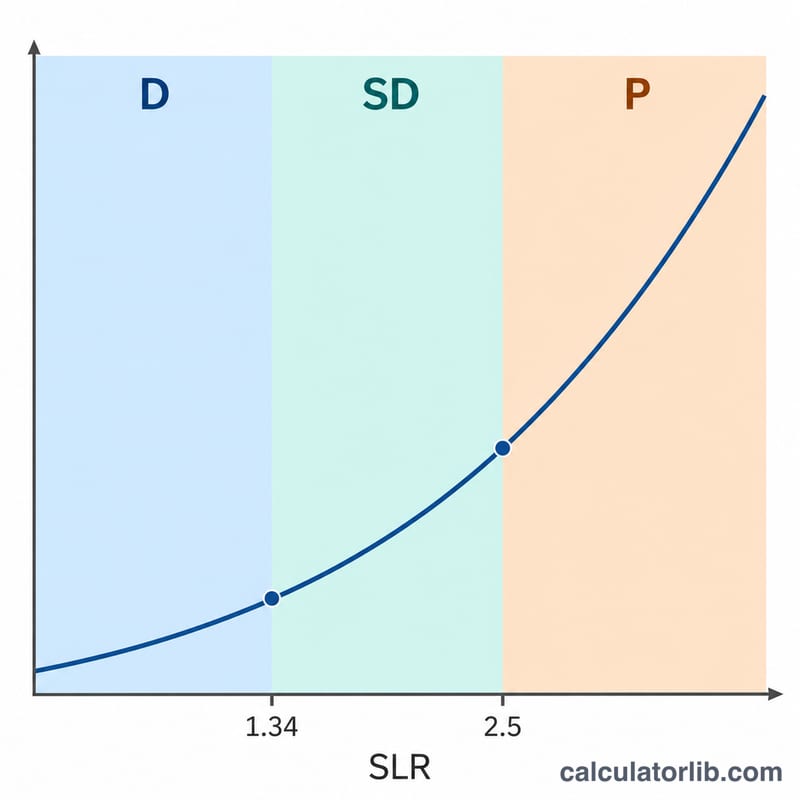
$$\text{SLR} = \frac{V}{\sqrt{\text{LWL}}}, \qquad V_{hull} = 1.34\sqrt{\text{LWL}}$$An SLR below about 1.34 means displacement mode, roughly 1.34 to 3.0 is semi-displacement, and above 3.0 the hull is planing.
Worked example
A boat has \(\text{LWL} = 40\) ft, \(\Delta = 30{,}000\) lb, \(P = 300\) hp and \(C = 150\).
$$V = \frac{150}{\sqrt{30000/300}} = \frac{150}{10} = 15\,\text{kn}$$$$\text{SLR} = \frac{15}{\sqrt{40}} = \frac{15}{6.325} = 2.37$$The classic hull speed is \(1.34 \times 6.325 = 8.47\) kn, so the boat runs at about 1.77 times hull speed and falls in the semi-displacement range.
Typical Hull Constant (C) Values by Hull Type
The Crouch formula, \(V = C / \sqrt{\Delta / P}\), uses speed \(V\) in knots, displacement \(\Delta\) in pounds, power \(P\) in horsepower and an empirical constant \(C\). The table lists commonly quoted approximate ranges for \(C\) (with imperial inputs) and the speed-length ratio (SLR = V/√LWL, LWL in feet) you can expect for each hull type.
| Hull type | Typical C | Typical SLR range |
|---|---|---|
| Heavy displacement-type trawlers and cruisers | about 120-140 | about 0.9-1.5 |
| Semi-displacement cruisers | about 140-160 | about 1.5-2.5 |
| Fast light cruisers and runabouts | about 160-190 | about 2.0-3.0 |
| Light high-speed planing craft | about 190-220 | above 3.0 |
Note: these values are approximate rules of thumb, not guarantees. The SLR ranges also depend on the power-to-weight ratio. Hull form, propeller efficiency, loading, trim and sea state all shift the real figure. Calibrate C against a similar boat with known speed, weight and power before relying on the result.
Speed-Length Ratio Regimes
The speed-length ratio is \(\text{SLR} = V / \sqrt{\text{LWL}}\), with V in knots and LWL in feet. The bands below are the conventional boundaries between hull-speed regimes. The transitions are gradual, not sharp.
| SLR band | Regime | Hull behavior | Typical hulls |
|---|---|---|---|
| Below 0.9 | Displacement | Wave-making resistance is low and rises gradually. The hull sits at its static trim, with little squat and no dynamic lift. | Sailboats at cruising speed, trawlers, tugs, workboats |
| 0.9-1.34 | Upper displacement | Wave-making resistance rises steeply as the bow and stern waves lengthen toward the hull length. The stern squats and the bow-up trim increases. Power needs climb rapidly near SLR 1.34 (classic hull speed). | Full-displacement trawlers, sailboats, long-range cruisers |
| 1.34-3.0 | Semi-displacement / transitional | The hull rides over the hump in the resistance curve. Dynamic lift grows, the stern squats at first, and the bow is higher. Resistance is high, and trim control (hull shape, trim tabs, weight placement) matters. | Semi-displacement cruisers, fast trawlers, light cruisers, many motor yachts |
| Above 3.0 | Planing | Dynamic lift supports most of the weight. The hull rises and trims by the stern, wetted area drops, and wave-making matters less than frictional and spray drag. | Runabouts, sport boats, light high-speed craft |
Scenario Comparison: How Power and Weight Change Speed
All rows use LWL = 40 ft (\(\sqrt{40} \approx 6.325\)) and C = 150. Speed is \(V = 150 / \sqrt{\Delta / P}\) and \(\text{SLR} = V / 6.325\). For comparison, the classic hull speed \(1.34 \times 6.325\) is about 8.5 knots.
| Scenario | Displacement (lb) | Power (hp) | Δ/P | Speed V (kn) | SLR | Regime |
|---|---|---|---|---|---|---|
| Baseline | 30,000 | 300 | 100 | 15 | 2.37 | Semi-displacement / transitional |
| Less power | 30,000 | 200 | 150 | 12.25 | 1.94 | Semi-displacement / transitional |
| More power | 30,000 | 450 | 66.7 | 18.37 | 2.90 | Semi-displacement / transitional (near planing threshold) |
| Heavier | 36,000 | 300 | 120 | 13.69 | 2.16 | Semi-displacement / transitional |
| Lighter | 25,000 | 300 | 83.3 | 16.43 | 2.60 | Semi-displacement / transitional |
Worked check for the 200 hp row: \(\Delta / P = 30000 / 200 = 150\), \(\sqrt{150} = 12.247\), so \(V = 150 / 12.247 = 12.25\) kn and \(\text{SLR} = 12.25 / 6.325 = 1.94\).
Because speed varies with \(\sqrt{P/\Delta}\), the model gives diminishing returns: 50% more power (300 to 450 hp) raises speed only about 22%, while 33% less power (300 to 200 hp) cuts it about 18%. These are estimates from an empirical formula, so treat them as planning figures, not performance guarantees.
FAQ
Is this exact?
No. It is an early-design estimate. Hull form, trim, propeller efficiency, sea state and load all change real performance, so use sea-trial data when you have it.
Why can a semi-displacement boat exceed 1.34 × √LWL?
Its hull shape generates dynamic lift and reduces wave-making resistance at higher speeds, so it is not limited by the wave length the way a full displacement hull is.
Which C should I choose?
Start around 150 and adjust using known data from similar boats. Lower values suit heavy, full-bodied hulls.