What is a T-joint weld strength calculator?
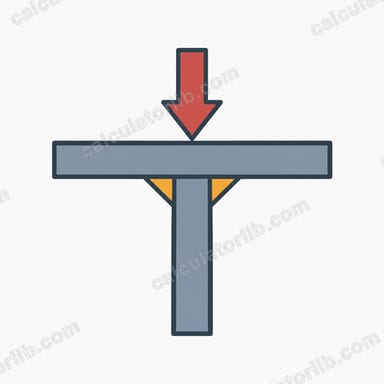
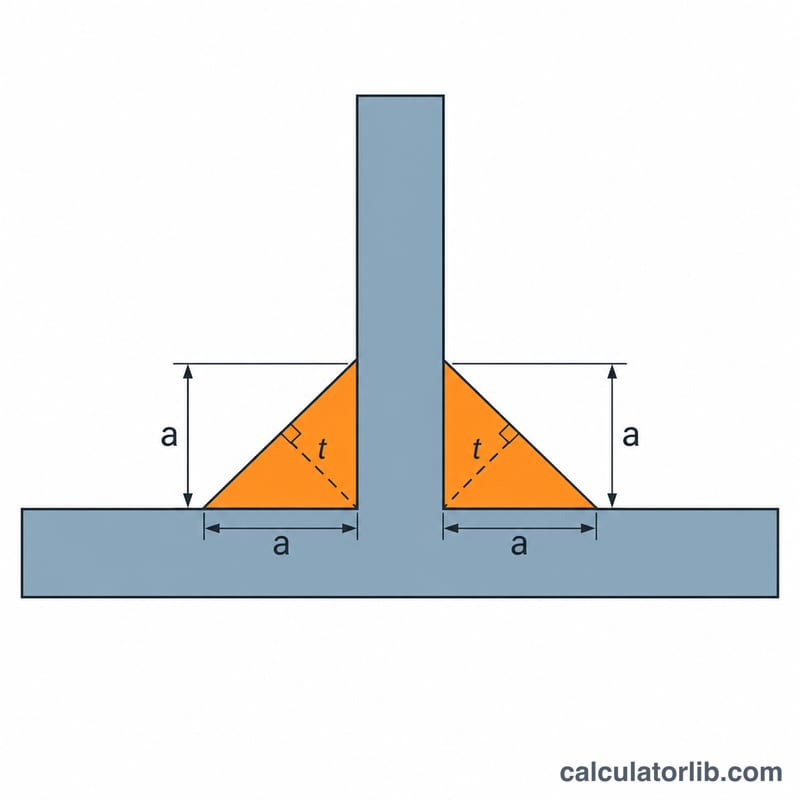
A T-joint joins two plates at right angles, and it is most commonly made with one or two fillet welds along the junction. This calculator estimates how much load such a fillet weld can carry, based on the weld leg size, the length of the weld, the number of welded sides and the tensile strength of the filler metal. It uses the classic effective-throat shear method found in AISC and similar steel design codes.
How to use it
Enter the fillet leg size in millimetres, the weld length, and choose whether the joint is welded on one side or both sides. Then enter the filler metal tensile strength (for example 480 MPa for an E70 electrode) and the safety factor you want to apply. The tool returns the effective throat, shear area, nominal strength, an allowable load (ASD) and an LRFD design strength.
The formula explained
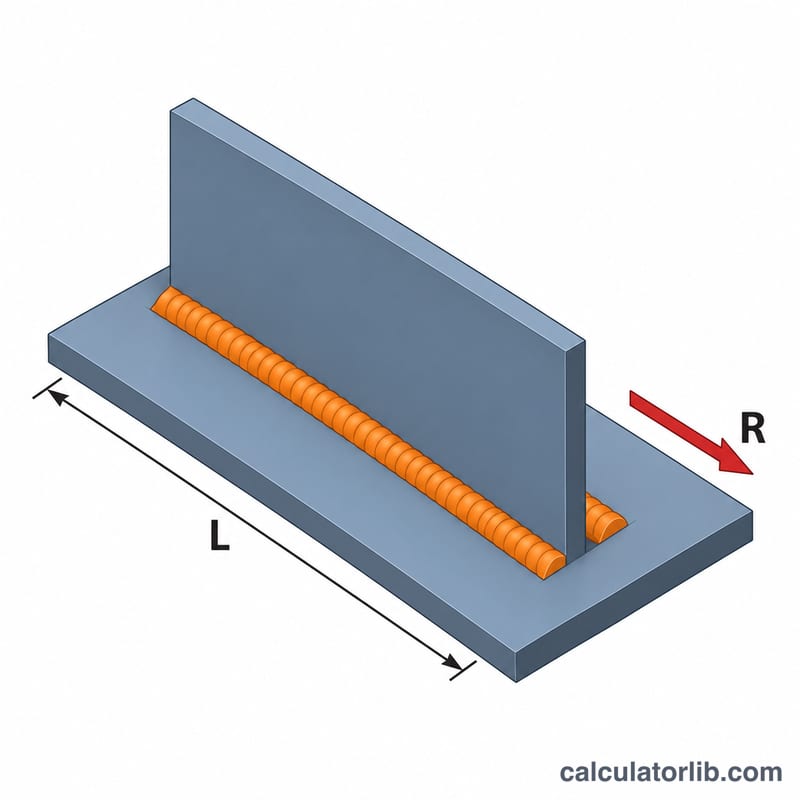
For an equal-leg fillet weld the effective throat is \(0.707\,w\). The weld metal is assumed to fail in shear at \(0.6\,F_{EXX}\):
$$R_n = 0.6 \times F_{EXX} \times 0.707\,w \times L \times n$$Here \(w\) = leg size (mm), \(L\) = weld length (mm), \(n\) = number of welded sides and \(F_{EXX}\) = filler tensile strength (MPa). The allowable load is \(R_n / SF\) and the LRFD design strength is \(0.75\,R_n\).
Worked example
A 6 mm fillet, 100 mm long, welded on both sides with a 480 MPa filler and a safety factor of 2:
$$A = 0.707 \times 6 \times 100 \times 2 = 848.4\,\text{mm}^2$$$$R_n = 0.6 \times 480 \times 848.4 = 244{,}339\,\text{N} \approx 244.34\,\text{kN}$$$$R_a = \frac{244.34}{2} = 122.17\,\text{kN}$$The LRFD design strength is \(0.75 \times 244.34 = 183.25\) kN.
Filler Metal Strength and Minimum Fillet Weld Size Tables
The filler metal strength \(F_{EXX}\) is the minimum tensile strength of the weld metal, taken from the electrode classification (AWS system, used in US practice). The number after "E" gives the strength in ksi.
| AWS classification | Min. tensile strength (ksi) | Min. tensile strength (MPa) |
|---|---|---|
| E60XX | 60 | 415 |
| E70XX | 70 | 480 |
| E80XX | 80 | 550 |
| E90XX | 90 | 620 |
| E100XX | 100 | 690 |
| E110XX | 110 | 760 |
The table below gives minimum fillet weld sizes from AISC 360 Section J2.4 (a US standard). Other codes may differ. The size is selected by the thicker part joined.
| Thicker part joined | Minimum fillet weld leg size |
|---|---|
| Up to 6 mm (1/4 in) | 3 mm (1/8 in) |
| Over 6 mm to 13 mm | 5 mm (3/16 in) |
| Over 13 mm to 19 mm | 6 mm (1/4 in) |
| Over 19 mm | 8 mm (5/16 in) |
Weld Capacity Comparison for Common Leg Sizes
Assumptions: E70 filler (\(F_{EXX} = 480\) MPa), weld length 100 mm, using \(R_n = 0.6 \times 480 \times 0.707 \times w \times L \times n / 1000\) in kN. Allowable load uses a safety factor of 2.0, and the LRFD design strength is \(0.75\,R_n\).
| Leg size (mm) | Welded sides | Rn (kN) | Allowable, SF = 2 (kN) | LRFD 0.75 Rn (kN) |
|---|---|---|---|---|
| 4 | 1 | 81.45 | 40.72 | 61.08 |
| 4 | 2 | 162.89 | 81.45 | 122.17 |
| 6 | 1 | 122.17 | 61.08 | 91.63 |
| 6 | 2 | 244.34 | 122.17 | 183.25 |
| 8 | 1 | 162.89 | 81.45 | 122.17 |
| 8 | 2 | 325.79 | 162.89 | 244.34 |
| 10 | 1 | 203.62 | 101.81 | 152.71 |
| 10 | 2 | 407.23 | 203.62 | 305.42 |
Example for 6 mm, one side: \(R_n = 0.6 \times 480 \times 0.707 \times 6 \times 100 \times 1 / 1000 = 122.17\) kN. With two sides the result doubles to 244.34 kN.
Capacity is linear in leg size, weld length and number of welded sides. Doubling any one of these doubles the nominal capacity, while the other inputs stay fixed.
Interpreting Your Result
\(R_n\) is the nominal shear strength of the weld metal. It is calculated from the effective throat (0.707 × leg size for an equal-leg fillet), the weld length, the number of welded sides, and 0.6 \(F_{EXX}\).
- Allowable strength (ASD): \(R_{allow} = R_n / \Omega\). AISC 360 uses \(\Omega = 2.00\) for fillet welds. The calculator lets you enter any safety factor.
- Design strength (LRFD): \(R_{design} = \phi R_n\) with \(\phi = 0.75\) in AISC 360.
Applied factored loads are compared to the LRFD design strength. Service (unfactored) loads are compared to the ASD allowable strength.
Limits of the result:
- The lower of the weld capacity and the base-metal capacity governs. This calculator evaluates weld metal only.
- Effective length, eccentric loading, load direction, and fatigue are not included. They need separate checks under the governing code.
- Factors and minimum sizes cited here follow AISC 360 (US). Other standards use different factors and methods.
This is general information and does not replace a design by a qualified engineer.
FAQ
Does this check the base metal? No. The result covers only the weld metal; base metal yielding, tearing and fatigue must be checked separately.
Does load direction matter? Yes. Transverse loading can raise capacity compared with longitudinal shear, so this simple method is conservative for many T-joints.
Is this a substitute for engineering design? No. Always verify results against the governing code and have a qualified engineer approve structural welds.