What this calculator does
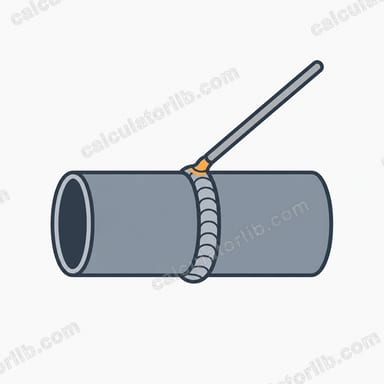
This calculator estimates how much filler metal (electrode, filler wire or rod) you need to weld circumferential pipe butt joints with a single-V groove preparation. It converts the groove geometry into a cross-section area, sweeps that area around the pipe to get a volume, converts the volume to weight using the metal density, and then adjusts for deposition efficiency so you know how much consumable to actually buy.
How to use it
Enter the pipe outside diameter and wall thickness in millimetres, then the groove included angle, root gap, root face (land) and reinforcement height. Enter the number of identical welds and the deposition efficiency of your process (about 60 to 65% for stick electrodes, 90 to 95% for solid MIG wire, close to 100% for TIG rod). The default density of 7.85 g/cm³ suits carbon steel; use about 8.0 for stainless steel.
The formula explained
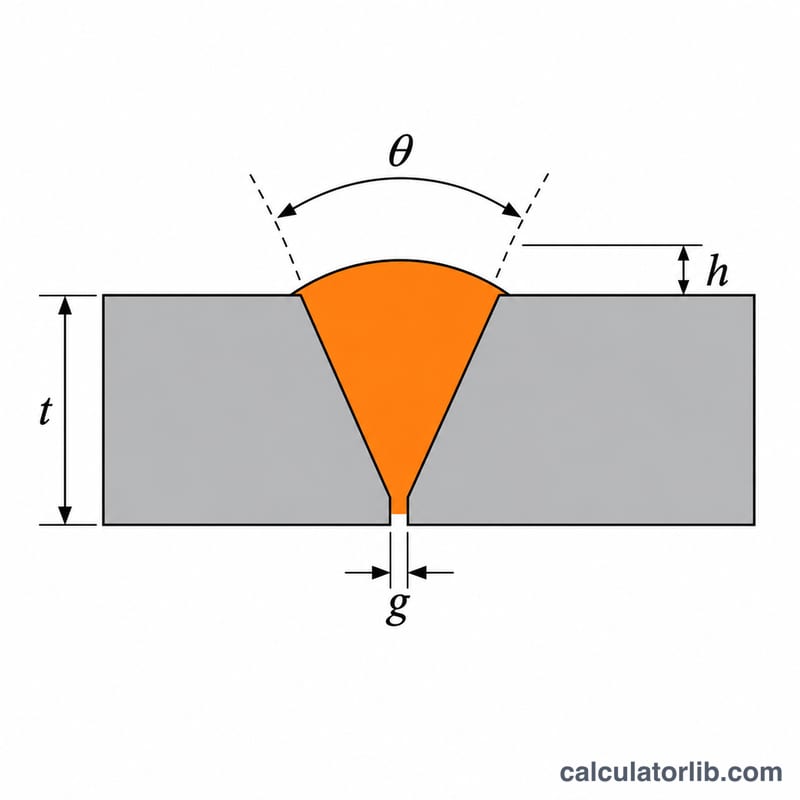
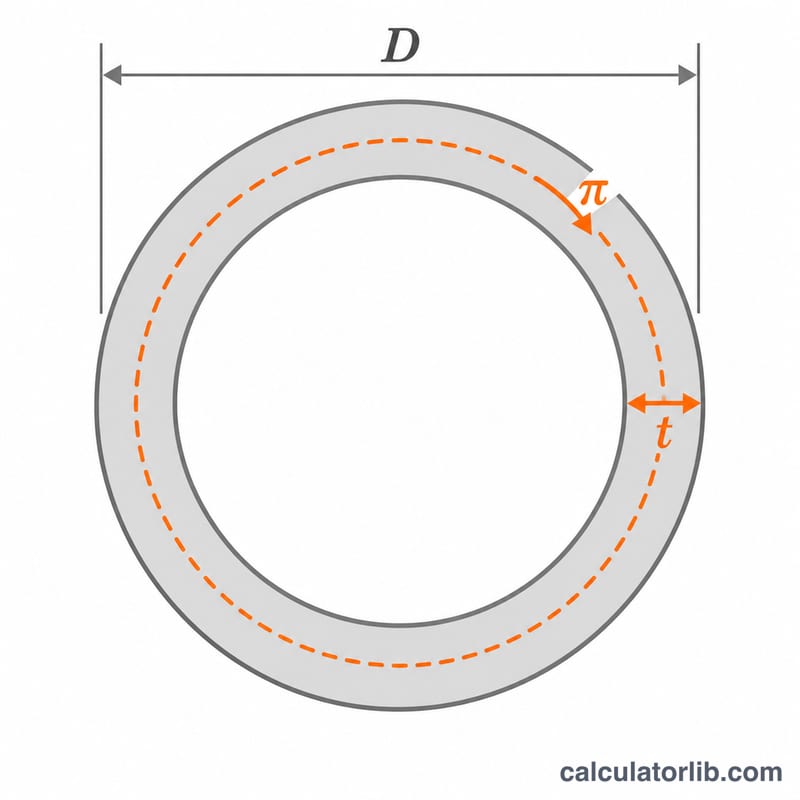
The groove area is a rectangle for the root gap plus a triangle for the V, with a parabolic cap on top. The weld is centred on the mean pipe diameter, so its length is \(\pi (D - t)\).
$$A = g\,t + (t-c)^2 \tan\frac{\theta}{2} + \frac{2}{3}\,h\,W_{top}$$Here \(g\) is the root gap, \(t\) the wall thickness, \(c\) the root face, \(\theta\) the included angle, \(h\) the reinforcement height and \(W_{top} = g + 2(t-c)\tan(\theta/2)\) the groove top width. The filler weight is:
$$W = \frac{A \times \pi (D - t) \times \rho \times N}{10^{6} \times \eta}$$with \(\rho\) in g/cm³, \(N\) the number of welds and \(\eta\) the efficiency as a fraction.
Worked example
A 100 mm OD pipe, 10 mm wall, 60° groove, 2 mm gap, 2 mm land, 2 mm reinforcement, one weld, 100% efficiency, carbon steel.
$$A = 2\times 10 + 8^2 \times 0.5774 + \tfrac{2}{3}\times 2 \times 11.238 = 71.93\,\text{mm}^2$$$$L = \pi \times 90 = 282.74\,\text{mm}$$$$W = \frac{71.93 \times 282.74 \times 7.85}{10^{6}} = 0.1597\,\text{kg}$$At 65% efficiency you would need about 0.246 kg of stick electrode for this one weld.
Deposition Efficiency and Density by Process and Material
The pipe weld filler metal calculator divides the weld metal weight by a deposition efficiency \(\eta\) to estimate how much electrode or wire must be purchased. It multiplies the cross-sectional area by the circumference and a density \(\rho\). The tables below give typical starting values for the efficiency and density fields. They are general figures only. Actual values vary with the consumable brand, diameter, welding position, parameters, stub-end loss, spatter and operator technique, so check the manufacturer's data sheet when you can.
Typical deposition efficiency by process
| Process | Typical efficiency (%) | Main sources of loss |
|---|---|---|
| SMAW (stick) | 55–65 | Stub ends, flux coating, spatter |
| GMAW (solid wire) | 90–95 | Spatter, small amounts of slag |
| FCAW (flux-cored) | 80–90 | Slag, spatter, fume |
| GTAW (rod) | 95–100 | Rod stub ends only |
| SAW | 95–99 | Slag, unfused flux |
Typical density by material
| Material | Density (g/cm³) |
|---|---|
| Carbon steel | 7.85 |
| Stainless steel 304/316 | about 7.9–8.0 |
| Duplex stainless steel | about 7.8 |
| Nickel alloys | about 8.4–8.9 |
Enter efficiency as a percentage and use the density that matches the filler metal being deposited. For example, 7.85 g/cm³ is 0.00785 g/mm³. Keep your length units consistent so the weight comes out correctly. Treat the result as an estimate and add a margin for scrap, repairs and rework.
FAQ
Does this include spatter and stub-end losses?
Yes, if you lower the deposition efficiency to reflect them. Stub loss, spatter and slag are all folded into that percentage.
Can I use it for fillet or socket welds?
No. It models a single-V butt joint. Other joint shapes need a different cross-section area.
Why add reinforcement?
Weld cap reinforcement adds real metal, often 5 to 15% of the total, so ignoring it underestimates consumption.