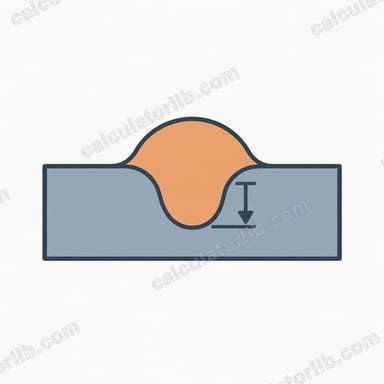
What is the Weld Penetration Calculator?
This calculator estimates how deep a weld pool melts into a thick plate based on the welding current, arc voltage, travel speed, arc efficiency and base material. It also reports the heat input per millimetre of weld, a key quantity in welding procedure specifications.
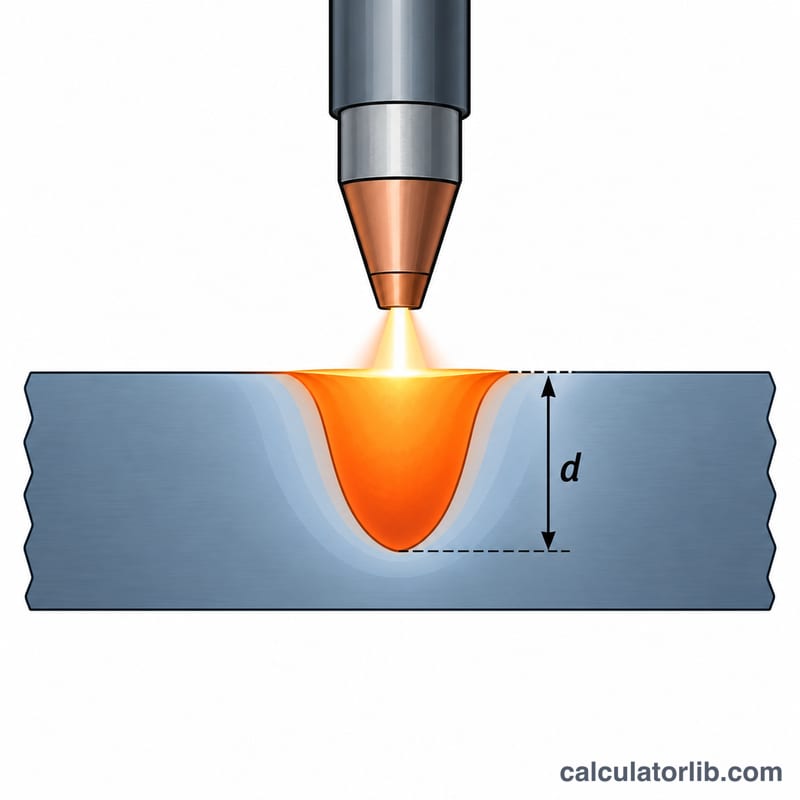
How to use it
Enter the current in amps, arc voltage in volts and travel speed in mm/s. Choose an arc efficiency (about 80% for MIG/MAG and 60% for TIG are typical, higher for submerged arc), select the base material and enter the starting temperature (20 °C, or the preheat temperature). The tool returns the penetration depth in mm and inches, plus gross and net heat input in J/mm.
The formula explained
The model uses the Rosenthal solution for a fast moving point source on a thick plate. Net heat per unit length is \(H = \eta V I / v\). The melt pool half-width, taken as the penetration of a semicircular pool, is:
$$d = \sqrt{\frac{2\,\eta V I}{\pi e\, v\, \rho c\,(T_m - T_0)}}$$Here \(\eta\) is arc efficiency, \(V\) voltage, \(I\) current, \(v\) travel speed, \(\rho c\) the volumetric heat capacity, \(T_m\) the melting temperature, \(T_0\) the initial temperature and \(e\) Euler number.
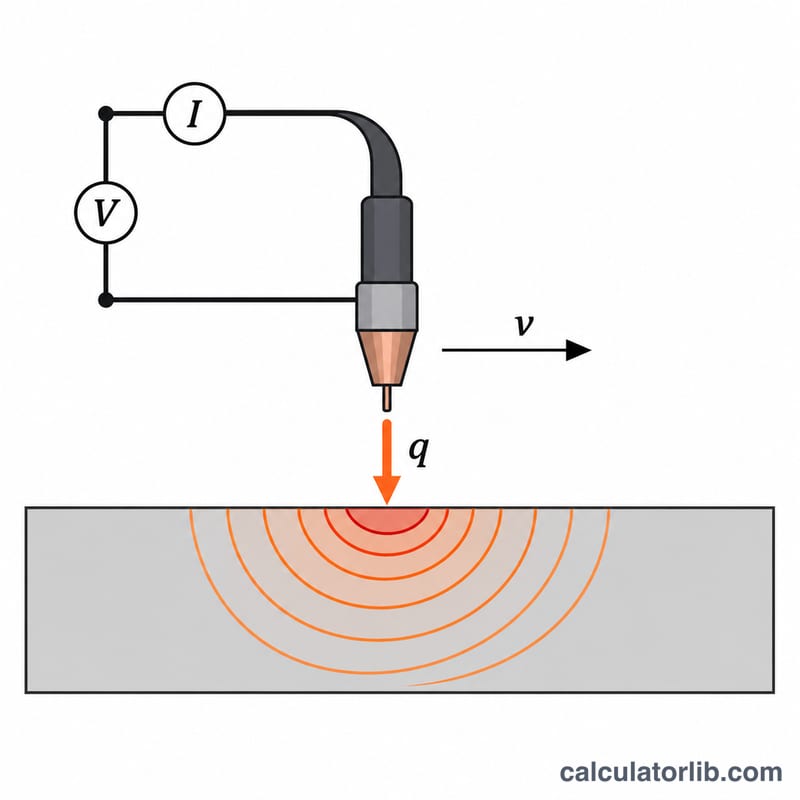
Worked example
Mild steel, 200 A, 24 V, 5 mm/s, 80% efficiency, 20 °C start, with \(\rho c = 0.0044\,\text{J/mm}^3\text{K}\) and \(T_m = 1500\,{}^\circ\text{C}\):
$$H = \frac{0.8 \times 24 \times 200}{5} = 768\,\text{J/mm}$$$$d = \sqrt{\frac{2 \times 768}{\pi e \times 0.0044 \times 1480}} = \sqrt{27.62} \approx 5.26\,\text{mm}$$Material Thermal Properties Used by the Calculator
The Rosenthal-based estimate needs two material properties: the volumetric heat capacity \(\rho c\) (density × specific heat) and the melting temperature \(T_m\). The penetration depth scales with \(1/\sqrt{\rho c\,(T_m - T_0)}\), so materials that need more energy to heat from \(T_0\) to melting penetrate less for the same net heat input per unit length.
| Material | Offered in tool? | ρc (J/mm³·K), approx. | Tm (°C), approx. |
|---|---|---|---|
| Mild / carbon steel | Yes (steel) | 0.0044 to 0.0050 | about 1500 (1430 to 1540) |
| Austenitic stainless steel (e.g. 304) | Yes (stainless) | 0.0040 to 0.0045 | about 1400 to 1450 |
| Aluminium alloys (e.g. 6061) | Yes (aluminium) | 0.0025 to 0.0028 | about 580 to 650 (pure Al: 660) |
| Titanium (e.g. Ti-6Al-4V) | No (reference only) | 0.0023 to 0.0027 | about 1600 to 1670 |
| Nickel alloys (e.g. Inconel 625) | No (reference only) | 0.0036 to 0.0040 | about 1290 to 1350 |
Notes:
- All values are approximate. Density and specific heat vary with alloy composition and temperature, and many alloys melt over a range (solidus to liquidus) rather than at a single temperature.
- The calculator itself offers steel, stainless and aluminium. Its internal constants are single representative values and may differ slightly from the ranges above. Titanium and nickel are listed only so you can judge how those materials compare.
- The preheat or interpass temperature \(T_0\) is entered separately. Raising it reduces \(T_m - T_0\) and so increases the predicted penetration.
- The Rosenthal model assumes a point source on a semi-infinite plate with constant properties. It ignores fluid flow in the weld pool, arc pressure and shielding gas effects, so treat the output as a first estimate and not a procedure value.
FAQ
Is this exact?
No. It is a physics-based estimate. Arc force, shielding gas, polarity, surface-active elements, weld pool convection and joint geometry can change real penetration substantially. Use test coupons to confirm.
How can I increase penetration?
Raise current, lower travel speed or preheat the plate. Because depth scales with the square root of heat per length, doubling heat input increases depth by about 41%.
Does it work for thin plates?
Only if the computed depth is well below the plate thickness. Otherwise the thick-plate assumption fails and burn-through is possible.