What is a truss weight calculator?
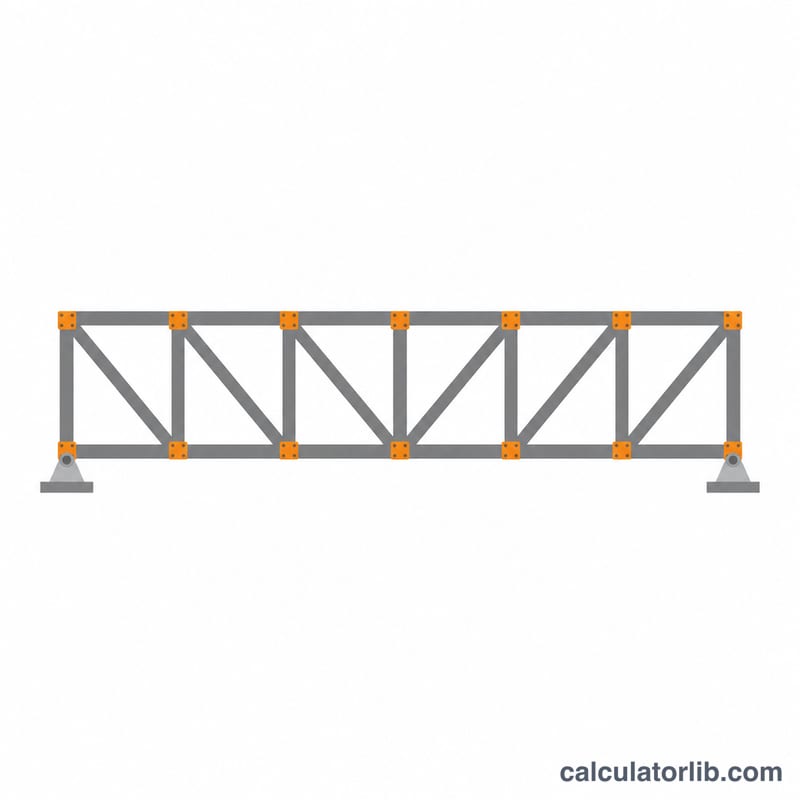
A truss is a framework of straight members, such as chords, webs and diagonals, joined at nodes. Knowing its self-weight is essential for lifting plans, transport, and for checking dead loads on supporting structures. This calculator gives a fast estimate of total truss mass from the number of members, their average length, cross-section area and material.
How to use it
Select the material, enter how many members the truss has, the average member length in metres, and the cross-section area of a typical member in cm². Add a percentage allowance for gusset plates, bolts, welds and other connection hardware; 5-15% is common for steel trusses. The result shows weight in kg and lb, per-member weight, total member length and material volume.
The formula explained
The weight is the material volume times density, plus the allowance:
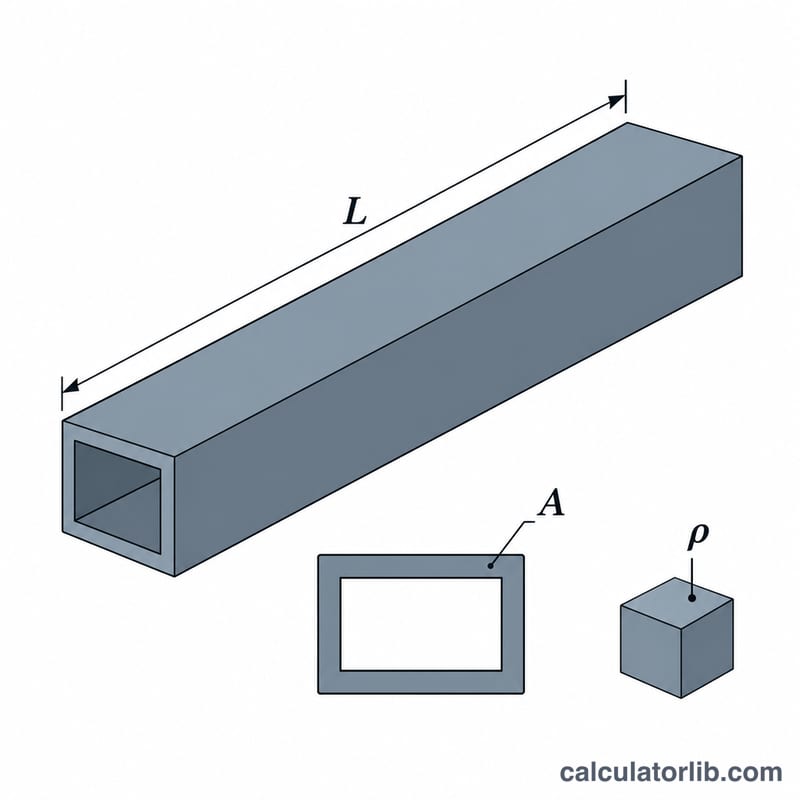
$$W = N \times L \times A \times \rho \times \left(1 + \frac{k}{100}\right)$$Here \(N\) = number of members, \(L\) = average length in m, \(A\) = cross-section area in m² (cm² × 0.0001), \(\rho\) = density in kg/m³ and \(k\) = allowance in percent.
Worked example
A steel truss has 21 members averaging 2 m, each with a 10 cm² section, and a 10% connection allowance. Steel density is 7,850 kg/m³.
$$V = 21 \times 2 \times 0.001 = 0.042\,\text{m}^3$$$$W = 0.042 \times 7850 \times 1.10 = 362.67\,\text{kg}$$That is about 799.6 lb, or 17.27 kg per member.
Material Density Reference Table
The calculator multiplies total member volume by a material density in kg/m³. The values below are typical figures; use the supplier's data sheet for a specific product.
| Material | Typical density (kg/m³) |
|---|---|
| Structural steel | 7,850 |
| Aluminium | about 2,700 |
| Softwood timber (spruce, pine) | about 400–600 |
| Glulam (glued laminated timber) | about 410–500 |
| Normal-weight concrete | about 2,400 |
Note: timber density varies with moisture content. Green or wet timber can be much heavier than kiln-dried timber, so state the moisture condition behind the density you use. Species, grade and glue content (for glulam) also shift the value.
Typical Connection Allowance Ranges
The connection allowance adds a percentage to the member weight to cover gusset plates, bolts, welds, nail plates and similar hardware.
| Construction type | Typical allowance |
|---|---|
| Welded steel trusses | about 5–10% |
| Bolted steel trusses | about 10–15% |
| Timber trusses with nail plates | about 3–8% |
| Heavy bolted or steel-plated timber connections | about 10–15% |
These are rule-of-thumb figures for early estimates, not values from any building code or standard. Where a fabricator or manufacturer provides a weight schedule or connection design, that information takes precedence over these ranges.
Cross-Section Area and Weight Unit Conversions
The calculator expects area in cm², length in m and density in kg/m³. Use these factors to convert other units first.
| Conversion | Factor | Example |
|---|---|---|
| cm² to m² | × 0.0001 | 25 cm² = 0.0025 m² |
| mm² to m² | × 0.000001 | 1,200 mm² = 0.0012 m² |
| in² to cm² | × 6.4516 | 10 in² = 64.516 cm² |
| kg to lb | × 2.20462 | 500 kg ≈ 1,102.31 lb |
| kg to kN (weight force) | × 0.00981 | 500 kg ≈ 4.905 kN |
| m to ft | × 3.28084 | 6 m ≈ 19.685 ft |
The kg to kN factor uses standard gravity, g = 9.81 m/s², so \(1000\ \text{kg} \times 0.00981 = 9.81\ \text{kN}\). The calculator gives mass in kg; multiply by this factor to get the dead load as a force.
FAQ
Is this accurate enough for design? It is an estimate based on average member size. For structural design, use actual member schedules and consult an engineer.
What if members have different sections? Run the calculator once per member group and add the results.
Does it include loads? No, it only computes the self-weight of the truss, not snow, wind or live loads.