What is the Rule of Nines?
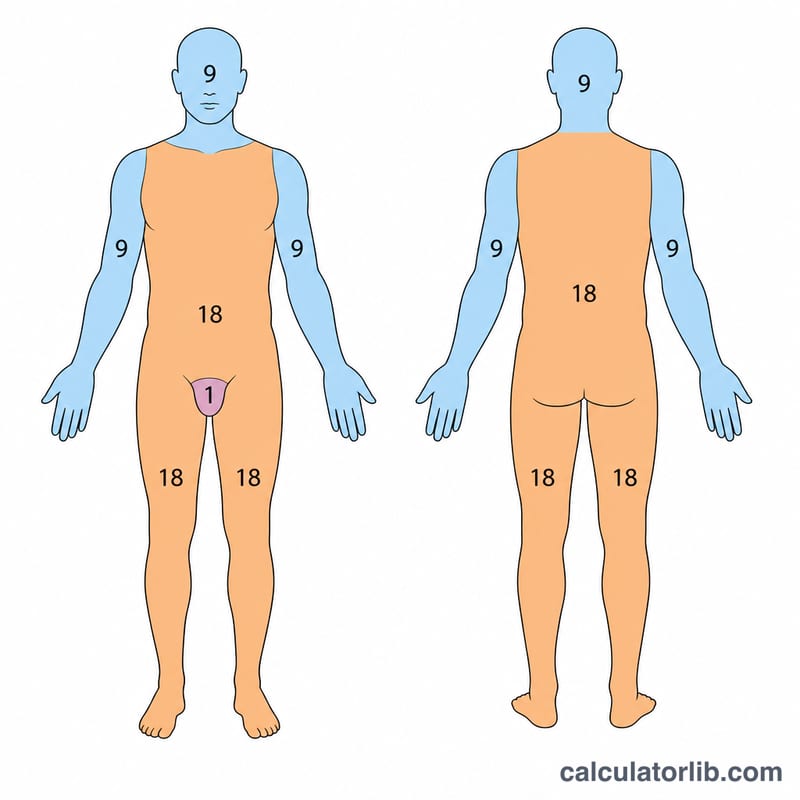
The Rule of Nines is a quick bedside method for estimating the percentage of total body surface area (TBSA) affected by partial-thickness and full-thickness burns. In an adult the body is divided into regions worth roughly 9% or multiples of 9%: head and neck 9%, each arm 9%, front of the trunk 18%, back of the trunk 18%, each leg 18%, and the genital area 1%. Children and infants have proportionally larger heads and smaller legs, so this calculator adjusts the weights by age group.
How to use this calculator
Select the age group, then enter for each region the percentage of that region that is burned (100 means the entire region). Do not count superficial, red-only burns. Enter body weight in kilograms to also see a Parkland fluid estimate. The result shows total TBSA, how much each region contributes, and a rough severity band.
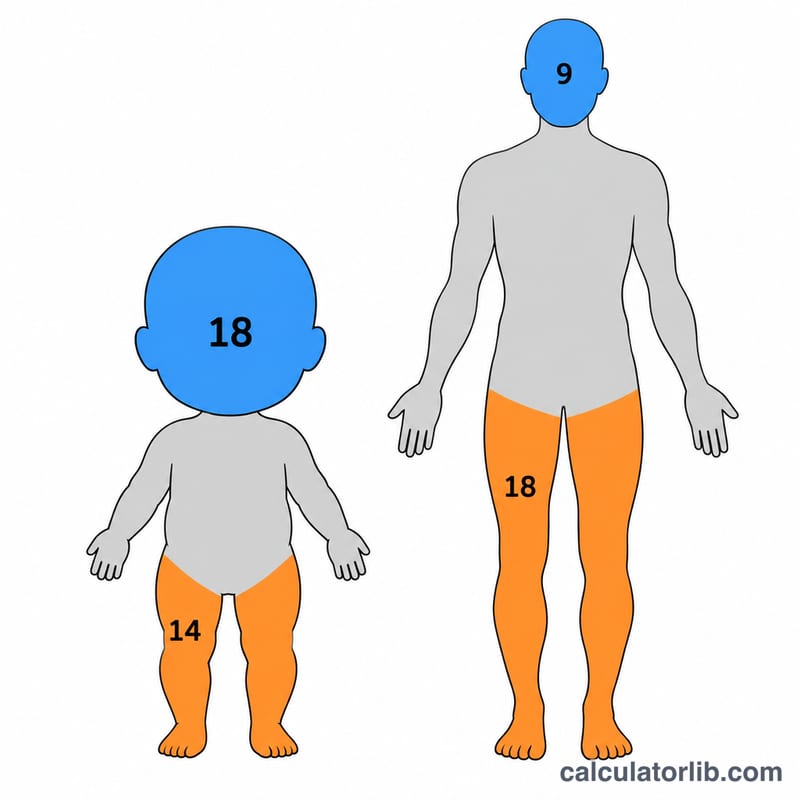
The formulas explained
Each region has a weight \(w_i\) (its share of the total body surface) and a burned fraction \(p_i\) in percent:
$$\text{TBSA} = \sum_{i} w_i \times \frac{p_i}{100}$$The Parkland estimate for the first 24 hours, with \(W\) = weight in kg and TBSA in percent, is:
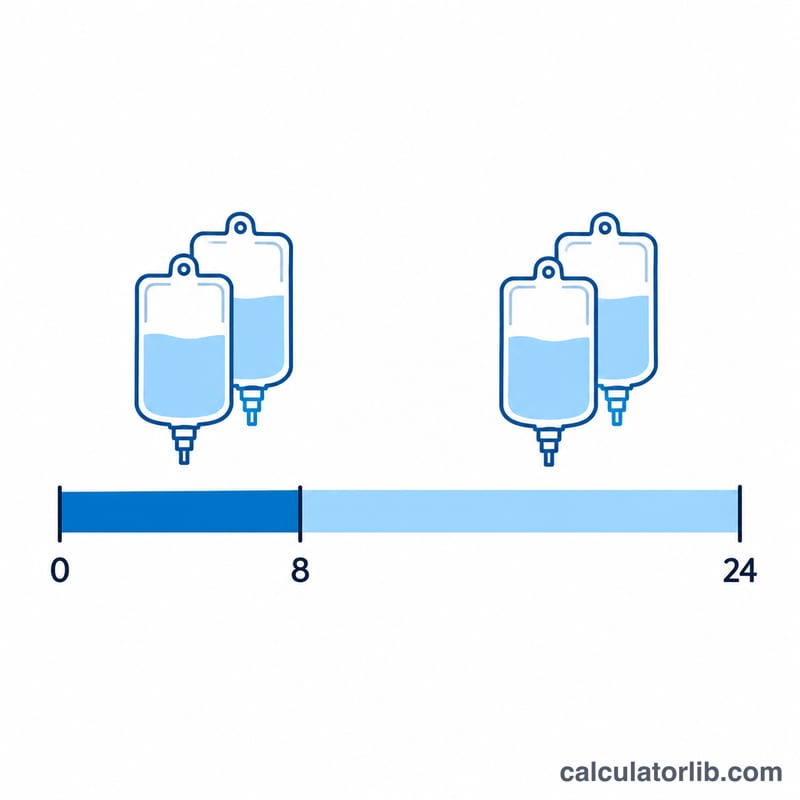
$$V_{24} = 4 \times W \times \text{TBSA}$$Half of \(V_{24}\) is given in the first 8 hours after injury.
Worked example
An adult weighing 70 kg has the left arm fully burned and half of the front of the trunk burned.
$$\text{TBSA} = 9 \times 1.0 + 18 \times 0.5 = 18\%$$$$V_{24} = 4 \times 70 \times 18 = 5040\,\text{mL}$$That is 2520 mL over the first 8 hours, or 315 mL per hour.
Interpreting the TBSA Result
The TBSA percentage estimates how much of the body surface has a partial-thickness or full-thickness burn. Superficial (first-degree, erythema-only) areas are normally left out of the total. The Rule of Nines gives a quick bedside estimate. It is less precise than a Lund-Browder chart, especially in children, whose head is proportionally larger and whose legs are proportionally smaller than an adult's.
Commonly cited severity bands
Classification schemes derived from American Burn Association (ABA) teaching are often summarised as follows. Exact cut-offs differ between sources and over time.
| Category | Adults | Children and older adults |
|---|---|---|
| Minor | Under about 10% TBSA | Under about 5% TBSA |
| Moderate | About 10–20% TBSA | About 5–10% TBSA |
| Major | Over about 20% TBSA | Over about 10% TBSA |
Thresholds for referral and fluid resuscitation
- Formal IV fluid resuscitation: It is commonly taught for burns of about 15% TBSA or more in adults and about 10% TBSA or more in children. Some current guidance, including ATLS-style teaching, uses a higher adult threshold of about 20%. Check which protocol applies locally.
- Burn centre referral: ABA referral criteria include partial-thickness burns over 10% TBSA. They also include any full-thickness burn and burns involving the face, hands, feet, genitalia, perineum or major joints. Electrical, chemical and inhalation injuries and burns in patients with significant comorbidities are also included. Many of these criteria apply whatever the TBSA is.
- Parkland estimate: The calculator uses 4 mL × body weight (kg) × %TBSA over 24 hours, with half given in the first 8 hours from the time of injury. This is a starting estimate only. Clinicians adjust the rate to measured response such as urine output.
TBSA is not the whole picture
Severity and the need for specialist care also depend on:
- Burn depth, because full-thickness burns are more serious than superficial ones of the same area.
- Age, since infants and older adults have higher risk.
- Location, because the airway, face, hands, feet, genitalia and circumferential limb or chest burns carry special risk.
- Inhalation injury and associated trauma.
- Comorbidities such as diabetes, heart or lung disease, and immunosuppression.
- Mechanism, such as electrical, chemical or scald, and possible non-accidental injury.
This is general educational information, not medical advice. A calculator result must not replace clinical assessment. For any significant burn, seek emergency care or follow your local burn service's protocols.
FAQ
How accurate is the Rule of Nines?
It is a fast approximation. Body shapes vary, so detailed charts such as Lund-Browder are preferred for children and for final calculations in burn centres.
Should superficial burns be counted?
No. Only partial-thickness (second-degree) and full-thickness (third-degree) burns are normally included in TBSA for fluid planning.
Can I rely on the fluid estimate?
The Parkland result is a starting point only. Fluids must be titrated to urine output and clinical response by a qualified clinician, and paediatric protocols often differ.